News
Capacitive Touchscreen EMI/EMC Optimization: Improving Touch Stability in Industrial Applications
Capacitive touchscreen EMI/EMC Optimization: Improving Touch Stability in Industrial Applications
Why Is touchscreen Immunity to Electromagnetic Interference Becoming Increasingly Important?
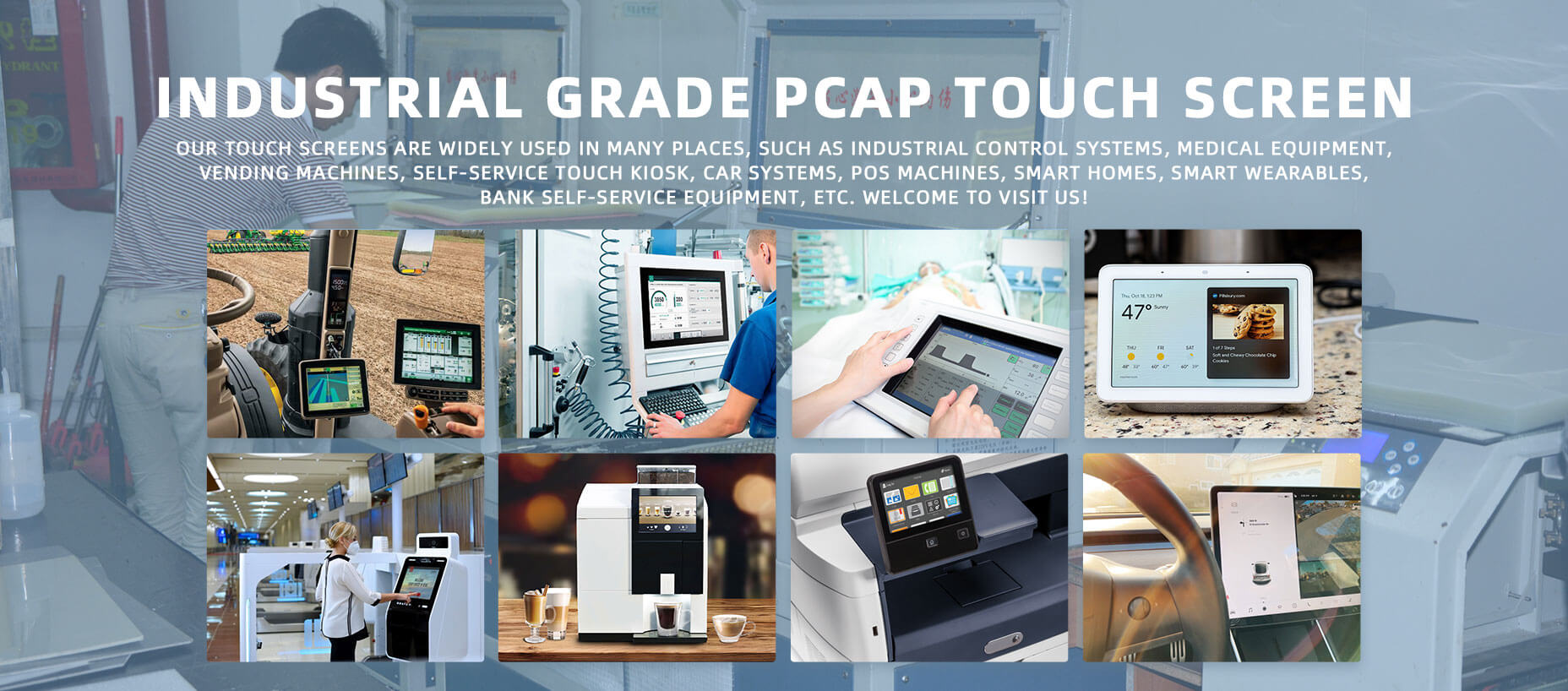
In industrial control systems, medical devices, smart terminals, automotive electronics, and outdoor display equipment, projected capacitive (PCAP) touchscreens have become a mainstream human-machine interface technology. With their responsive touch performance, multi-touch capabilities, and intuitive user experience, PCAP touchscreens are widely used across a variety of electronic devices.
However, as electronic devices become increasingly integrated, the electromagnetic environments in which touchscreens operate are becoming more complex.
LCD displays, wireless communication modules, power conversion circuits, motor drivers, and other high-frequency electronic components can all generate different forms of electromagnetic noise. When this noise couples into the touch sensor or touch controller, it may interfere with signal acquisition and processing, resulting in touch offset, delayed response, false touches, missed touches, or even temporary touch failure under certain operating conditions.
For industrial touch display devices, electromagnetic immunity is not only a matter of user experience. It also directly affects equipment reliability and operational safety.
Therefore, improving the stability of capacitive touchscreens through hardware design, signal processing, structural optimization, and system-level EMI/EMC verification has become an important engineering challenge in touch display development.
This article explores the electromagnetic interference sources affecting capacitive touchscreens, the key optimization techniques used to improve immunity, practical engineering considerations, and future development trends.

1. Why Are Capacitive touchscreen Susceptible to Electromagnetic Interference?
1.1 PCAP touchscreen Operating Principles and Signal Characteristics
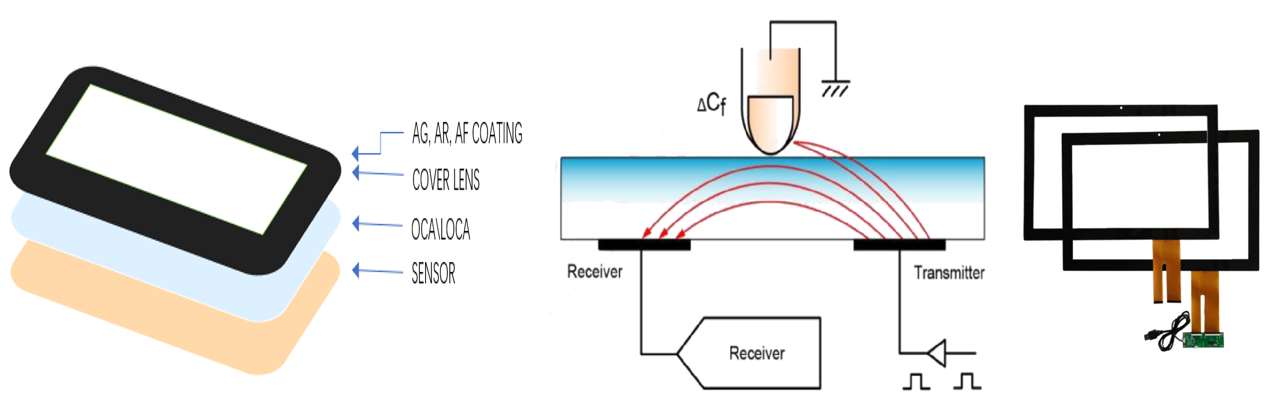
A capacitive touchscreen typically determines finger position and movement by detecting changes in capacitance between sensor electrodes before and after a touch.
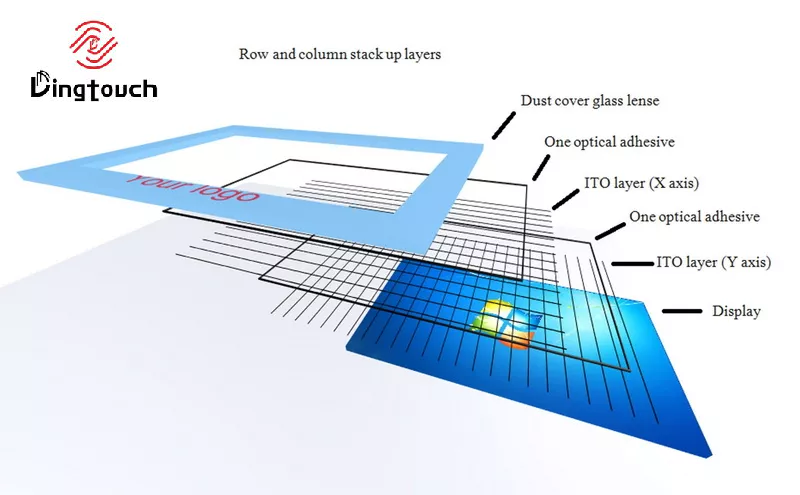
In a typical projected capacitive structure, the touch sensor consists of Tx (transmit) and Rx (receive) electrodes. The touch controller applies an excitation signal to the Tx electrodes and measures the capacitive response through the Rx electrodes. It then processes the collected data to calculate touch coordinates.
When a finger approaches the screen surface, the capacitive coupling between the finger and the sensor changes. The touch IC detects this variation and identifies the touch position.
The challenge is that the capacitance change caused by a touch is relatively small, while the sensor must complete multiple electrode scans within a limited time. External noise entering the touch detection chain can therefore reduce the signal-to-noise ratio and compromise touch recognition stability.
It is important to understand that PCAP touchscreens do not necessarily malfunction simply because an interference signal has a frequency close to the touchscreen scanning frequency. The actual impact depends on several factors, including noise amplitude, coupling paths, the touch IC's receiver bandwidth, scanning timing, and signal processing capabilities.
1.2 Electromagnetic Interference from LCD Displays
In integrated touch display devices, the LCD module is one of the most common internal sources of interference.
Display row and column driving, pixel switching, backlight driving, and high-speed interface signals can all generate electromagnetic noise.
For example:
-
LCD data lines and clock signals may couple into touch sensors through radiated emissions or parasitic capacitance.
-
Switching activity within the display panel may cause fluctuations in touch sensor signals.
-
Interactions between display refresh timing and touch scanning timing may produce periodic noise or touch instability under certain operating conditions.
In some devices, touch problems may only occur with specific images, brightness levels, or display refresh modes. These issues usually require an analysis of display timing, touch scan data, and noise spectra rather than being attributed directly to the touch IC.
1.3 High-Frequency Interference from Wireless Communication Modules
Modern electronic devices commonly integrate Wi-Fi, Bluetooth, NFC, cellular communication, and other wireless technologies.
These modules may generate strong RF signals during transmission. Although their carrier frequencies are generally much higher than the fundamental scanning frequencies of PCAP touch controllers, RF energy can still affect touchscreen operation through several mechanisms:
-
RF signals couple into touch sensor electrodes.
-
Parasitic coupling occurs between wireless modules and touchscreen FPCs.
-
RF energy enters the touch IC and is rectified or demodulated by nonlinear circuits, producing lower-frequency noise that affects touch detection.
-
Power supply fluctuations or ground noise generated during wireless transmission indirectly affect touch signal acquisition.
Therefore, false touches or missed touches occurring while Wi-Fi, Bluetooth, or cellular communication is active are not necessarily caused by direct frequency overlap between RF signals and touch scanning. More often, they involve RF coupling, nonlinear circuit responses, or power integrity issues.
1.4 Power Supply Ripple and Ground Noise
Touch controllers have specific requirements for power supply quality and ground reference stability.
Significant power ripple, switching power supply noise, or transient voltage fluctuations may affect the touch IC analog front end, internal reference voltages, and electrode scanning signals.
In addition, improper grounding between the display module, mainboard, wireless module, and touch controller may create unwanted noise current paths, causing variations in the touch detection reference.
In industrial equipment, motor startup, relay switching, inverter operation, and changes in power loads are all potential sources of interference that touchscreen systems must be designed to withstand.
1.5 External Electromagnetic Interference in Industrial Environments
Industrial touch display devices often operate in more demanding electromagnetic environments.
Typical interference sources include:
-
Switching noise generated by variable-frequency drives and motor controllers.
-
Electromagnetic radiation from high-frequency welding equipment and industrial communication systems.
-
Electrostatic discharge (ESD) affecting touch panels, FPCs, and controllers.
-
Electrical fast transient/burst (EFT) and surge disturbances entering the system through power or signal lines.
These disturbances may affect touch accuracy and can also cause controller resets, communication errors, or temporary device malfunctions.
Therefore, EMI/EMC optimization for industrial PCAP touchscreens must extend beyond the touch sensor itself to the entire touch display system.
2. Seven Key EMI/EMC Optimization Techniques for Capacitive touchscreen
Improving touchscreen immunity to electromagnetic interference generally requires coordinated optimization of hardware, software, mechanical structures, and system design. A single technique is rarely sufficient to address every type of interference.
2.1 Dynamic Scanning Frequency and Frequency Hopping
Touch ICs typically scan sensor electrodes periodically to acquire touch data.
When external noise is concentrated within certain frequency ranges, the touch controller may adjust its scanning frequency, excitation parameters, or scanning sequence to reduce interference between the touch signal and the noise.
For example, if significant noise is detected at a particular scanning frequency, the controller may switch to another validated operating frequency and reassess signal quality.
This approach can help reduce the effects of certain narrowband interference sources. However, its effectiveness depends on whether the touch IC supports the relevant functions and whether a suitable low-noise frequency window is available.
Scanning frequency should not be adjusted solely according to the LCD refresh rate. Effective optimization requires a comprehensive assessment of the touch IC architecture, display timing, noise spectrum, and actual system operating conditions.
2.2 Differential Detection and Common-Mode Noise Rejection
Differential detection is an important technique for improving touch signal immunity.
When two related detection channels experience similar common-mode noise, comparing their signal differences can help suppress interference components shared by both channels.
In capacitive touch systems, appropriate electrode structures, detection methods, and signal processing strategies can reduce the impact of certain power supply and common-mode noise sources.
However, differential techniques cannot eliminate all noise. If interference couples differently into individual electrodes or directly affects the effective touch signal, the benefits of differential processing may be limited.
Therefore, differential detection is generally used together with electrode layout optimization, grounding design, and other filtering techniques.
2.3 Coordinated Hardware and Software Filtering
Touch ICs typically use multiple signal processing methods to filter and analyze acquired raw data.
Common optimization techniques include:
Low-pass filtering
Reduces the impact of high-frequency noise on touch coordinates and improves trajectory smoothness. However, excessive filtering may increase touch response latency.
Temporal filtering
Analyzes consecutive scan data to determine whether touch signals are stable and continuous, reducing false touches caused by transient noise.
Spatial filtering
Combines data from adjacent electrodes or multiple detection channels to identify abnormal signals and improve touch localization under localized noise conditions.
Adaptive thresholds
Dynamically adjusts touch detection thresholds according to environmental noise levels, touch signal strength, and system operating conditions, improving recognition stability across different environments.
In practical applications, filtering algorithms must balance noise immunity, touch sensitivity, and response speed. Excessive filtering may reduce recognition performance for rapid movements, light touches, or edge touches.
2.4 Touch Sensor Shielding and Grounding Design
Shielding is an important hardware technique for reducing electromagnetic interference coupling.
Depending on the touch display structure, metallic shielding layers, ITO conductive layers, conductive mesh, or other suitable materials may be used to reduce external noise coupling into the touch sensor.
For example, in industrial touch display devices, appropriate shielding behind the display module, touch sensor grounding structures, and FPC shielding layouts can help reduce the effects of certain external electric fields and RF interference.
However, adding more shielding does not always improve performance.
An improperly designed shielding structure may increase parasitic capacitance, affect the electric field distribution of the touch sensor, or even reduce touch sensitivity.
Therefore, shielding material, placement, grounding methods, and compatibility with the touch IC must all be carefully evaluated.
For devices requiring high optical transmission, touch sensitivity, and EMI performance, shielding solutions often involve trade-offs between optical and electromagnetic properties.
2.5 Touch-LCD Timing Synchronization
In integrated touch display devices, the timing relationship between touch scanning and LCD display signals may directly affect touch signal quality.
When the display panel switches rapidly, the resulting noise may enter the touch sensor's acquisition window.
If the touch IC and LCD control system support synchronization, touch scanning timing can be adjusted to avoid periods when display switching generates stronger noise.
For example, using a display frame synchronization signal or other available timing information to optimize touch sampling may help reduce certain display-related interference.
However, synchronization is not suitable for every display architecture. The feasibility and effectiveness of this approach depend on the LCD interface, touch IC, and main controller system.
2.6 touchscreen FPC and PCB Layout Optimization
The FPC is a critical connection between the touch sensor and the touch controller. Its design quality directly affects the electromagnetic compatibility of the system.
In practical projects, FPC layout optimization generally includes:
-
Shortening transmission paths for sensitive touch signals.
-
Avoiding long parallel routing between touch signal lines and high-frequency clocks, RF signals, or switching power lines.
-
Optimizing ground and shielding layouts to reduce parasitic coupling.
-
Routing the FPC appropriately to avoid proximity to wireless antennas or high-noise power circuits.
-
Properly partitioning touch ICs, display drivers, and power conversion circuits to minimize interference propagation.
For high-brightness, wide-temperature, industrial-grade, or large-format touch display projects, FPC and PCB layout optimization should be completed during the initial design phase rather than treated as a corrective measure after touch problems appear.
2.7 Touch IC Noise Immunity Algorithms and System-Level Tuning
The electromagnetic immunity of modern touch ICs depends not only on hardware architecture but also on their internal algorithms and parameter configurations.
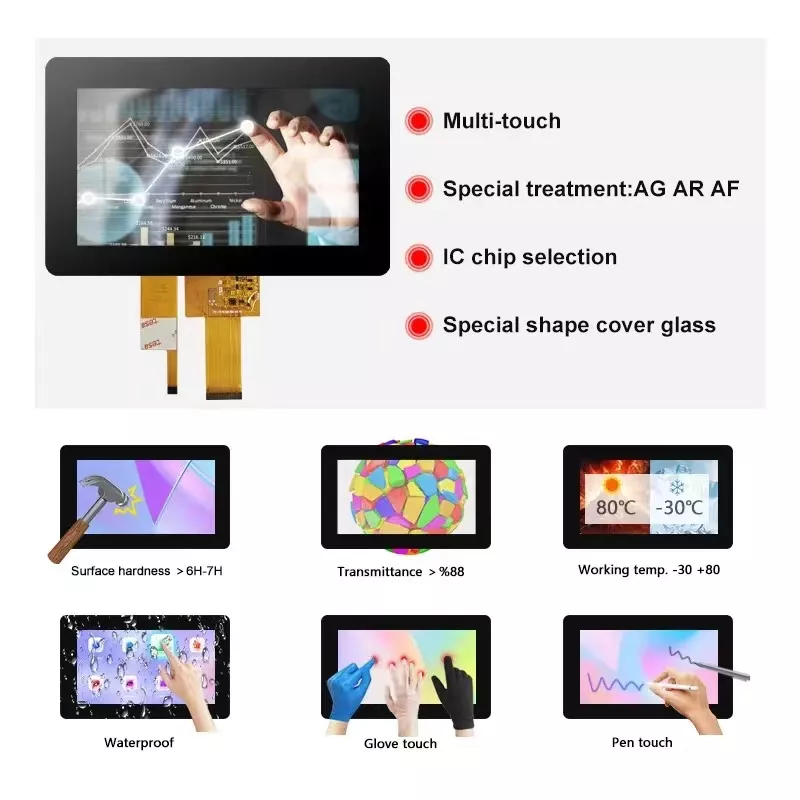
Some touch controllers support noise detection, dynamic parameter adjustment, abnormal touch recognition, and functions such as water rejection or glove touch. These features can improve touch recognition under specific application conditions.
For example, industrial equipment may need to operate with thick cover glass, metal structures, strong electromagnetic noise, and complex grounding conditions simultaneously. Selecting an appropriate touch IC, optimizing sensor structures, and tuning controller parameters can improve actual touch performance.
It is important to note that artificial intelligence and adaptive algorithms are not standard features of every touch IC. For a specific project, immunity should be evaluated based on the chip's actual capabilities, available parameters, and verified test results rather than algorithm names alone.
3. From Touch Panel to Complete Device: Industrial EMI/EMC Optimization Practices
For industrial touch display devices, effective immunity design requires the touch panel, LCD, touch IC, FPC, mainboard, power supply, and mechanical structure to be evaluated as one complete system.
3.1 Identify Interference Sources and Coupling Paths First
When a touchscreen experiences false touches, missed touches, or response abnormalities, the first step is to identify the interference source.
Engineers generally investigate whether touch abnormalities are related to the following conditions:
-
Changes in LCD brightness, image content, or refresh mode.
-
Wi-Fi, Bluetooth, or cellular transmission activity.
-
Motor, relay, or variable-frequency drive startup.
-
Power load changes.
-
ESD, EFT, or other external electromagnetic events.
By comparing touch data, system logs, and power or signal waveforms under different operating conditions, engineers can more accurately identify interference sources and coupling paths.
3.2 Select the Appropriate touchscreen Solution for the Application
Different applications have different requirements for touchscreen electromagnetic immunity.
Industrial control equipment
Requires particular attention to power supply noise, grounding structures, ESD/EFT environments, and signal coupling between the touch display module and mainboard.
Outdoor touch terminals
Require comprehensive consideration of high-brightness backlighting, temperature variations, wet-finger operation, cover glass structures, and interference from wireless communication modules.
Medical devices
Require not only responsive and stable touch performance but also system-level EMC evaluation based on the intended application and applicable standards.
Automotive and mobile devices
Require attention to power transients, wireless RF environments, mechanical space limitations, and changes in touch performance under different operating conditions.
During solution development, the touch IC, sensor structure, LCD interface, FPC design, and shielding strategy should be selected and optimized according to the actual electromagnetic environment of the project.
3.3 Verify Immunity Through System-Level Testing
EMI/EMC optimization cannot rely solely on theoretical design or testing of individual modules.
For industrial touch display devices, appropriate testing and verification should be conducted according to the intended operating environment, applicable standards, and customer requirements.
Typical tests and evaluation items include:
-
Electrostatic discharge immunity (ESD).
-
Electrical fast transient/burst immunity (EFT).
-
Surge immunity.
-
Radiated RF electromagnetic field immunity.
-
Conducted and radiated emissions testing.
-
Touch performance evaluation during wireless module operation.
It is important to understand that EMI primarily concerns electromagnetic interference generated by equipment, while EMC covers the ability of equipment to operate properly in its specified electromagnetic environment while meeting applicable emission requirements.
touchscreen stability testing and system-level EMC certification are also not equivalent. Whether a product meets a particular certification or standard must be determined based on the complete product, test configuration, and actual test results.
4. Future Trends in Capacitive touchscreen EMI/EMC Optimization
As touch display devices evolve toward higher integration, more demanding application environments, and greater intelligence, PCAP touchscreen immunity technologies will continue to develop.
4.1 Smarter Adaptive Noise Management
Future touch controllers will continue to improve their ability to detect environmental noise in real time.
By analyzing sensor data under different operating conditions, systems may dynamically adjust scanning parameters, touch thresholds, and signal processing strategies to adapt to changing electromagnetic environments.
For products with appropriate hardware and algorithm support, machine learning may also help identify specific interference patterns and improve touch stability in complex environments.
However, the practical value of AI technologies must still be verified through response latency, false touch rates, missed touch rates, and test results under different noise conditions.
4.2 More Integrated Touch Display Architectures
As display and touch technologies become increasingly integrated, coordinated design between touch sensors, display drivers, and control systems will become more important.
Future touch display modules may adopt more compact sensor structures, optimized electrode layouts, and improved signal processing architectures to reduce interference coupling at the system level.
For OEM/ODM projects, this means that touchscreen immunity optimization will increasingly depend on joint development across display, touch, mechanical, and circuit design teams.
4.3 Advanced Shielding Materials and Transparent Conductive Technologies
New transparent conductive materials continue to offer potential for applications requiring a balance between display clarity, touch sensitivity, and electromagnetic shielding.
For example, improved metal mesh, silver nanowire materials, and other transparent conductive structures may provide alternative shielding options for specific touch display solutions.
However, their actual performance must be evaluated in terms of optical transmission, reflectance, parasitic capacitance, grounding methods, and manufacturing processes.
For industrial touch display projects, the key is not to pursue a single material or technology but to select a solution that meets the overall performance requirements.
4.4 System Optimization for 5G and Complex RF Environments
With the widespread adoption of 5G, Wi-Fi 6/7, and other wireless communication technologies, touch display devices may encounter increasingly complex RF operating environments.
Although wireless communication carrier frequencies are generally much higher than touchscreen scanning frequencies, RF energy may still affect touch detection through circuit, structural, and power supply coupling paths.
Future immunity designs will therefore place greater emphasis on RF isolation between wireless modules and touch sensors, antenna placement, FPC shielding, and system-level electromagnetic compatibility verification.
5. Conclusion: Reliable Touch Performance Starts with System-Level EMI/EMC Design
The electromagnetic immunity of capacitive touchscreens is an important factor affecting the stability, response speed, and accuracy of industrial touch display devices.
From LCD display noise and wireless RF interference to power supply ripple and transient electromagnetic disturbances in industrial environments, touchscreen systems may be affected by multiple factors simultaneously.
Dynamic scanning, differential detection, filtering algorithms, shielding design, touch-LCD timing optimization, and FPC/PCB layout improvements can all help reduce the impact of certain interference sources on touch performance.
However, a reliable immunity solution is not simply a matter of adding shielding layers or replacing the touch IC. It requires systematic analysis and verification based on device structure, display interface, touch sensor, power supply design, and the actual operating environment.
For industrial control systems, medical devices, outdoor terminals, and other high-reliability applications, working with a supplier that has integrated touch and display design capabilities can help identify potential interference issues early, optimize hardware architecture, and improve overall system reliability.
DINGTouch specializes in industrial touch display customization, providing capacitive touchscreens, LCD display modules, cover glass, FPC, and optical bonding solutions according to project requirements.
For touch applications in complex electromagnetic environments, DINGTouch can support solution evaluation and engineering optimization based on the specific display interface, touch IC, cover glass structure, and complete device requirements.
Stable touch performance comes not only from the touch controller itself, but also from the coordinated design of the display, touch system, and overall electromagnetic compatibility architecture.
Ready to Build Your Outdoor Display Solution?
Get in touch with us at sales@szdingtouch.com. Our expert engineers will help you design a cost-effective, tailored solution to meet your project’s exact specifications.
DINGTouch:Committed to continuous innovation and improvement of product quality to meet customers' high requirements and expectations.
DINGTouch is a manufacturer that provides high quality touch screen panels. Focus on the design, manufacturing and sales of touch screen panels, and are committed to providing customized solutions that satisfy customers.
DINGTouch: In the process of customizing touch screen panels, we focus on close cooperation and communication with customers. Understanding customers' needs and providing customized solutions will meet customers' individual needs. The company's products are favored by customers for their high quality and reliability, and provide them with the best Touchscreen panel solutions.
DINGTouch is a company specializing in the R&D and production of touch screen technology, headquartered in Shenzhen, China. As a professional touch screen supplier, DINGTouch is committed to providing high-quality, stable and reliable touch screen products to meet the diverse needs of customers. We continue to carry out technological innovation and product optimization to ensure that its touch screen products have good sensitivity, accuracy and durability.
In addition to the products themselves, we also focus on cooperation and communication with customers, and are committed to providing customized solutions and excellent after-sales services. Through continuous efforts to improve product quality and customer satisfaction, we have established a good reputation in the touchscreen industry and won widespread market recognition.
• PCAP maximum size 65”
• Multi-touch (Touch screen can be customized to your needs.)
• Optical bonding service/air bonding
• LCD interface: HDMI/RGB/MIPI/LVDS/EDP, etc.
• PCAP interface: IIC/USB interface
• CTP can customize the cover glass surface treatment process AG (anti-glare), AR (anti-reflection), AF (anti-fingerprint), waterproof, and glove touch
• Supports 0.55 mm-12 mm coverslip touch.
• Support operating temperature: -40℃-90℃.
In conclusion, Dingtouch as a professional touch screen manufacturer with more than 10 years touch screen experience.We have many capacitive touch screen. Such as 5 inch touch screen,7 inch touch screen,10.1inch touch screen,15 inch touch screen,15.6 inch touch screen,17 inch touch screen,18.5 inch touch screen,19 inch touch screen,21.5 inch touch screen,32 inch touch screen, However, we also welcome to customize your own touch screen . Contact our team today to learn what capacitive touch screen are best for our retail business needs.
Contact us NOW! sales@szdingtouch.com
#Medicaltouchscreencalibration, #capacitivetouchcalibrationguide, #IEC60601touchscreen, #DINGTouchmedicaldisplay, #touchscreenaccuracy, #touchscreen driftfix, #medicalequipmenttouchsolutions, #IP65touchpanel, #IK10medicaltouchscreen, #glove touch medical monitor,#ILITEKTouchControllerICSelectionGuide ,#OCAtoOCR #GT911,#CustomizedWideTemperatureTouchScreenSolutions,#Waterproof Touchscreen,
#highbrightnessLCD, #sunlightreadabledisplay,#industrialLCDbacklight, #outdoor displaymodule, #customLCDsolution, #1000–2000nitsdisplay, #DINGTouchtouchscreen.
DINGTouch — Custom Touch Display Solutions Expert
Every touch, clear and precise, ready for any environment.

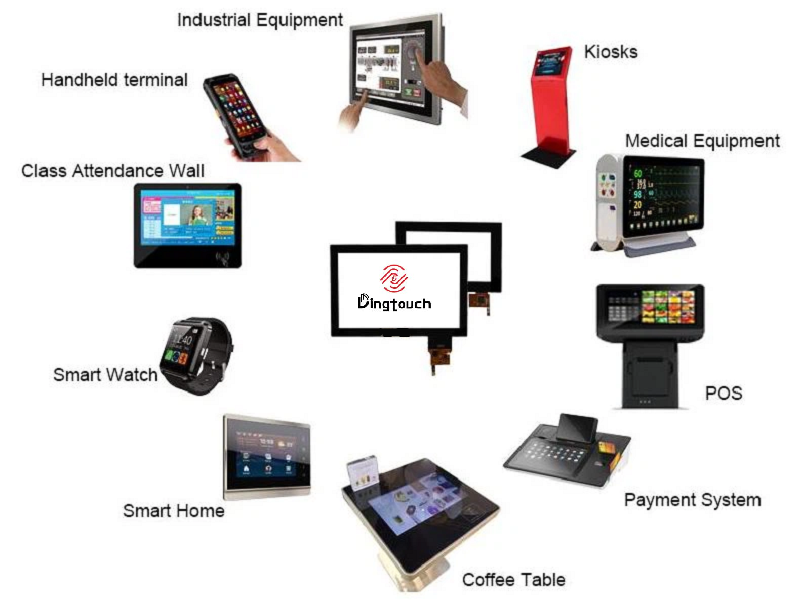
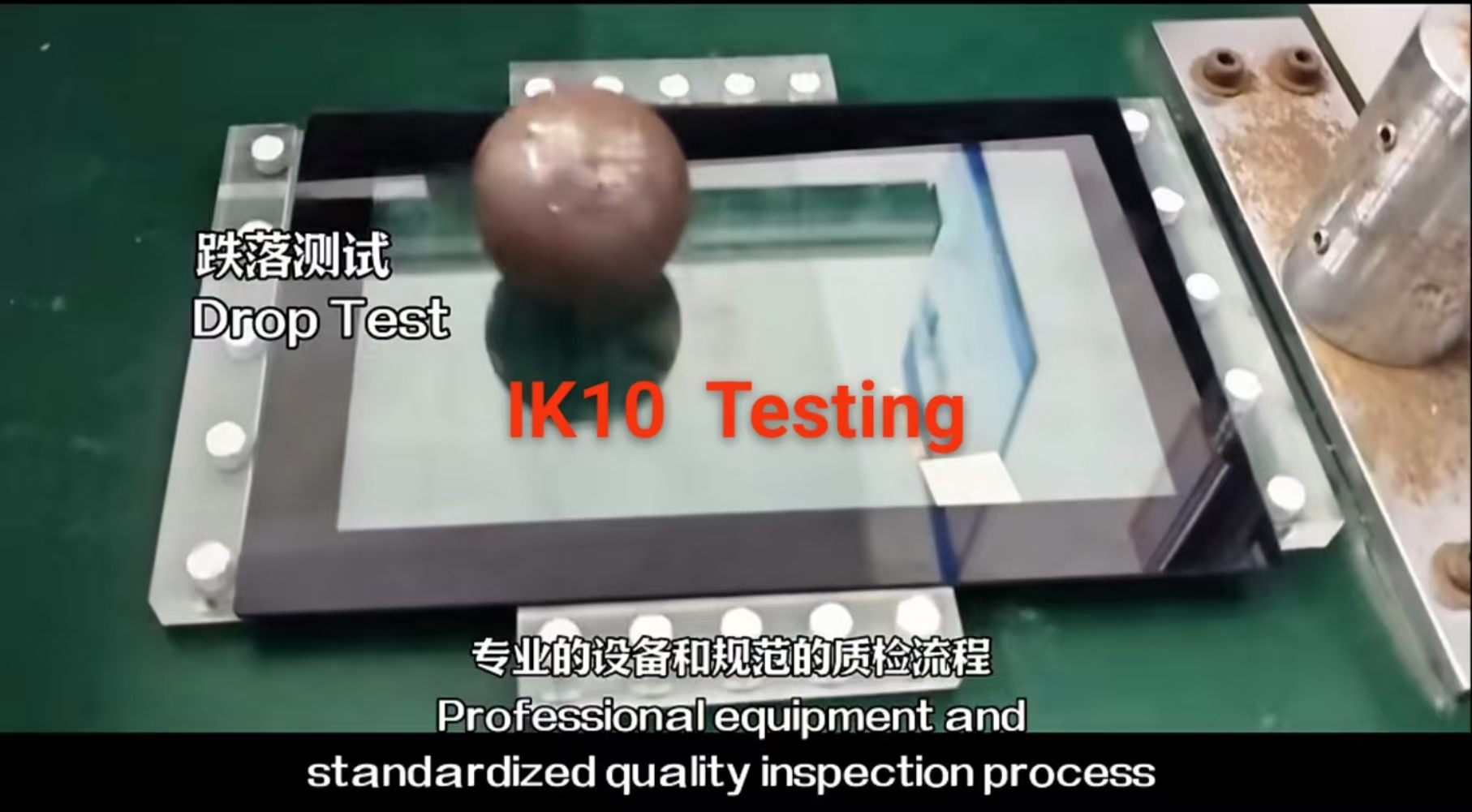


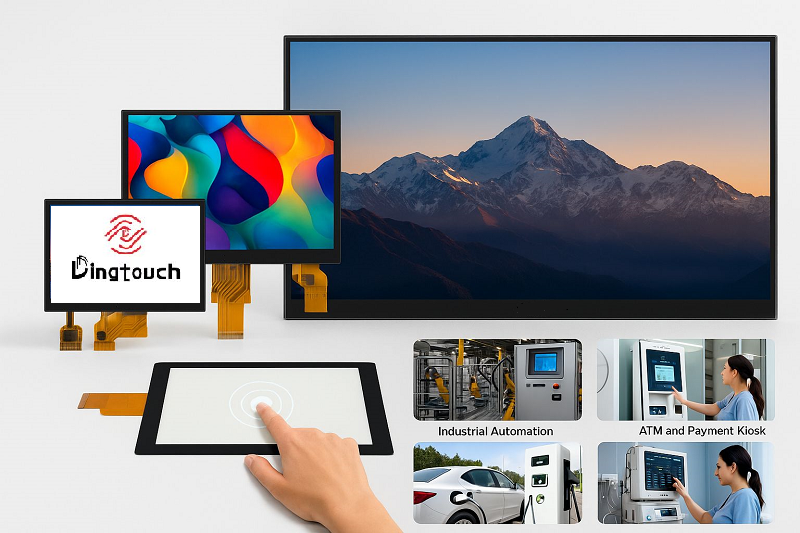

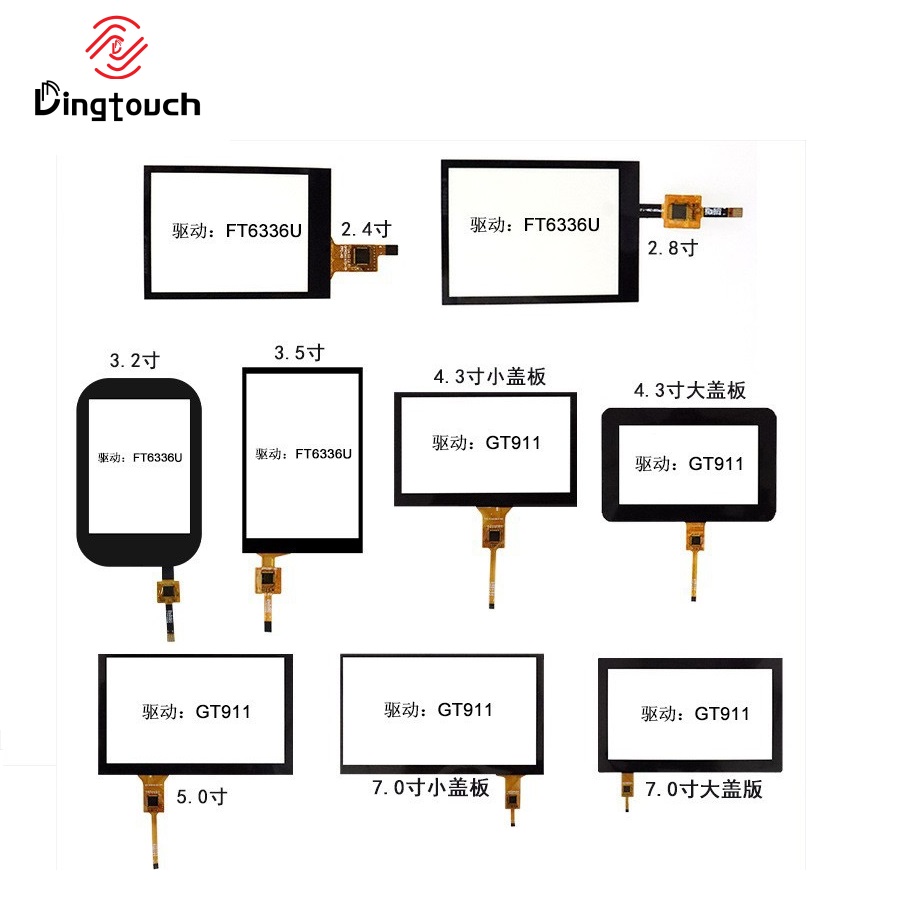
What DINGTOUCH can do:
Dingtouch Industrial capacitive touch screen Manufacturer

CATEGORIES
CONTACT US
Contact: Dingtouch
Phone: +8615815536116
Tel: +8615815536116
Email: sales@szdingtouch.com
Add: Building A, Bailu Plaza, No. 48, Gonghe Industrial Road, Gongle Community, Xixiang Street, Baoan District, Shenzhen,China. 518126
 Dingtouch