News
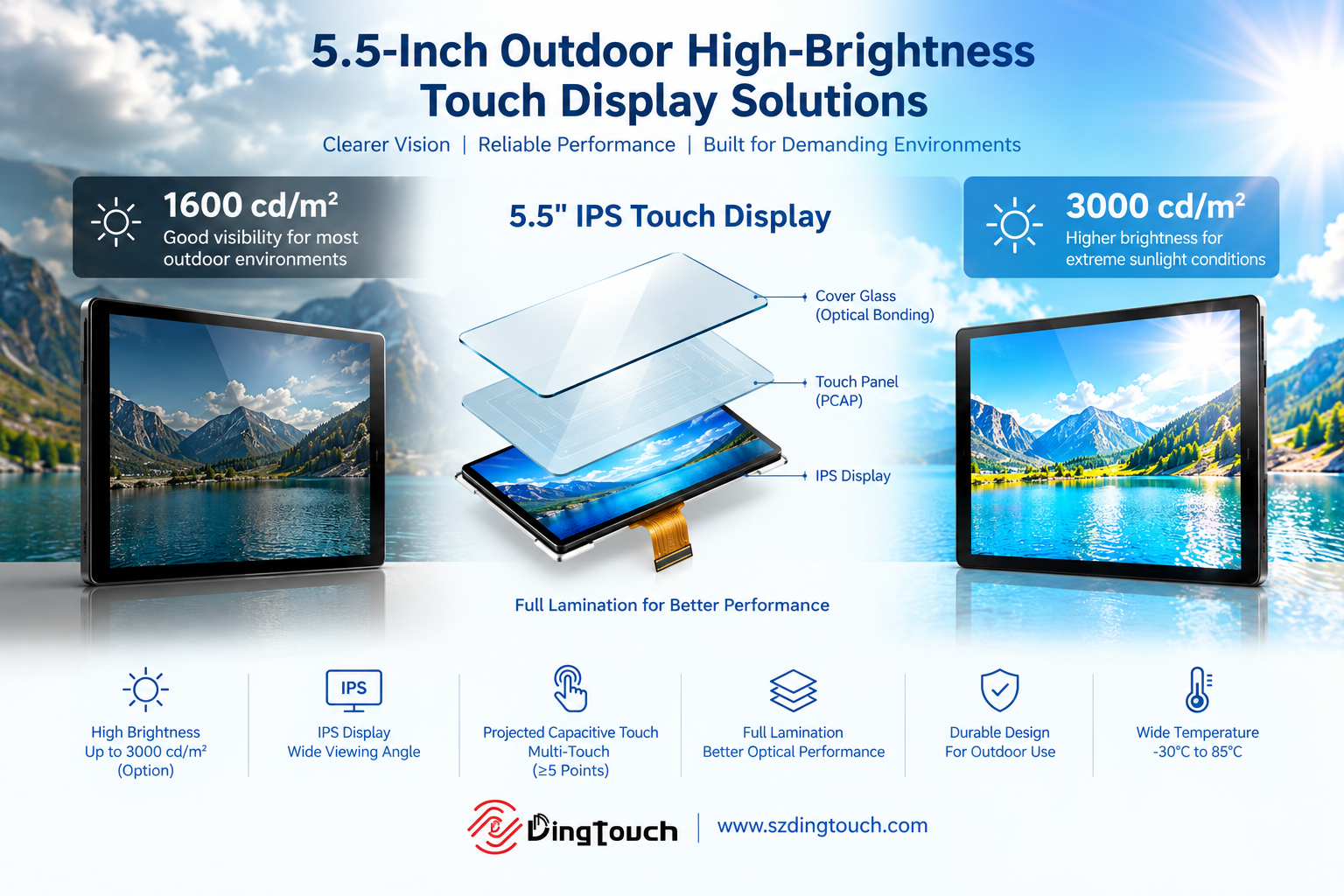
DINGTouch 5.5-Inch Outdoor High-Brightness Touch Display Solutions: 1600 cd/m² and 3000 cd/m²
 DINGTouch 5.5-Inch Outdoor High-Brightness Touch Display Solutions: 1600 cd/m² and 3000 cd/m²
1. Introduction: A Reliable 5.5-Inch Display for Outdoor Applications
Outdoor electronic devices require more than a standard LCD module. Direct sunlight, changing ambient temperatures, reflections, and frequent touch interactions can all affect display visibility and user experience.
For OEM and equipment manufacturers developing outdoor control panels, industrial handheld terminals, smart instruments, and embedded Linux devices, selecting the right display solution is essential to achieving reliable product performance.
DINGTouch offers two 5.5-inch outdoor high-brightness touch display configurations, with target brightness levels of 1600 cd/m² and 3000 cd/m². Both solutions are designed around IPS TFT technology, projected capacitive (PCAP) touch, chemically strengthened cover glass, and full optical bonding.
The display can be evaluated with the URVE Board Pi platform based on the Rockchip RK3566 processor, providing a practical starting point for hardware integration and prototype development.
Whether your project prioritizes balanced outdoor readability or enhanced visibility in demanding sunlight conditions, DINGTouch can help evaluate a suitable display and touch integration solution.
2. Two High-Brightness Display Solutions for Different Outdoor Environments
DINGTouch is developing two brightness configurations to support different application requirements.
Option A: 5.5-Inch 1600 cd/m² High-Brightness Touch Display
The 1600 cd/m² configuration is intended for outdoor equipment and semi-outdoor environments where high visibility is required without automatically selecting the highest possible backlight brightness.
Potential applications include:
-
Outdoor industrial control panels
-
Portable diagnostic and measurement instruments
-
Embedded Linux control terminals
-
Smart access and equipment management devices
-
Outdoor electronic interfaces with frequent touch operation
The final brightness target should be verified on the complete display assembly, including the cover glass, optical bonding layer, and touch sensor.
 Option B: 5.5-Inch 3000 cd/m² Ultra-High-Brightness Touch Display
For applications exposed to stronger ambient light or direct sunlight, the 3000 cd/m² configuration provides a higher-brightness development direction.
Potential applications include:
-
Sunlight-readable outdoor terminals
-
Outdoor industrial equipment
-
Vehicle-mounted or mobile equipment interfaces
-
High-brightness embedded displays
-
Outdoor instruments requiring improved screen visibility
A 3000 cd/m² backlight target can increase power consumption and thermal load. Therefore, the backlight, display structure, touch performance, and enclosure cooling should be evaluated together during prototype development.
Important: The 1600 cd/m² and 3000 cd/m² values are target configurations measured at the front surface of the finished module after optical bonding and cover-glass integration. Actual delivered brightness should be confirmed through prototype measurement and agreed acceptance criteria.
3. Key Technical Specifications of the 5.5-Inch Outdoor Touch Display
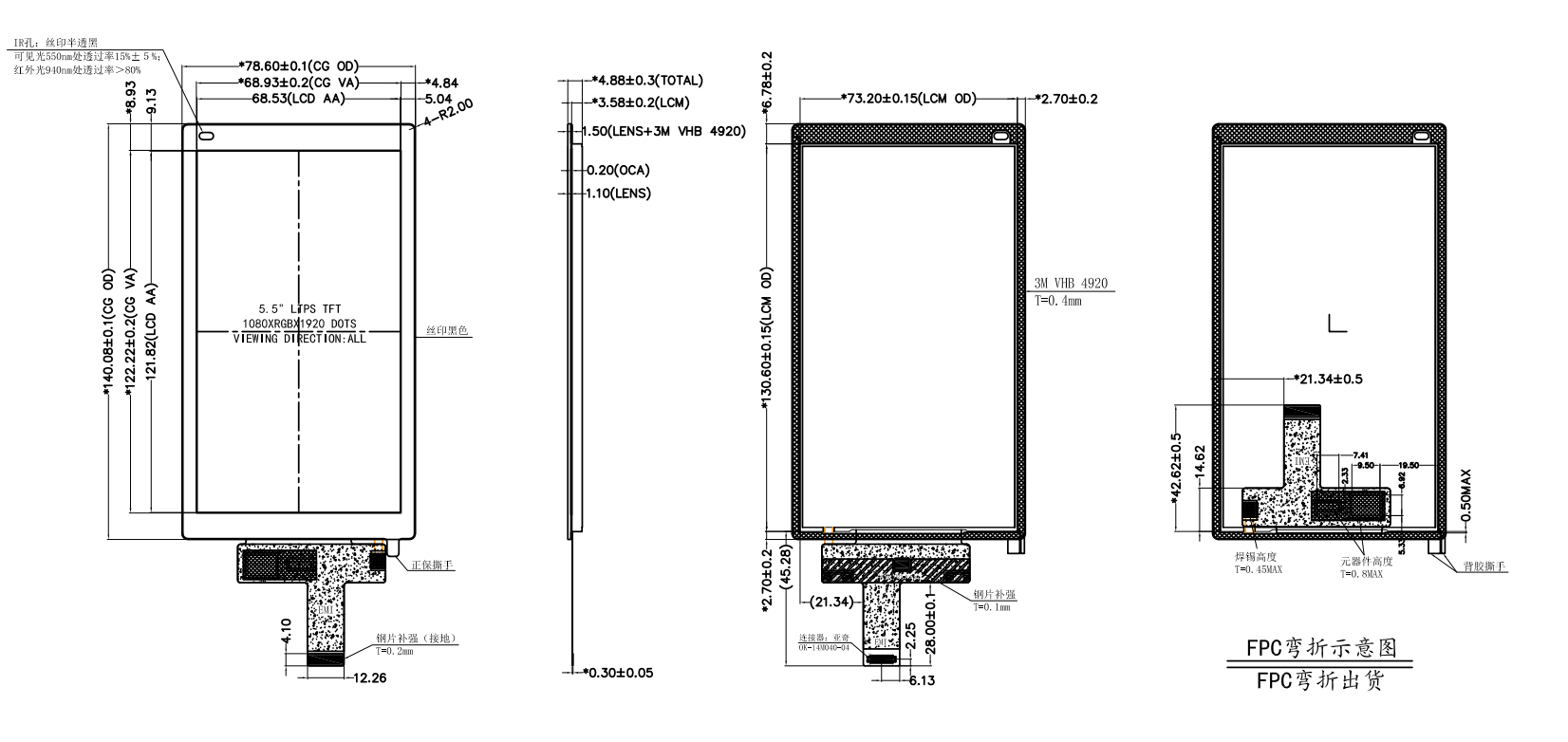
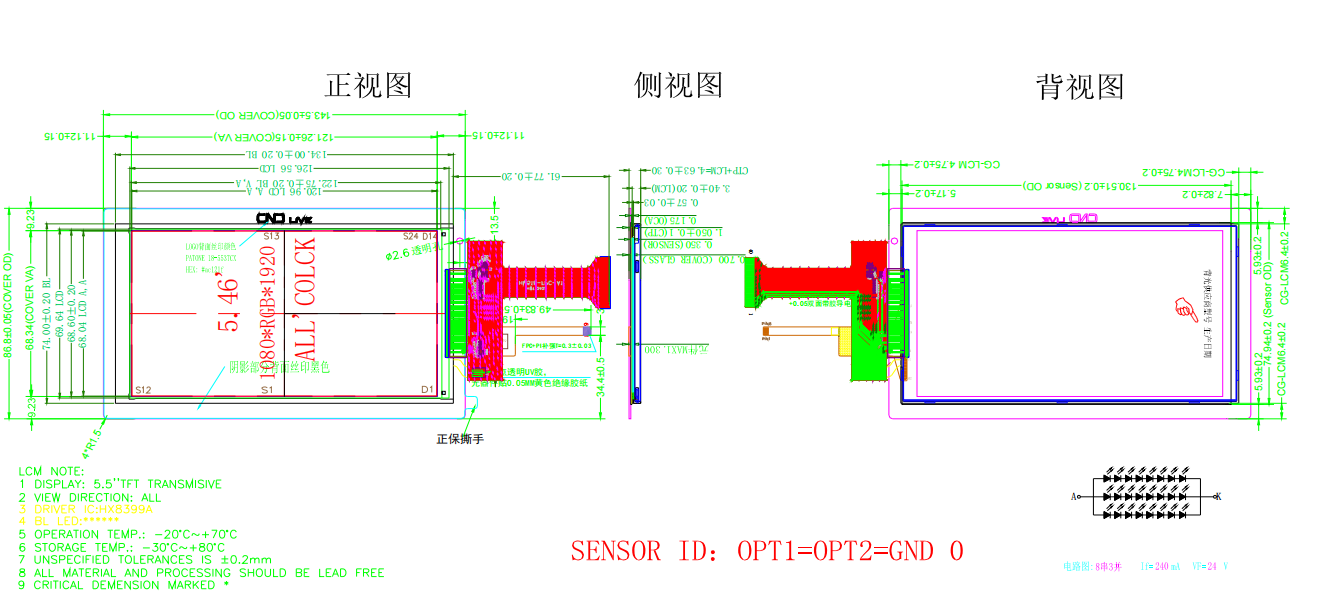
The following specifications define the proposed development direction. Final parameters will be confirmed according to the selected LCD panel, touch controller, optical structure, and host interface.
| Parameter | Proposed specification |
|---|---|
| Display size | 5.2–5.8 inches, 5.5 inches preferred |
| Display technology | IPS TFT LCD |
| Brightness options | 1600 cd/m² or 3000 cd/m² target |
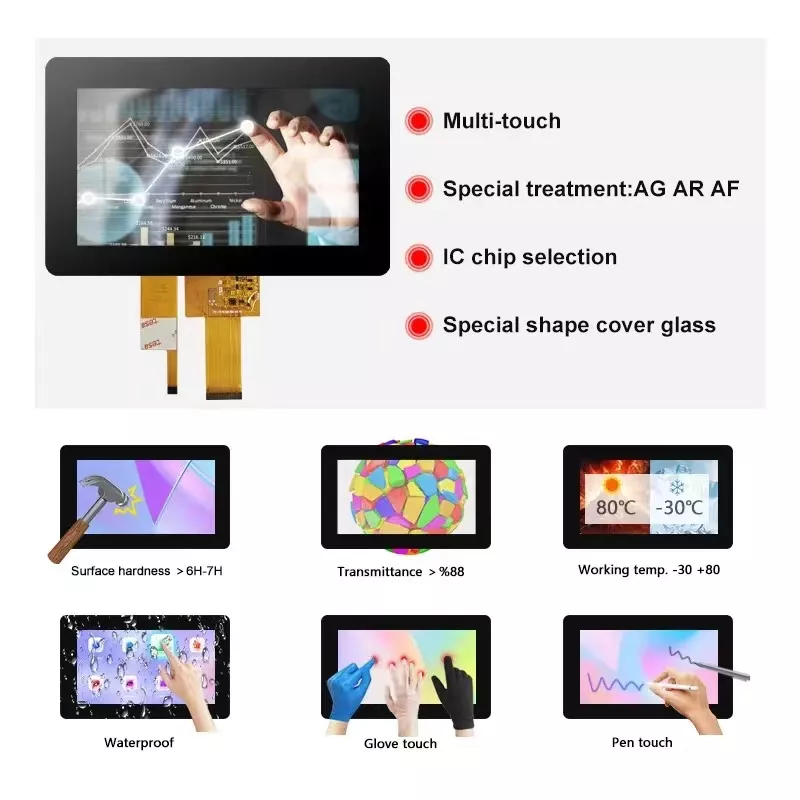
| Touch technology | Projected capacitive touch (PCAP) |
| Touch points | Minimum 5-point multi-touch |
| Optical bonding | Full optical bonding using OCA or LOCA |
| Cover glass | Chemically strengthened cover glass |
| Surface treatment | Anti-reflective (AR) and anti-fingerprint (AF) coatings preferred |
| Viewing orientation | Landscape operation |
| Display rotation | Native landscape resolution preferred; software rotation acceptable |
| Operating temperature | -20°C to +70°C preferred |
| Backlight control | PWM dimming |
| Application platform | URVE Board Pi / Rockchip RK3566 |
| Operating system | Linux / Debian |
The exact resolution, display interface, touch interface, brightness, and temperature performance must be finalized after reviewing the selected panel and integration requirements.
4. Optical Bonding and Cover Glass: Improving Outdoor Readability
High brightness alone does not guarantee good sunlight readability.
Reflections between the LCD, touch sensor, cover glass, and air gaps can reduce perceived contrast, especially under strong ambient light.
DINGTouch supports full optical bonding using OCA or LOCA, depending on the display structure and project requirements.
Full Optical Bonding
Full optical bonding fills the gap between the display and the cover glass or touch assembly with an optical adhesive.
Potential benefits include:
-
Reducing internal reflections caused by air gaps
-
Improving perceived contrast in bright environments
-
Enhancing the visual integration of the display assembly
-
Supporting a more robust integrated touchscreen structure
For this project, optical bonding should be evaluated as part of the complete module rather than as an isolated manufacturing process.
Chemically Strengthened Cover Glass
A chemically strengthened cover glass can improve resistance to everyday handling and surface damage compared with an appropriately selected untreated glass structure.
For outdoor applications, DINGTouch can evaluate cover-glass thickness, edge design, touch sensitivity, and surface treatments according to the mechanical structure of the host device.
Anti-Reflective and Anti-Fingerprint Coatings
AR coating is preferred when reducing surface reflections is a priority.
AF coating can help reduce fingerprints and improve surface cleaning.
The effectiveness of these coatings depends on the glass structure, coating specifications, lighting conditions, and cleaning requirements. Their optical performance and durability should be verified on the finished assembly.
 5. Outdoor Touch Performance: PCAP Technology with at Least 5 Touch Points
The proposed display uses projected capacitive touch technology with a minimum of five simultaneous touch points.
For outdoor applications, touch performance must be considered alongside cover-glass thickness, optical bonding, environmental conditions, and the electrical noise generated by the host system.
The touch solution should be evaluated for:
-
Stable touch detection through the selected cover glass
-
Reliable multi-touch operation
-
Compatibility with the intended USB HID or I2C interface
-
Touch-controller performance under electrical interference
-
Operation across the specified temperature range
Depending on the project, additional evaluation may be required for wet-finger operation, water interference, gloves, or electromagnetic compatibility.
These features should be confirmed through application-specific testing rather than assumed from the basic PCAP specification.
6. Compatibility with URVE Board Pi and Rockchip RK3566
The proposed host platform is the URVE Board Pi, based on the Rockchip RK3566 processor.
The host requirements include:
-
Linux / Debian operating system
-
Four-lane MIPI DSI, with the host platform supporting up to 2560 × 1440 at 60 Hz
-
A 30-pin combination MIPI DSI / LVDS connector
-
HDMI 2.0 output as an alternative display connection
-
USB HID or I2C touch communication
-
Native MIPI DSI preferred for the production version
Native MIPI DSI for the Production Version
Native MIPI DSI is the preferred direction for the production design because it can reduce the need for an additional display bridge and may help lower system power consumption and simplify the hardware architecture.
However, the final power savings depend on the complete system, including the display panel, backlight, touch controller, and interface implementation.
Before selecting the production display, the following compatibility items should be confirmed:
-
The host board's actual MIPI DSI output configuration and available lanes.
-
The display panel's supported resolution, timing parameters, and refresh rate.
-
The availability of a compatible Linux / Debian display driver.
-
The required connector pin assignment and FPC cable structure.
-
The touch-controller driver and communication interface.
The host platform's maximum supported resolution does not automatically mean that every display panel can operate at that resolution. The LCD timing, MIPI lane configuration, and software support must all be compatible.
USB HID for Prototype Development
For the initial prototype, USB HID touch communication is preferred.
USB HID can simplify early development because it commonly uses standard operating-system input support and may reduce the need for custom touch-driver integration.
For production, the project can evaluate whether native MIPI DSI combined with I2C touch provides a more suitable architecture.
7. Brightness, Power Consumption, and Thermal Management
The difference between a 1600 cd/m² display and a 3000 cd/m² display is not limited to visibility.
Higher brightness generally requires greater backlight power, which can increase heat generation inside the enclosure.
For an outdoor embedded device, thermal design should consider:
-
Backlight power consumption at maximum brightness
-
Temperature rise inside the enclosure
-
LCD operating-temperature limits
-
Touch-controller temperature performance
-
Brightness stability during extended operation
-
Available heat dissipation and ventilation
DINGTouch can evaluate PWM backlight brightness control to support system-level brightness adjustment.
PWM frequency, dimming range, and potential interaction with the touch system should be confirmed during testing.
For battery-powered equipment, the 1600 cd/m² configuration may provide a useful balance between visibility and energy consumption. For applications where direct-sunlight visibility is the dominant requirement, the 3000 cd/m² configuration may be worth evaluating.
The final selection should be based on actual outdoor testing, not brightness specifications alone.
8. Landscape Operation and Resolution Options
The customer's preferred display orientation is landscape.
A native landscape resolution is preferred because it can simplify software configuration, display timing, and integration.
If the selected LCD panel has a native portrait resolution, software rotation may also be acceptable, provided that the URVE Board Pi, Linux / Debian graphics stack, and application software support the required rotation.
The preferred approach is to confirm the display orientation early in the project to avoid unnecessary changes to the FPC routing, mounting structure, or software interface.
9. How DINGTouch Supports OEM and ODM Display Development
DINGTouch specializes in industrial touchscreen and display integration for OEM and ODM projects.
For this 5.5-inch outdoor display project, the proposed development process includes:
Step 1: Requirement Review
Confirm the target display size, brightness, cover-glass dimensions, optical bonding, touch performance, temperature range, and host interface.
Step 2: Display and Touch Configuration
Evaluate the 1600 cd/m² and 3000 cd/m² configurations, including the selected IPS LCD, PCAP touch sensor, cover glass, and optical bonding structure.
Step 3: Host Compatibility Evaluation
Review the URVE Board Pi hardware, MIPI DSI / LVDS interface, USB HID or I2C touch communication, and Linux / Debian software requirements.
Step 4: Prototype Testing
Evaluate brightness at the finished module surface, touch response, display compatibility, power consumption, thermal behavior, and outdoor readability.
Step 5: Production Optimization
After prototype validation, optimize the display structure, FPC, cover glass, touch configuration, and production interface according to the project requirements.
DINGTouch can provide technical support for display selection, touch integration, optical bonding, and customized cover-glass development.
10. Frequently Asked Questions
Can DINGTouch provide a 5.5-inch outdoor high-brightness touchscreen?
DINGTouch can evaluate a 5.5-inch outdoor touchscreen configuration based on the customer's requirements, including 1600 cd/m² and 3000 cd/m² brightness targets, IPS TFT, PCAP touch, and full optical bonding.
The final configuration depends on the selected LCD panel and prototype validation.
Is 3000 cd/m² necessary for outdoor displays?
Not every outdoor application requires 3000 cd/m².
A 1600 cd/m² display may be suitable for many outdoor or semi-outdoor environments. A 3000 cd/m² configuration may be more appropriate when stronger sunlight readability is required.
The correct choice depends on ambient lighting, surface reflections, optical bonding, and enclosure conditions.
Does the display support the Rockchip RK3566 platform?
The project is intended for evaluation with the URVE Board Pi based on the Rockchip RK3566 processor.
The MIPI DSI timing, display driver, connector pin assignment, and touch interface must be verified before production.
Can the cover glass and touch panel be customized?
Yes. DINGTouch can evaluate customized cover-glass dimensions, surface coatings, touch sensor configurations, and optical bonding structures according to the mechanical and optical requirements of the project.
11. Contact DINGTouch for Your Outdoor Touch Display Project
Are you developing an outdoor industrial terminal, embedded Linux device, smart instrument, or sunlight-readable touchscreen product?
DINGTouch can help you evaluate a suitable high-brightness display configuration based on your host platform, mechanical structure, and operating environment.
Our engineering team can review your display specifications and help determine whether a 1600 cd/m² or 3000 cd/m² configuration is the better starting point.
Contact DINGTouch to discuss your 5.5-inch outdoor high-brightness touchscreen project.
Shenzhen Dingtouch Electronics Technology Co.Ltd.
Website: www.szdingtouch.com
Email: sales@szdingtouch.com
Tell us your target brightness, host board, interface, and application environment to begin your display integration evaluation.

CATEGORIES
CONTACT US
Contact: Dingtouch
Phone: +8615815536116
Tel: +8615815536116
Email: sales@szdingtouch.com
Add: Building A, Bailu Plaza, No. 48, Gonghe Industrial Road, Gongle Community, Xixiang Street, Baoan District, Shenzhen,China. 518126
 Dingtouch