News
Why Do Touch Displays Need Optical Bonding?

Why Do Touch Displays Need Optical Bonding?
From Optical Performance to Industrial Reliability — DINGTouch Full Lamination Touch Display Solutions
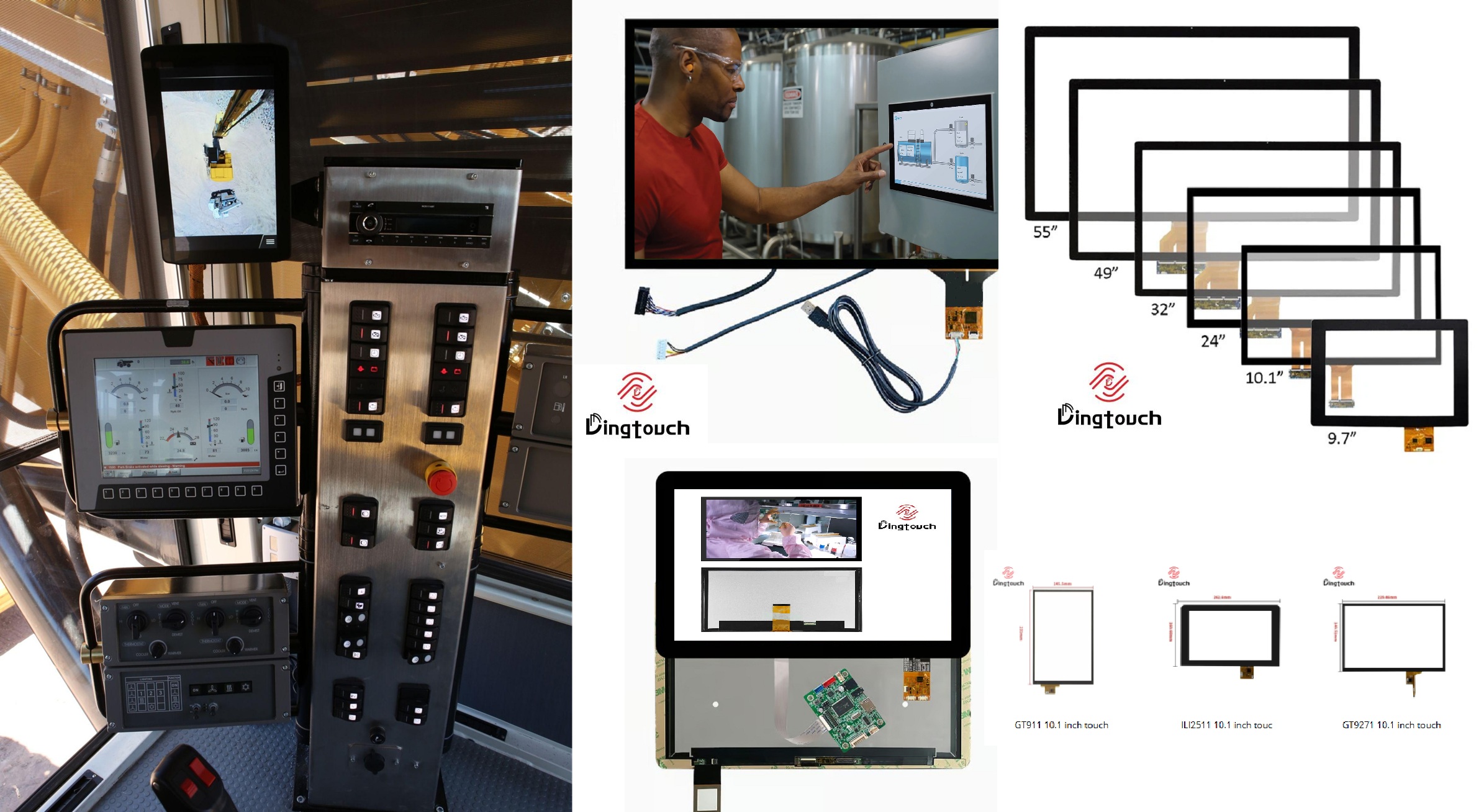
In outdoor environments, industrial equipment, vehicle displays, and human-machine interfaces (HMI), many users experience similar problems:
The screen becomes reflective like a mirror under strong sunlight.
Dust, moisture, or internal fogging appears after long-term operation.
Touch accuracy decreases due to parallax effects.
The display performance deteriorates after vibration or impact.
These issues are not always caused by the LCD itself. In many cases, they are closely related to the bonding method between the touch panel and display module.
Traditional frame bonding fixes the touch panel only around the edges, leaving an air gap between the touch sensor and LCD. Optical bonding, however, uses optical adhesive to completely fill this gap, creating a more integrated and reliable touch display module.
Although it may look like “just adding a layer of adhesive”, optical bonding actually improves:
- Optical performance
- Touch accuracy
- Mechanical strength
- Dust and moisture resistance
- Long-term reliability
For industrial, medical, automotive, and outdoor applications, optical bonding has become an essential technology for high-performance touch displays.
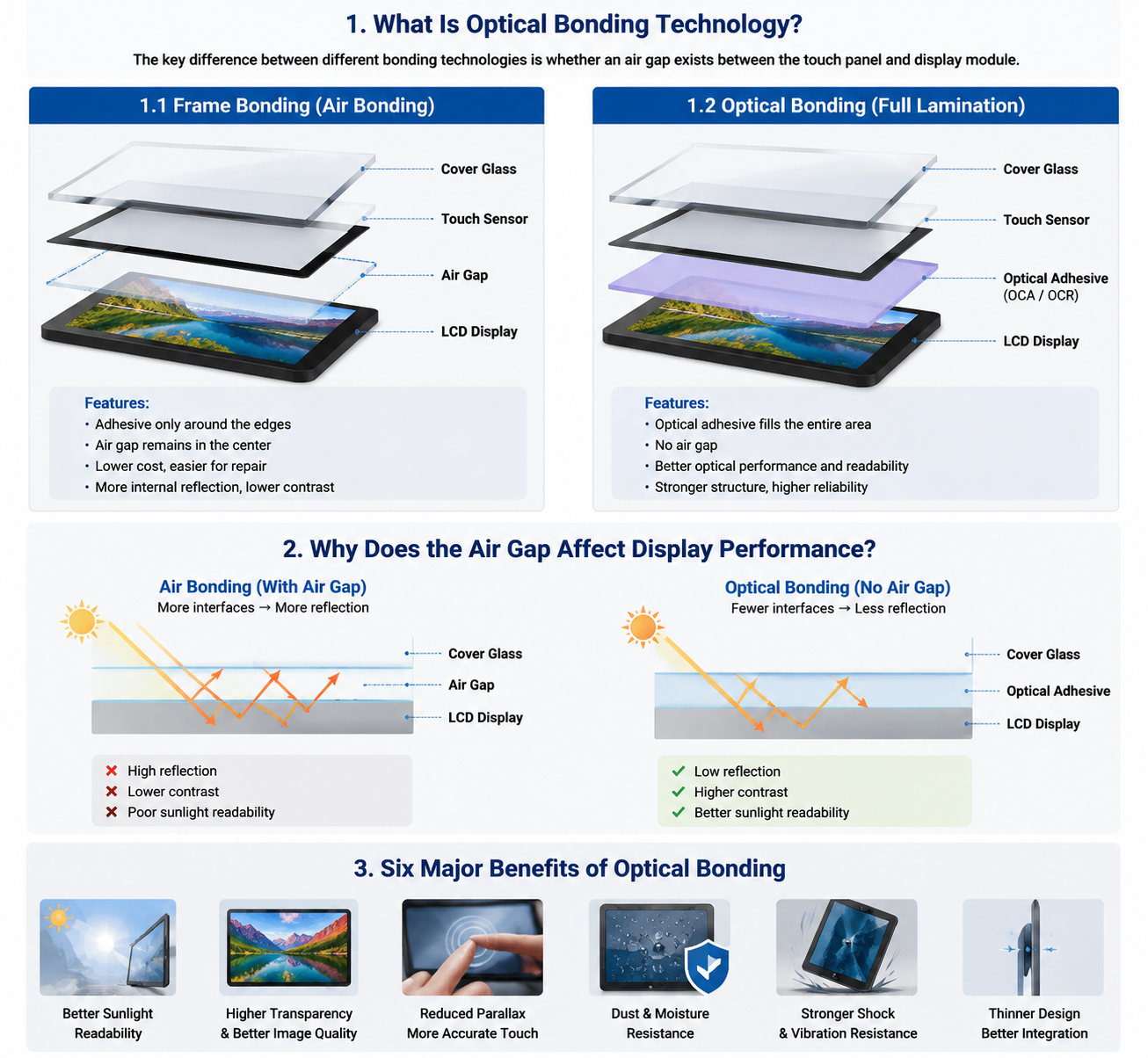
1. What Is Optical Bonding Technology?
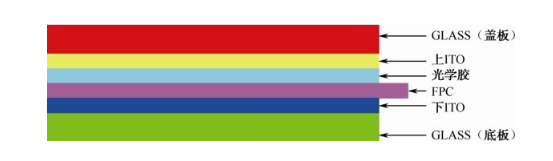
A typical touch display module consists of:
Cover Glass
↓
Touch Sensor
↓
LCD Display
The key difference between different bonding technologies is whether an air gap exists between these layers.
1.1 Frame Bonding (Air Bonding)
Frame bonding, also known as bezel bonding, uses double-sided adhesive around the edges to fix the touch panel and LCD.
The center area remains an air gap.
Structure:
- Mature manufacturing process
- Lower cost
- Easier repair and replacement
- Suitable for cost-sensitive products
Limitations:
The air layer creates additional optical interfaces.
When light passes through:
Glass → Air → LCD
different refractive indexes cause additional reflection and refraction.
This results in:
- More glare
- Lower contrast
- Reduced outdoor visibility
- Possible image reflection and ghosting
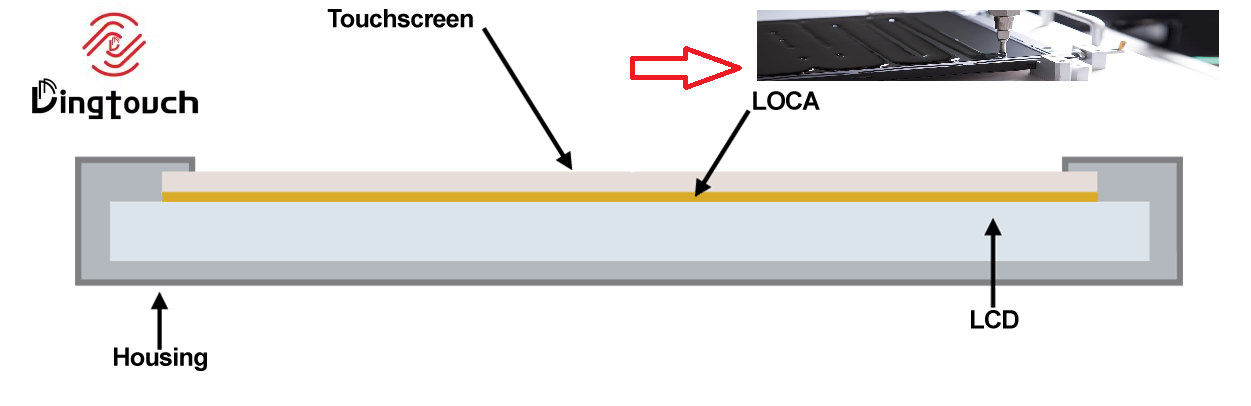
1.2 Optical Bonding (Full Lamination)
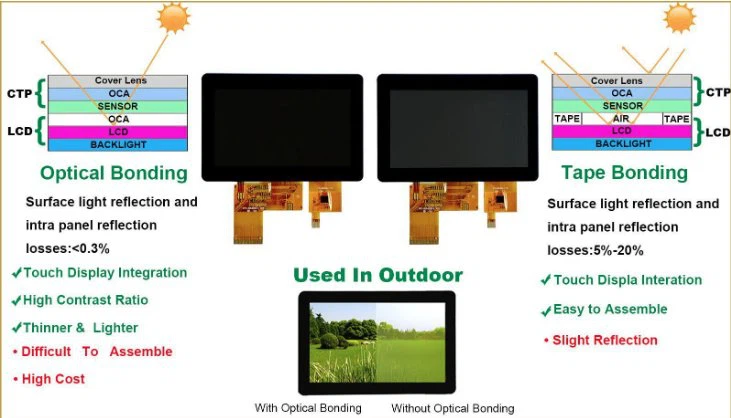
Optical bonding uses transparent optical adhesive to completely fill the space between the touch panel and LCD.
Structure:
Common optical bonding materials include:
- OCA (Optically Clear Adhesive)
- OCR (Optically Clear Resin)
- LOCA (Liquid Optically Clear Adhesive)
The purpose is not simply adding adhesive.
The real goal is:
Replacing the air layer with an optical medium that has a closer refractive index to glass and display materials, reducing internal reflection and improving image quality.
2. Why Does the Air Gap Affect Display Performance?
Many people think:
“If the display is not clear enough, just increase the backlight brightness.”
However, outdoor visibility is often not limited by brightness, but by internal reflection.
In an air-bonded structure, external light reflects between:
- Cover glass
- Air layer
- LCD surface
Under strong sunlight, reflected ambient light can become stronger than the displayed image itself.
This causes:
- Black areas appearing gray
- Reduced image depth
- Poor text visibility
- Lower viewing quality
Optical bonding fills the air gap with optical adhesive, reducing the refractive index difference between materials.
As a result:
- Internal reflection is reduced
- More display light reaches the user's eyes
- Image contrast is improved
Therefore:
Optical bonding improves effective contrast, not just brightness.
3. Six Major Benefits of Optical Bonding Touch Displays
1. Better Sunlight Readability in Bright Environments
The biggest challenge for outdoor displays is not only brightness, but:
How to reduce environmental light interference.
Optical bonding reduces internal reflection and improves:
- Black level performance
- Image clarity
- Text readability
- Viewing comfort
It is widely used in:
- Outdoor terminals
- Charging stations
- Vehicle displays
- Industrial control panels
- Smart kiosks
For outdoor applications, DINGTouch combines:
- High brightness LCD (500~2000 nits)
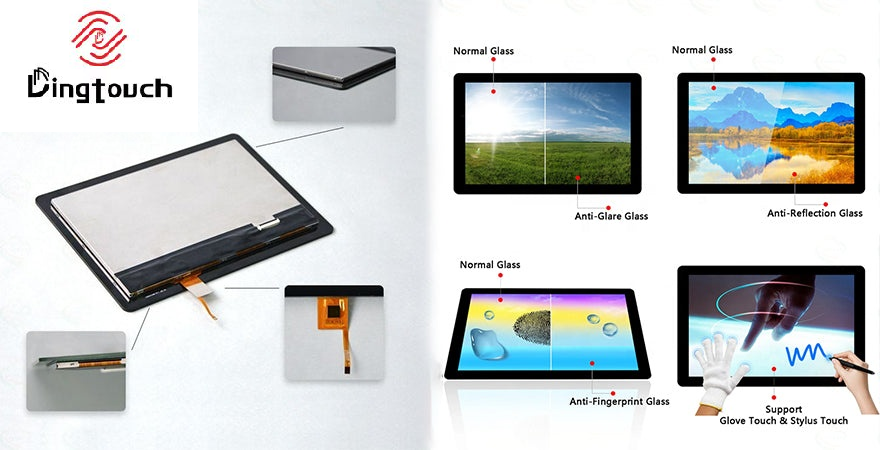
- Anti-glare (AG) coating
- Anti-reflection (AR) coating
- Optical bonding technology
to create reliable sunlight-readable display solutions.
2. More Transparent and Clear Image Quality Under the Same Backlight
Because optical bonding reduces light loss inside the module:
The display can achieve:
- Higher optical efficiency
- Better color performance
- Improved contrast
For power-sensitive products, optical bonding can also reduce backlight power consumption while maintaining the same visual performance.
Applications include:
- Portable industrial equipment
- Battery-powered terminals
- Smart instruments
3. Reduced Parallax and More Accurate Touch Experience
In air-bonded structures, there is a physical distance between:
Touch surface
and
Displayed image.
When users:
- View from different angles
- Tap small icons
- Write or draw
touch positioning may appear inaccurate.
Optical bonding reduces the optical distance between the finger and displayed image.
Benefits:
- More precise touch operation
- More natural handwriting experience
- Smartphone-like interaction feeling
Especially important for:
- Industrial HMI
- Medical equipment
- Vehicle control systems
- Interactive terminals
4. Improved Dust and Moisture Resistance
Air gaps inside traditional frame bonding structures can allow:
- Dust accumulation
- Moisture penetration
- Internal condensation
With optical bonding, the internal space is filled, reducing the possibility of:
- Dust entering
- Moisture accumulation
- Display fogging
This makes optical bonding suitable for:
- Outdoor equipment
- Marine applications
- Industrial environments
- High humidity conditions
Please note:
Optical bonding does not automatically mean waterproof.
True IP65/IP67 protection still requires:
- Sealed housing design
- Waterproof gaskets
- Protected connectors
5. Enhanced Shock and Vibration Resistance
Optical adhesive provides more than bonding.
It can also:
- Distribute impact forces
- Reduce layer movement
- Improve module rigidity
When combined with:
- Tempered glass
- Chemically strengthened glass
- IK protection design
the touch display can achieve higher durability in harsh environments.
Applications include:
- Industrial machines
- Transportation systems
- Vehicle displays
- Automation equipment
6. Thinner Structure and Better Product Integration
Removing the air gap helps reduce overall module thickness.
The display becomes:
- More compact
- More integrated
- More visually attractive
Optical bonding is widely used in:
- Smart cockpit displays
- Industrial control panels
- Commercial displays
- Advanced HMI systems
 4. DINGTouch Optical Bonding Touch Display Applications
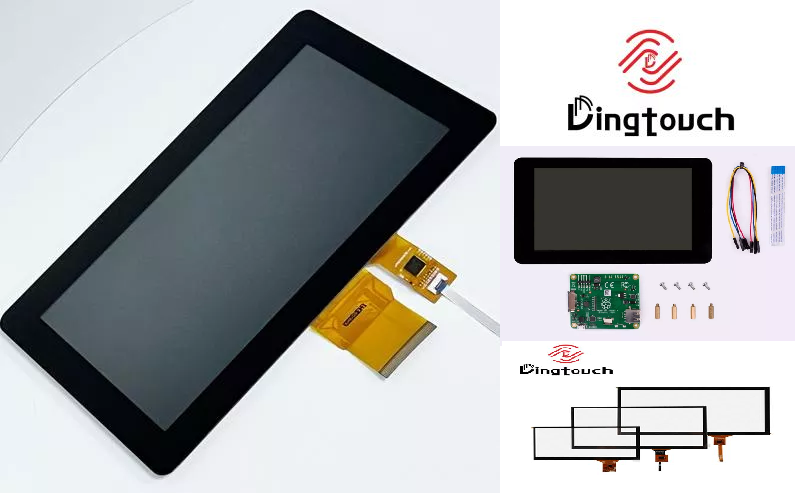
As a professional custom touch display manufacturer, DINGTouch has successfully developed and mass-produced optical bonding solutions covering multiple industrial display sizes.
Current mature product sizes include:
| Size | Applications |
|---|---|
| 5.0 inch | Industrial instruments, smart devices |
| 7.0 inch | HMI systems, control terminals |
| 8.0 inch | Industrial control, vehicle systems |
| 10.1 inch | Automation equipment, smart terminals |
| 10.4 inch | Medical and industrial instruments |
| 12.1 inch | Industrial panels and inspection equipment |
| 13.3 inch | Vehicle and industrial displays |
| 15.6 inch | Industrial PC and intelligent terminals |
DINGTouch supports:
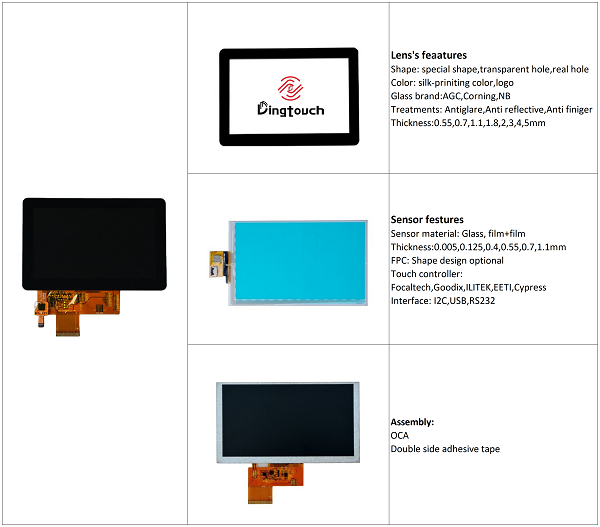
- PCAP capacitive touch technology
- G+G touch structure
- USB / I2C interfaces
- OCA optical bonding
- OCR liquid bonding
- High brightness LCD
- Wide temperature displays
- AG / AR / AF surface treatments
5. OCA vs OCR Optical Bonding — What Is the Difference?
OCA Optical Adhesive
OCA is a solid optical adhesive film.
Features:
- Uniform thickness
- High production consistency
- Suitable for standardized products
Advantages:
✓ Stable manufacturing process
✓ Excellent optical performance
✓ Suitable for small and medium-size displays
Applications:
5", 7", 8", 10.1" industrial touch displays.
OCR / LOCA Liquid Optical Adhesive
OCR and LOCA are liquid optical resins.
Advantages:
✓ Strong filling capability
✓ Suitable for complex structures
✓ Better for large-size displays
Challenges:
Require precise control of:
- Dispensing volume
- Curing process
- Bubble control
- Adhesive thickness
6. Is Optical Bonding Always Better Than Frame Bonding?
The answer is:
Not every product requires optical bonding.
The correct solution depends on the application requirements.
| Application | Recommended Solution |
|---|---|
| Standard consumer display | Frame bonding |
| Cost-sensitive products | Frame bonding |
| Outdoor equipment | Optical bonding |
| Industrial HMI | Optical bonding |
| Medical devices | Optical bonding |
| Vehicle displays | Optical bonding |
| High reliability equipment | Optical bonding |
Frame bonding advantages:
- Lower cost
- Simple process
- Easier maintenance
Optical bonding advantages:
- Better visibility
- More accurate touch
- Higher reliability
The best technology is not always the most expensive one.
The best solution is the one that matches the actual working environment.

Conclusion: Optical Bonding Is More Than a Display Upgrade
With the rapid development of industrial automation, smart transportation, outdoor equipment, and medical electronics, touch displays are evolving from:
“Basic display and touch function”
to:
“Clear visibility, accurate interaction, and long-term reliability.”
Optical bonding technology provides:
- Reduced reflection
- Better sunlight readability
- Lower parallax
- Improved dust and moisture resistance
- Stronger mechanical reliability
It has become a key technology for modern industrial touch displays.
DINGTouch specializes in customized touch display solutions, providing PCAP touch screens, TFT LCD modules, and optical bonding solutions from 5" to 15.6" and beyond, helping customers create clearer, stronger, and more reliable human-machine interaction products.

CATEGORIES
CONTACT US
Contact: Dingtouch
Phone: +8615815536116
Tel: +8615815536116
Email: sales@szdingtouch.com
Add: Building A, Bailu Plaza, No. 48, Gonghe Industrial Road, Gongle Community, Xixiang Street, Baoan District, Shenzhen,China. 518126
 Dingtouch