News
Chemically Strengthened Glass vs. Tempered Glass: How to Choose the Right Cover Glass for Touch Displays?
 Chemically Strengthened Glass vs. Tempered Glass: How to Choose the Right Cover Glass for Touch Displays?
Selecting the right cover glass is an important step in developing a reliable touch display. Whether used in industrial control panels, medical equipment, automotive interfaces, or outdoor terminals, the cover glass must provide sufficient mechanical protection while maintaining optical clarity, touch responsiveness, and long-term reliability.
Two commonly used strengthening methods are chemical strengthening and thermal tempering.
Although both processes improve the mechanical performance of glass, they work differently and offer distinct advantages in terms of impact resistance, thickness, flatness, design flexibility, and manufacturing requirements.
So, which one is better for your application?
The answer depends on more than glass strength alone. Factors such as cover glass thickness, optical bonding requirements, impact resistance, installation structure, and operating environment must all be considered.
For industrial touch display manufacturers and OEM/ODM developers, understanding these differences early in the design process can help reduce development risks, improve production consistency, and achieve a better balance between durability and cost.
In this article, DINGTouch explains the key differences between chemically strengthened and tempered glass and provides practical recommendations for selecting the right solution for industrial touch display applications.
1. What Is Chemically Strengthened Glass?
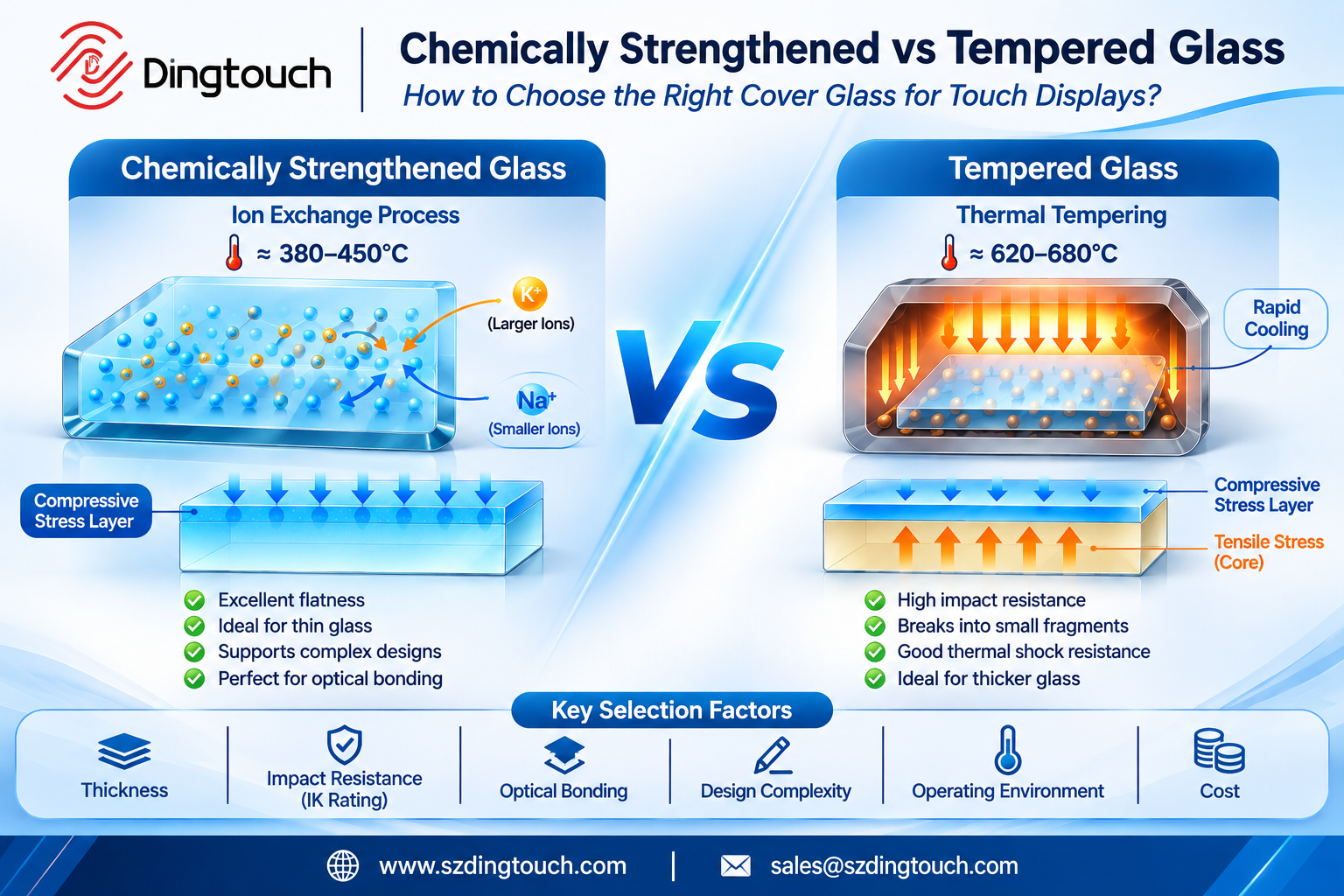
Chemically strengthened glass, also known as chemically toughened glass, is produced through an ion-exchange process.
During manufacturing, the glass is immersed in a molten potassium salt bath, typically at approximately 380–450°C, depending on the glass composition and process requirements.
Smaller sodium ions near the glass surface are replaced by larger potassium ions. Because the larger ions occupy more space within the glass structure, they create a compressive stress layer on the surface.
This surface compression makes it more difficult for existing microscopic cracks to develop and propagate, improving the glass's resistance to mechanical damage.
Unlike thermal tempering, chemical strengthening does not rely on rapid cooling. This helps preserve dimensional accuracy and makes the process particularly suitable for thin glass and precision cover glass designs.
Main Advantages of Chemically Strengthened Glass
-
Excellent thin-glass performance: Suitable for lightweight and slim touch display structures.
-
Better dimensional stability: Generally offers better flatness control, particularly for thin glass.
-
Design flexibility: Supports complex outlines, precision cutouts, and customized dimensions.
-
Good surface strength: The compressive surface layer improves resistance to crack initiation.
-
Optical bonding suitability: Helps meet flatness requirements in high-quality OCA and LOCA bonding applications.
-
Industrial customization: Suitable for customized cover glass used in medical, automotive, and industrial HMI.
Limitations of Chemically Strengthened Glass
-
Processing costs are generally higher than conventional thermal tempering.
-
Strengthening performance depends on glass composition, ion-exchange depth, and surface compressive stress.
-
The compressive layer is concentrated near the surface rather than extending through a relatively thick portion of the glass.
-
Cutting, drilling, and edge machining should be completed before chemical strengthening.
-
Breakage may produce larger, sharper fragments than fully tempered glass.
Chemically strengthened glass is particularly suitable for touch displays requiring thin profiles, precise dimensions, high optical quality, and customized industrial designs.
2. What Is Tempered Glass?
Tempered glass, also known as thermally tempered glass, is manufactured through a controlled heating and rapid-cooling process.
The glass is first heated to approximately 620–680°C, depending on its composition and manufacturing process. It is then rapidly cooled using high-pressure air.
The outer surfaces cool and solidify faster than the interior. As the glass continues cooling, a stress distribution develops, with compressive stress on the surfaces and tensile stress in the central region.
This stress structure improves the glass's resistance to mechanical impact and thermal shock compared with untreated glass.
When fully tempered glass breaks, it generally fragments into numerous relatively small pieces rather than large, sharp shards. This breakage behavior can reduce certain injury risks, although the actual safety performance depends on the applicable glass standard and product construction.
Main Advantages of Tempered Glass
-
Good mechanical strength: Suitable for applications requiring robust glass structures.
-
Improved impact resistance: Provides good resistance to mechanical loading when properly designed.
-
Thermal shock resistance: Generally performs better than untreated glass under temperature changes.
-
Safer breakage behavior: Fully tempered glass typically breaks into smaller granular fragments.
-
Mature manufacturing process: Widely available with established production methods.
-
Cost efficiency: Can offer competitive processing costs for suitable designs.
Limitations of Tempered Glass
-
Thin glass can be more challenging to process because of thermal distortion and flatness requirements.
-
Warpage may affect optical bonding and assembly consistency.
-
Cutting, drilling, or machining after tempering is not permitted because it can cause breakage.
-
Complex shapes and precision cutouts require careful manufacturing planning.
-
Edge quality and surface defects before tempering can significantly influence the final strength.
Tempered glass is commonly considered for thicker cover glass constructions, public-facing equipment, outdoor kiosks, and industrial products where mechanical protection is a major design priority.
3. Chemically Strengthened Glass vs. Tempered Glass: Key Differences
Although both methods improve glass strength, their manufacturing principles and resulting characteristics are different.
The following table summarizes the main engineering considerations when selecting cover glass for touch displays.
| Comparison | Chemically Strengthened Glass | Tempered Glass |
|---|---|---|
| Strengthening method | Ion exchange | Thermal tempering |
| Typical processing temperature | Approximately 380–450°C | Approximately 620–680°C |
| Strengthening mechanism | Surface ion exchange and compression | Surface compression through rapid cooling |
| Typical applications | Thin and precision cover glass | Thicker protective glass |
| Thin-glass suitability | Excellent | More challenging |
| Flatness control | Generally better for thin glass | Requires careful thermal control |
| Surface crack resistance | Excellent when properly processed | Good |
| Impact resistance | Good, depending on design | Often advantageous in thicker constructions |
| Thermal shock resistance | Depends on glass composition and stress profile | Generally good |
| Complex geometries | Good manufacturing flexibility | More challenging |
| Post-strengthening machining | Not recommended | Not possible |
| Breakage behavior | May produce larger sharp fragments | Generally smaller granular fragments |
| Optical bonding | Well suited to precision bonding | Depends on flatness and construction |
| Relative processing cost | Generally higher | Generally lower |
Important: These are general engineering comparisons rather than absolute performance rankings. Actual mechanical performance depends on glass composition, thickness, strengthening parameters, edge quality, and the complete product structure.
There is also no universal 3 mm dividing line between the two technologies. Thin tempered glass and relatively thick chemically strengthened glass are both possible under specific manufacturing conditions.
The final choice should be based on actual mechanical testing and manufacturing feasibility.
4. Six Important Factors When Selecting touchscreen Cover Glass
Choosing between chemical strengthening and thermal tempering requires evaluating the entire touch display assembly rather than considering the glass material independently.
4.1 Glass Thickness and Product Structure
Glass thickness is one of the first factors to consider.
For thin cover glass applications, chemically strengthened glass is often preferred because it offers better dimensional stability and supports lightweight product designs.
Common cover glass thicknesses for touch displays include:
-
0.55 mm
-
0.7 mm
-
1.1 mm
-
1.8 mm
-
2.0 mm
-
3.0 mm
For industrial applications requiring greater structural protection, thicker glass constructions may also be considered, including 4 mm, 5 mm, 6 mm, 8 mm, 10 mm, and 12 mm.
However, increasing thickness does not automatically guarantee better overall performance.
The design must also consider:
-
Touch sensor sensitivity
-
Glass edge support
-
Enclosure structure
-
Optical bonding thickness
-
Product weight
-
Installation conditions
For example, a 6 mm chemically strengthened cover glass may be suitable for a specialized industrial application, while a fully tempered construction may be more appropriate for another application requiring a particular breakage behavior.
The manufacturing process and final performance must be evaluated together.
4.2 Optical Bonding and Surface Flatness
Optical bonding is widely used in industrial and medical touch displays to improve optical performance.
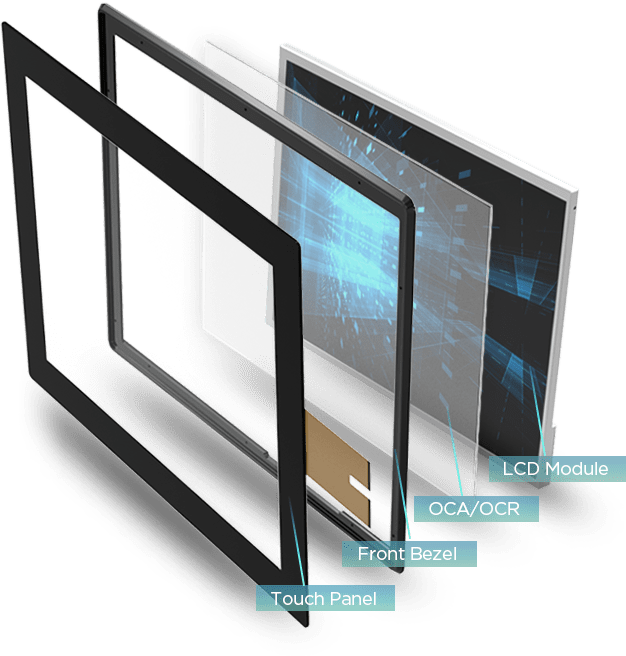
By filling the air gap between the LCD and cover glass with OCA or LOCA adhesive, optical bonding can:
-
Reduce internal reflections
-
Improve sunlight readability
-
Increase perceived contrast
-
Reduce dust and moisture intrusion into the bonding gap
-
Improve the structural integration of the display assembly
However, bonding quality depends on several factors, including glass flatness, dimensional accuracy, surface cleanliness, adhesive characteristics, and assembly conditions.
Excessive glass warpage may result in uneven adhesive thickness, air bubbles, edge lifting, or inconsistent bonding quality.
Chemically strengthened glass is often advantageous in thin cover glass applications because its manufacturing process generally introduces less thermal distortion.
For thicker tempered glass, flatness requirements should be evaluated carefully before selecting the bonding process.
At DINGTouch, cover glass selection is evaluated together with the LCD module, PCAP sensor, adhesive system, and overall mechanical structure to ensure compatibility throughout the assembly process.
4.3 Impact Resistance and IK Protection Requirements
For industrial touch displays, impact resistance is often a critical selection criterion.
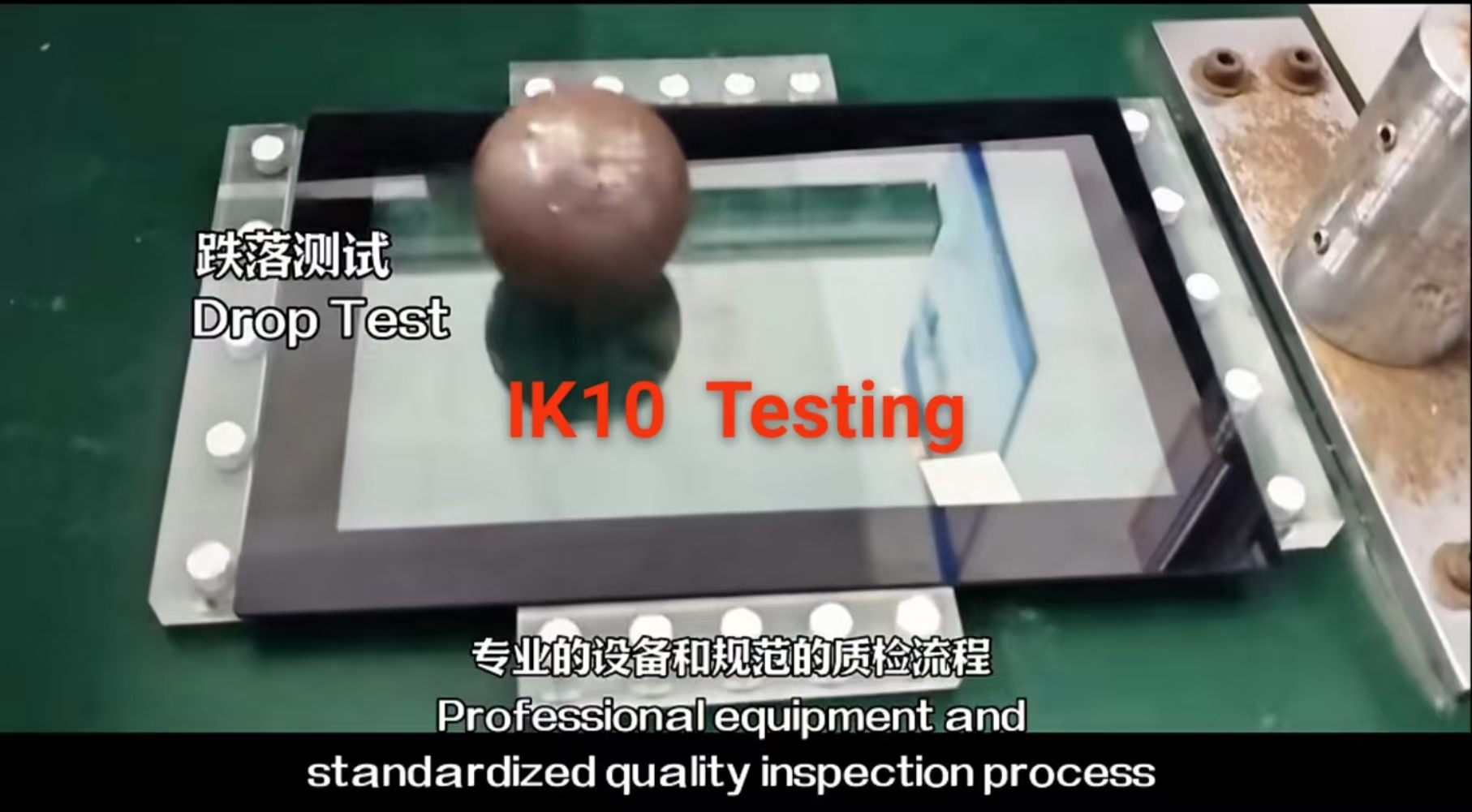
The IK rating system, defined by IEC 62262, classifies the resistance of electrical equipment enclosures against external mechanical impacts.
For example:
-
IK06: 1 J impact energy
-
IK07: 2 J impact energy
-
IK08: 5 J impact energy
-
IK09: 10 J impact energy
-
IK10: 20 J impact energy
An important distinction is that an IK rating applies to the tested equipment enclosure or assembly, not simply to the cover glass material.
The final result depends on multiple factors:
-
Glass material and thickness
-
Glass edge strength
-
Mounting and support structure
-
Adhesive and bonding method
-
Enclosure rigidity
-
Impact location and test conditions
For example, an industrial HMI designed for IK10 protection requires more than simply selecting thick tempered glass.
The cover glass, touch sensor, bonding structure, and housing must work together to withstand the specified impact conditions.
For applications involving repeated mechanical contact, accidental collisions, or public access, thicker protective glass and a properly engineered support structure may be necessary.
The correct approach is to establish the required IK target first and then validate the complete display assembly through testing.
4.4 Complex Shapes and Customized Designs
Modern industrial touch displays are no longer limited to conventional rectangular glass.
Many OEM projects require:
-
Rounded corners and irregular outlines
-
Customized mounting holes
-
Precision openings for buttons or sensors
-
Narrow bezels
-
Decorative printing and customized logos
-
Special dimensions for embedded equipment
Chemically strengthened glass offers good manufacturing flexibility for these designs because machining and shaping can be completed before the ion-exchange process.
Thermally tempered glass also supports customized geometries, but the design must account for minimum dimensions, edge distances, hole sizes, and thermal processing limitations.
All cutting, drilling, grinding, and edge finishing should be completed before the final strengthening process.
For customized industrial touchscreens, early design evaluation helps avoid unnecessary tooling changes and manufacturing difficulties.
4.5 Operating Environment and Surface Treatments
The operating environment also influences cover glass selection.
Different applications may require additional surface treatments and protective features.
| Requirement | Possible Solution |
|---|---|
| Fingerprint resistance | AF coating |
| Reduced surface reflection | AR coating |
| Reduced glare | AG treatment |
| Outdoor sunlight readability | High-brightness LCD + optical bonding + suitable AR/AG treatment |
| Chemical resistance | Suitable glass material and protective coating |
| Frequent cleaning | Chemical-resistant surface treatment |
| Water and dust exposure | Sealed enclosure and suitable touch configuration |
| High mechanical impact | Appropriate glass thickness and structural reinforcement |
For industrial and outdoor applications, AG, AR, and AF treatments can generally be considered with both chemically strengthened and tempered glass.
However, coating compatibility, process sequence, adhesion, and durability should be confirmed with the glass manufacturer.
It is also important to distinguish between glass protection and complete product protection. Waterproof performance, for example, depends on the entire enclosure, sealing structure, connectors, and assembly process rather than the cover glass alone.
4.6 Manufacturing Cost and Long-Term Reliability
Cost is another important consideration during product development.
Tempered glass generally has a mature and cost-effective manufacturing process for suitable designs.
Chemically strengthened glass typically involves longer processing cycles and tighter process control, which may increase manufacturing costs.
However, the lowest material price does not always produce the lowest overall project cost.
For example:
-
Better flatness may improve optical bonding yield.
-
Greater design flexibility may simplify customized product development.
-
More suitable impact protection may reduce field failures.
-
Correct glass selection may reduce redesign and testing costs.
For OEM/ODM projects, the total cost should include material, processing, assembly yield, testing, and long-term reliability.
 5. Which Type of Cover Glass Is Better for Different Applications?
Different industries have different mechanical and optical requirements. The preferred strengthening method should therefore be selected according to the actual application.
| Application | Typical Consideration | Initial Recommendation |
|---|---|---|
| Industrial HMI | Thin glass, touch sensitivity, durability | Chemical strengthening |
| Medical equipment | Optical clarity, cleaning, precise bonding | Chemical strengthening |
| Automotive displays | Slim design, optical quality, dimensional stability | Chemical strengthening |
| Outdoor kiosks | Impact resistance, vandal resistance | Evaluate thicker tempered glass |
| Public self-service terminals | Mechanical protection and breakage behavior | Evaluate tempered glass |
| Industrial control panels | Glass thickness and IK requirements | Application-dependent |
| Marine displays | Water exposure, sunlight readability, impact protection | Application-dependent |
| Heavy-duty equipment | Thick protective glass and mechanical loading | Evaluate tempered glass |
These recommendations are starting points, not mandatory material specifications.
For example, an outdoor industrial display does not automatically require tempered glass. A chemically strengthened solution may also be suitable if its thickness, mechanical structure, and test results meet the project requirements.
Similarly, medical equipment does not always require chemically strengthened glass. The final decision depends on the required mechanical protection, cleaning conditions, and assembly design.
6. How DINGTouch Approaches Customized Cover Glass Solutions
At DINGTouch, cover glass selection is considered part of the complete touch display development process.
As an industrial touch display manufacturer with 15 years of customization experience, we support OEM/ODM projects requiring integrated display, touch sensor, cover glass, and optical bonding solutions.
Rather than selecting glass based on thickness alone, we evaluate the interaction between the glass, touch sensor, LCD module, adhesive, and mechanical enclosure.
Our customization capabilities include:
1. Customized Cover Glass
-
Customized dimensions and thickness
-
Rectangular, circular, and irregular shapes
-
Precision cutouts and mounting holes
-
Customized logo and silk-screen printing
-
AG, AR, and AF surface treatments
2. Industrial Capacitive touchscreen
-
G+G and G+F+F structures
-
Customized PCAP sensor designs
-
Multi-touch functionality
-
Water-resistant touch solutions
-
Glove-touch configurations
-
EMI/EMC optimization
3. Optical Bonding and Display Integration
-
OCA and LOCA full lamination
-
LCD + PCAP + cover glass integration
-
Customized optical bonding structures
-
High-brightness industrial display solutions
-
Wide-temperature display assemblies
4. Mechanical and Environmental Optimization
-
IP65/IP67-oriented design solutions
-
IK08/IK10 impact protection development
-
Thick cover glass configurations
-
Wide-temperature operation
-
Customized mounting and enclosure compatibility
Our engineering team can evaluate the customer's drawings, mechanical structure, display specifications, and operating environment to recommend a suitable cover glass solution.
The objective is to achieve the right balance between mechanical protection, touch performance, optical quality, manufacturing feasibility, and cost.
7. Conclusion: Choose Glass Based on Application Requirements, Not Just Strength
Chemically strengthened glass and thermally tempered glass both play important roles in modern touch display manufacturing.
Chemically strengthened glass is generally a strong choice for thin cover glass designs, precision dimensions, optical bonding, and customized industrial touch interfaces.
Tempered glass is often advantageous for thicker constructions where impact resistance and granular breakage behavior are important considerations.
However, neither process is universally superior.
The right solution depends on glass thickness, surface quality, mechanical loading, edge design, bonding requirements, operating environment, and the overall enclosure structure.
For industrial touch display projects, the most reliable approach is to evaluate cover glass together with the complete display assembly rather than treating it as an independent component.
Looking for a customized cover glass or industrial touchscreen solution?
DINGTouch provides customized capacitive touchscreens, cover glass, LCD touch display assemblies, and OCA/LOCA optical bonding solutions for industrial, medical, automotive, and outdoor applications.
Contact DINGTouch to discuss your project requirements and develop a suitable glass and touch display solution.
Website: www.szdingtouch.com
Email: sales@szdingtouch.com
 8. Frequently Asked Questions (FAQ)
Q1. Is chemically strengthened glass stronger than tempered glass?
Neither is universally stronger. Chemical strengthening creates surface compression through ion exchange, while thermal tempering creates a compressive surface layer through controlled heating and rapid cooling.
Their mechanical performance depends on glass composition, thickness, surface condition, edge quality, and strengthening parameters.
Q2. Which glass is better for industrial touchscreen?
Chemically strengthened glass is often preferred for thin industrial touchscreens requiring good flatness, precision dimensions, and optical bonding.
Tempered glass may be more suitable for thicker structures requiring particular impact resistance and breakage characteristics.
The final choice depends on the application and test requirements.
Q3. Can chemically strengthened glass be used for IK10 touch displays?
Potentially, yes. However, IK10 compliance cannot be determined by the glass strengthening method alone.
Glass thickness, mounting structure, edge support, adhesive, enclosure rigidity, and complete assembly performance must all be evaluated and tested.
Q4. Can tempered glass be used for optical bonding?
Yes. Tempered glass can be used for OCA or LOCA optical bonding when its flatness, dimensions, surface condition, and assembly tolerances meet the bonding requirements.
Q5. Can chemically strengthened glass be made thicker than 3 mm?
Yes. Chemical strengthening is not limited to glass below 3 mm. Thicker glass can also undergo ion-exchange strengthening, depending on material composition and manufacturing capability.
Q6. Can AG, AR, and AF coatings be applied to strengthened glass?
Generally, yes. Both chemically strengthened and tempered glass can be combined with AG, AR, and AF treatments.
However, the manufacturing sequence and coating compatibility should be confirmed to avoid compromising surface quality and mechanical performance.
Q7. Does thicker cover glass reduce touchscreen sensitivity?
It can. Increasing the distance between the finger and the touch sensor generally reduces capacitive coupling, potentially affecting touch sensitivity.
For thick cover glass applications, PCAP sensor design, controller selection, firmware tuning, and touch sensitivity optimization should be evaluated together.
Q8. Can DINGTouch customize cover glass for industrial touch displays?
Yes. DINGTouch supports customized cover glass dimensions, thicknesses, shapes, cutouts, printing, and AG/AR/AF treatments, as well as G+G touchscreens, LCD integration, and OCA/LOCA optical bonding.
Customers can provide drawings, glass specifications, or application requirements for engineering evaluation.
Ready to Build Your Outdoor Display Solution?
Get in touch with us at sales@szdingtouch.com. Our expert engineers will help you design a cost-effective, tailored solution to meet your project’s exact specifications.
DINGTouch:Committed to continuous innovation and improvement of product quality to meet customers' high requirements and expectations.
DINGTouch is a manufacturer that provides high quality touch screen panels. Focus on the design, manufacturing and sales of touch screen panels, and are committed to providing customized solutions that satisfy customers.
DINGTouch: In the process of customizing touch screen panels, we focus on close cooperation and communication with customers. Understanding customers' needs and providing customized solutions will meet customers' individual needs. The company's products are favored by customers for their high quality and reliability, and provide them with the best touchscreen panel solutions.
DINGTouch is a company specializing in the R&D and production of touch screen technology, headquartered in Shenzhen, China. As a professional touch screen supplier, DINGTouch is committed to providing high-quality, stable and reliable touch screen products to meet the diverse needs of customers. We continue to carry out technological innovation and product optimization to ensure that its touch screen products have good sensitivity, accuracy and durability.
In addition to the products themselves, we also focus on cooperation and communication with customers, and are committed to providing customized solutions and excellent after-sales services. Through continuous efforts to improve product quality and customer satisfaction, we have established a good reputation in the touchscreen industry and won widespread market recognition.




CATEGORIES
CONTACT US
Contact: Dingtouch
Phone: +8615815536116
Tel: +8615815536116
Email: sales@szdingtouch.com
Add: Building A, Bailu Plaza, No. 48, Gonghe Industrial Road, Gongle Community, Xixiang Street, Baoan District, Shenzhen,China. 518126
 Dingtouch