News
Marine Industrial LCD Display Selection Guide: Key Requirements for Shipboard Equipment
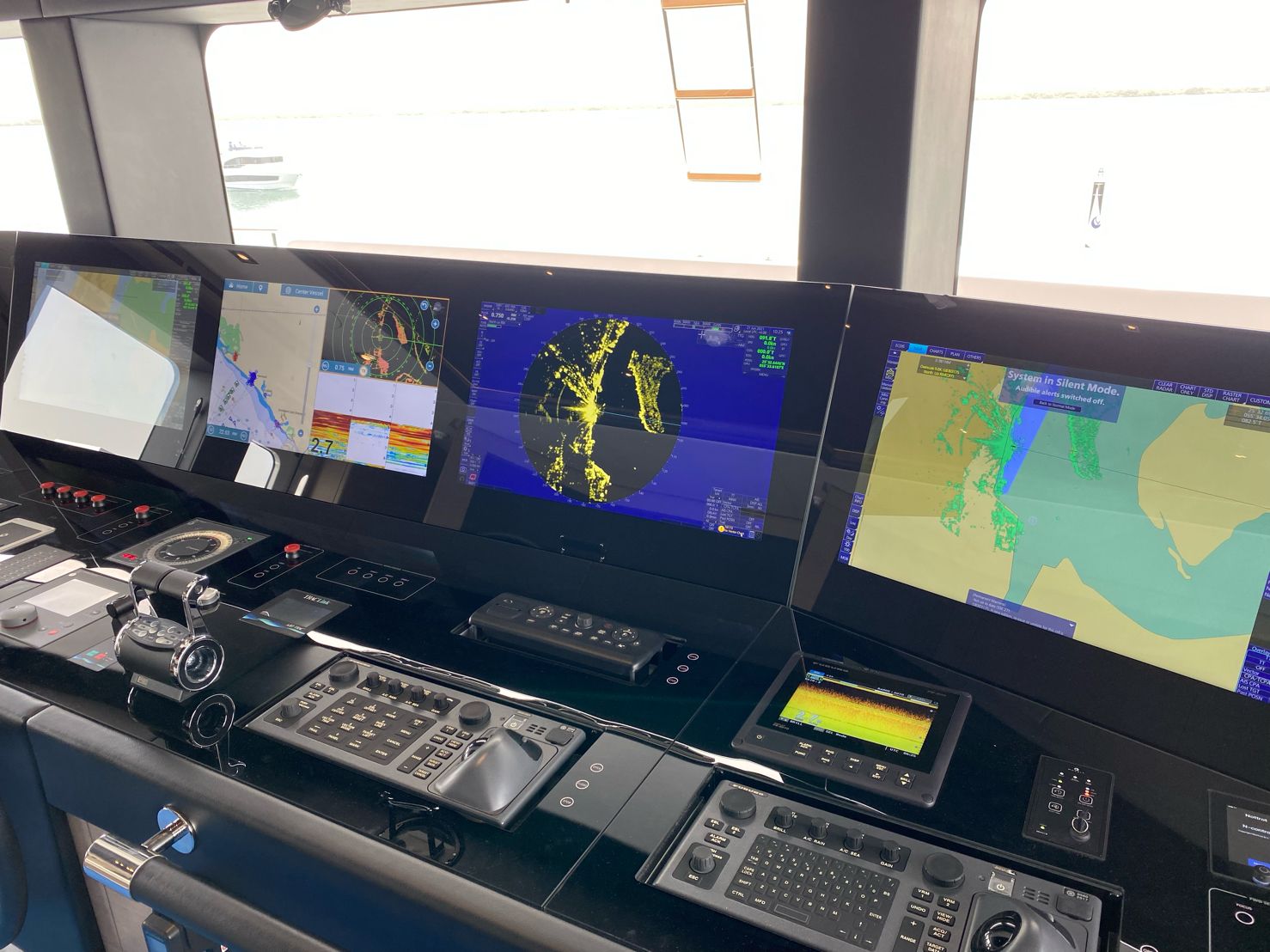
Marine Industrial LCD Display Selection Guide: Key Requirements for Shipboard Equipment
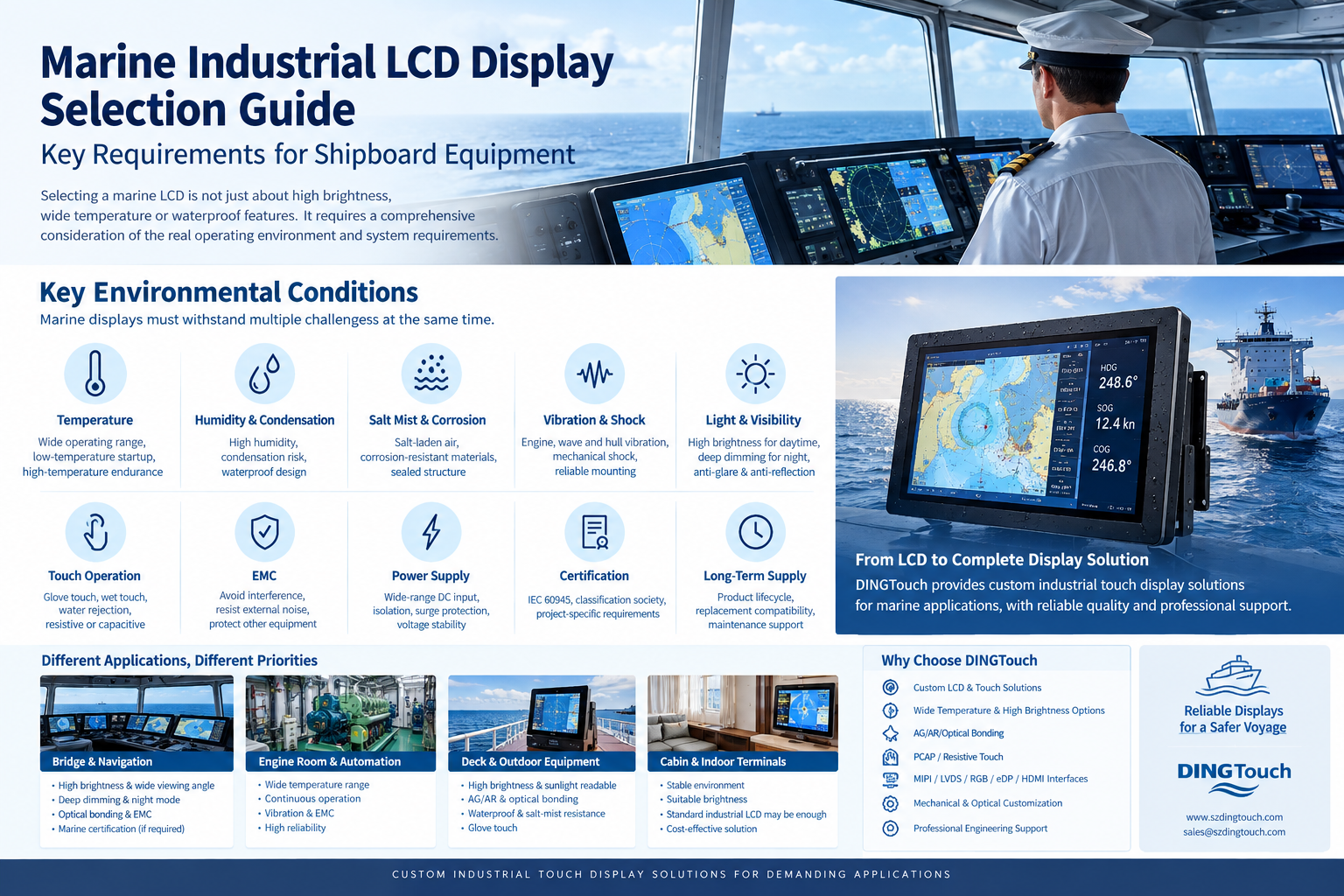
Selecting an LCD display for marine equipment is not as simple as choosing a screen with wide temperature, high brightness, and waterproof features.
Marine displays may be installed in very different locations, including bridge consoles, engine rooms, deck equipment, control cabinets, monitoring terminals, and outdoor operator panels. Each environment can impose different requirements for brightness, temperature range, moisture resistance, vibration resistance, touch operation, EMC, and long-term reliability.
For this reason, marine LCD selection should start with the actual operating environment and system requirements, rather than simply searching for a generic “marine LCD.”
Depending on the application, a marine display may need to consider:
- Wide operating and storage temperature
- High humidity and condensation
- Salt mist and corrosion
- Vibration and mechanical shock
- Strong daylight and reflections
- Night-time low-brightness operation
- Glove and wet-touch operation
- Optical bonding and anti-reflective treatment
- EMC and electrical interference
- Wide-range DC power input
- Long-term product availability
- IEC 60945, classification society, or project-specific requirements
Most importantly, an industrial LCD specification and a certified marine display are not the same thing. A panel with suitable industrial environmental specifications does not automatically mean that the complete equipment is certified for marine use.
 1. What Makes the Marine Environment Different?
Marine equipment operates in an environment where several stresses can occur simultaneously.
A typical shipboard environment may combine:
- High humidity
- Salt-containing air
- Temperature fluctuations
- Condensation
- Continuous vibration
- Strong sunlight
- Limited ventilation
- Electrical noise from motors and power systems
- Long periods of continuous operation
The combination of moisture + salt + temperature changes is particularly important.
Salt and moisture can increase the risk of corrosion on connectors, PCBs, metal structures, exposed conductive components, and other parts of the display system. Temperature differences between indoor and outdoor areas can also create condensation inside equipment.
Therefore, marine LCD design should not focus only on the LCD panel itself.
A complete display solution may need to combine:
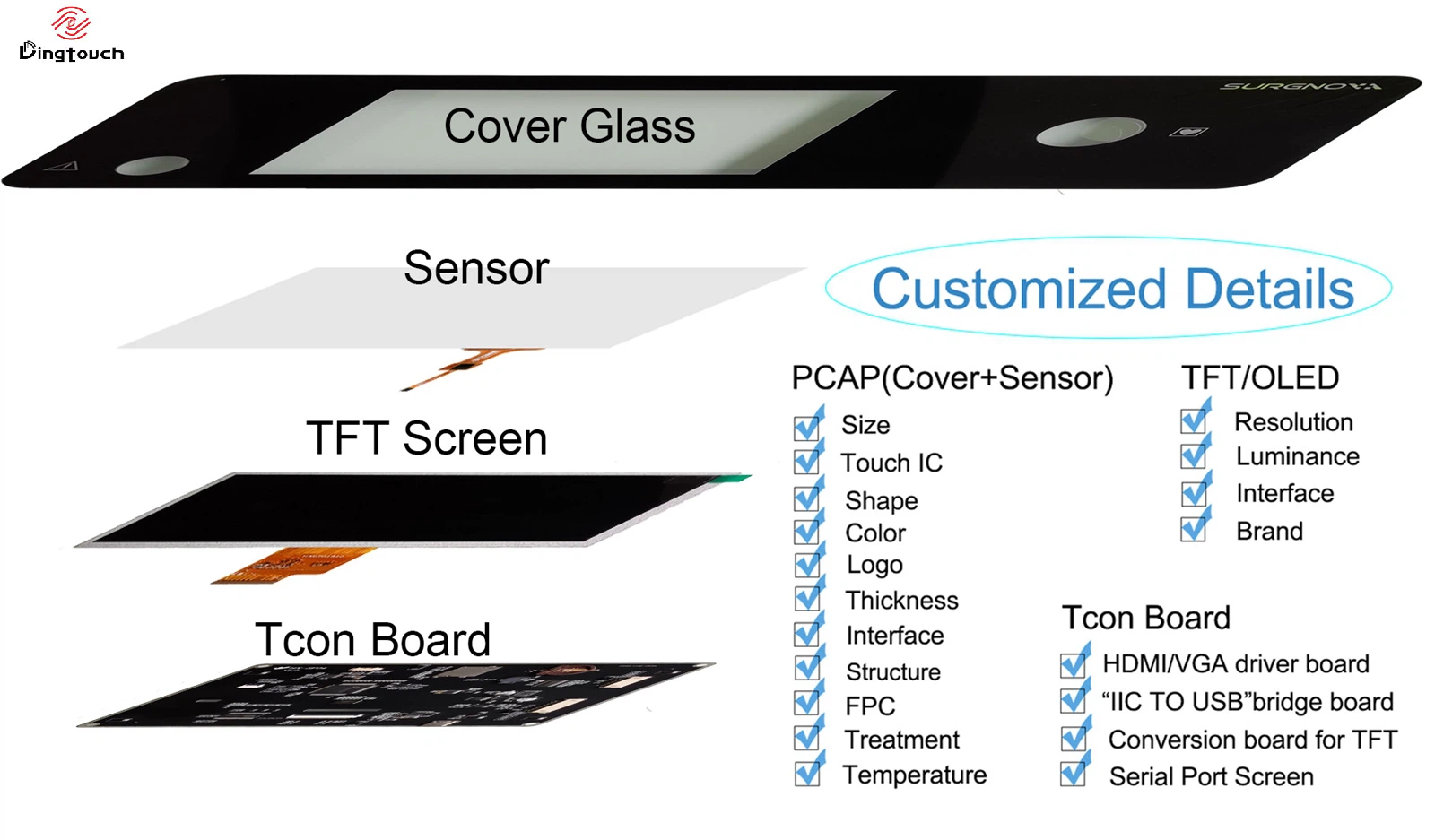
LCD + touch panel + cover glass + optical bonding + controller board + power system + enclosure + sealing + EMC design
This is why the environmental specification of the LCD module and the IP rating of the final equipment should always be evaluated separately.
2. Operating Temperature: Select According to Installation Location
A common mistake in industrial display procurement is assuming that every marine LCD must operate at an extremely wide temperature range such as -30°C to +85°C.
In reality, the required temperature range depends heavily on where the display is installed.
Bridge and Control Room
Displays installed inside an air-conditioned bridge or control room may experience relatively stable temperatures.
In these applications, engineers may place greater emphasis on:
- Brightness control
- Wide viewing angle
- Display uniformity
- Long-term operation
- Touch reliability
- EMC performance
Engine Room
Displays installed near engines, generators, or other heat-producing equipment may experience significantly higher ambient temperatures.
The system should therefore consider:
- High-temperature operation
- Heat dissipation
- Backlight lifetime
- Driver board temperature
- Connector reliability
- Continuous operation
Deck and Outdoor Equipment
Outdoor marine equipment may experience both high and low temperatures, as well as direct sunlight, humidity, rain, and wind.
In these applications, a wider temperature specification may be required, together with appropriate enclosure and sealing design.
Cold-Climate Marine Applications
For ships operating in cold regions, low-temperature startup can be more important than simply specifying a wide operating range.
At low temperatures, LCD response can become slower, while adhesives, cables, touch controllers, and other components may also behave differently.
Therefore, engineers should evaluate the temperature range of the complete display assembly, not just the LCD panel.
Key point: A -30°C to +80°C LCD does not automatically mean that the entire display system can operate reliably from -30°C to +80°C.
The touch panel, controller, FPC, cable, bonding materials, backlight, power supply, and enclosure should also be evaluated.
3. High Brightness Is Important—but Night-Time Dimming Matters Too
Marine bridge displays face a unique optical challenge.
During the daytime, sunlight and reflections from the sea can make the display difficult to read. At night, however, excessive brightness can interfere with the operator's dark adaptation.
This means that marine display design should not simply pursue the highest possible brightness.
For example, a display may require:
- High brightness for daytime operation
- Anti-glare treatment
- Anti-reflective treatment
- Wide viewing angles
- Smooth brightness adjustment
- Very low brightness for night operation
- Day / Dusk / Night display modes
For bridge, navigation, and outdoor marine applications, brightness adjustment range can be just as important as maximum brightness.
A 1,000-nit display that cannot be dimmed sufficiently may not be suitable for every bridge application.
4. Sunlight Readability Requires More Than a High-Brightness Backlight
For outdoor marine displays, increasing the backlight brightness is only part of the solution.
Light can reflect from multiple interfaces within the display structure, including the cover glass, touch panel, LCD surface, and air gaps.
A conventional air-gap structure may therefore still produce significant reflections even when the LCD provides 800 or 1,000 cd/m² brightness.
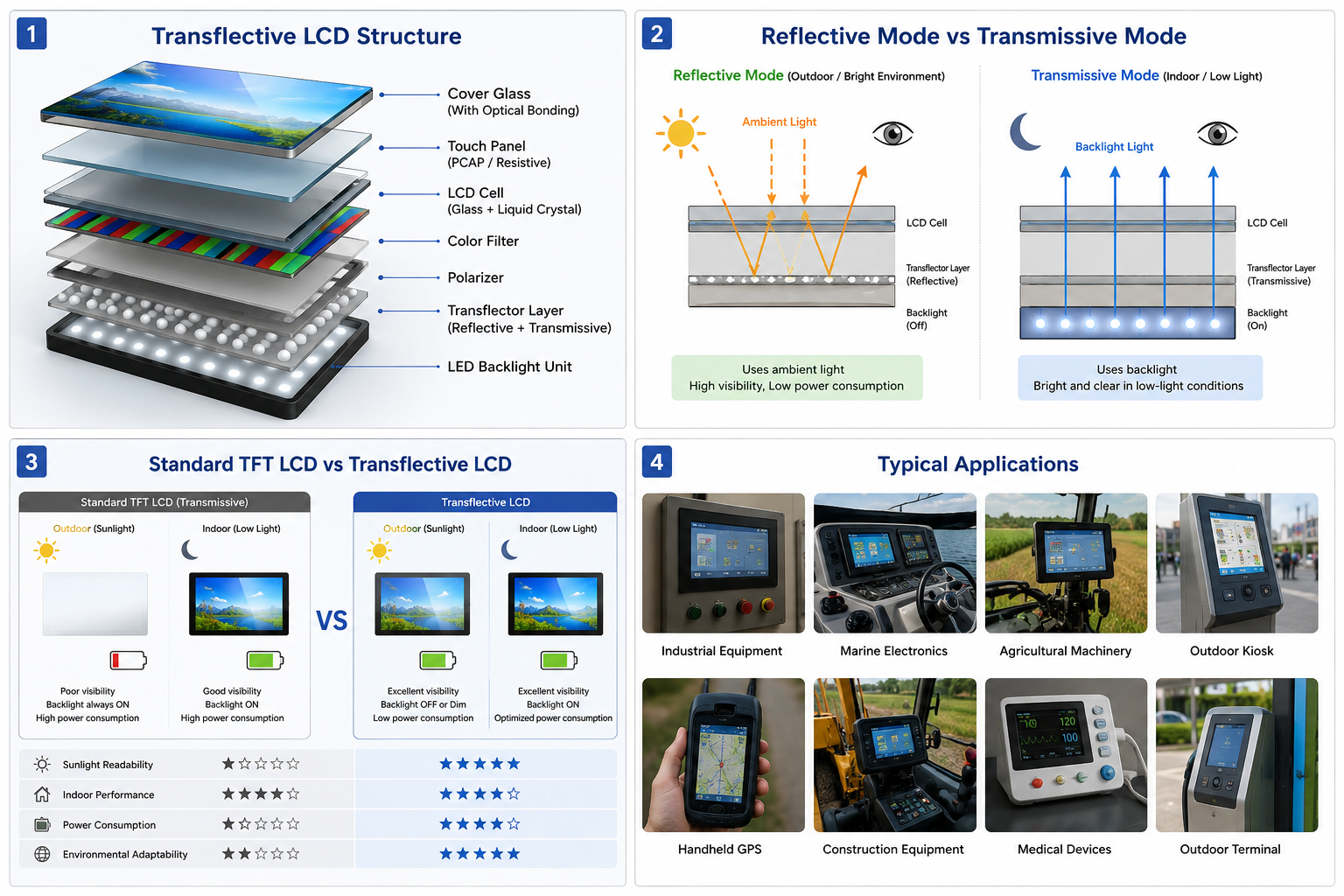
A more complete sunlight-readable solution may combine:
High-Brightness LCD
A high-brightness backlight improves visibility under strong ambient light.
Anti-Glare (AG)
AG treatment reduces distracting reflections caused by external light sources.
Anti-Reflective (AR)
AR treatment helps reduce optical reflection and improve contrast in bright environments.
Optical Bonding
Optical bonding eliminates the air gap between display layers.
A typical structure can be:
Cover Glass → Touch Panel → Optical Adhesive → LCD
Compared with an air-gap structure, optical bonding can reduce internal reflections and improve perceived contrast.
It can also help prevent dust and moisture from accumulating between display layers.
For marine applications exposed to sunlight, therefore, the better question is not:
“Does the LCD have 1,000 nits?”
but rather:
“Can the complete display remain readable under the actual marine lighting conditions?”
5. Humidity, Condensation, and Salt Mist Need Special Attention
Marine environments contain high levels of moisture and salt.
Over time, these conditions can contribute to:
- Metal corrosion
- Connector oxidation
- PCB contamination
- Electrical leakage
- Touch malfunction
- Housing degradation
- Reduced long-term reliability
Condensation can be particularly problematic.
When warm and humid air enters equipment and the internal temperature falls below the dew point, moisture may form inside the system.
Therefore, marine display design may need to consider:
- Sealed front structures
- Appropriate enclosure design
- Corrosion-resistant materials
- Protected connectors
- Conformal coating where appropriate
- Waterproof membrane or sealing solutions
- Anti-condensation design
- Appropriate IP protection for the final enclosure
It is important to distinguish between LCD environmental specifications and IP protection.
An LCD module rated for -20°C to +70°C does not automatically have IP65 or IP67 protection.
The IP rating normally applies to the complete enclosure or equipment structure, depending on how the equipment is tested.
6. Vibration and Shock: The Display Structure Matters
Ships continuously experience mechanical vibration generated by:
- Engines
- Generators
- Propulsion systems
- Pumps
- Fans
- Mechanical equipment
- Waves and hull movement
The LCD glass itself is only one part of the system that must withstand these conditions.
Engineers should also examine:
- FPC connections
- LVDS/eDP/MIPI cables
- Backlight wiring
- Touch-panel connections
- Controller boards
- Connectors
- Mounting brackets
- Screws and mechanical fasteners
- Structural stress around the LCD
A display with identical size, resolution, and interface may still behave differently if the mechanical mounting structure is changed.
For marine equipment replacement projects, engineers should therefore confirm not only the electrical specifications but also the mechanical mounting method and connector reliability.
For equipment subject to formal marine approval, applicable environmental testing requirements should be checked according to the equipment category and project specification.
7. Does a Marine touchscreen Need PCAP?
Modern marine equipment increasingly uses touch interfaces, but marine touchscreens face different conditions from consumer electronics.
Operators may need to use the display while wearing:
- Work gloves
- Protective gloves
- Winter gloves
The screen may also be exposed to:
- Water droplets
- Rain
- Salt water
- Oil
- Dirt
- Cleaning fluids
Therefore, choosing between PCAP and resistive touch should be based on the actual operating environment.
PCAP touchscreen
Projected capacitive touch can provide:
- Multi-touch
- High optical clarity
- Modern user interface experience
- Glove-touch capability when properly designed
- Water rejection when appropriately configured
However, engineers should confirm the actual performance rather than assuming every PCAP touchscreen supports gloves and water.
Important parameters include:
- Glove mode
- Water rejection
- Touch sensitivity
- Cover-glass thickness
- Touch controller
- EMI resistance
- Salt-water exposure
- Touch performance at low temperatures
Resistive touchscreen
Resistive touch remains useful for certain industrial and marine applications.
It can be considered when:
- Operators mainly use heavy gloves
- Multi-touch is unnecessary
- Simple button-style interaction is sufficient
- High touch reliability is more important than a smartphone-like interface
The choice should therefore be based on the operator, environment, and application, rather than simply assuming that PCAP is always better.
8. EMC Is a Critical Part of Marine Display Design
Marine equipment often operates alongside:
- Radar systems
- Radio communication equipment
- Navigation systems
- Motors
- Inverters
- Power converters
- Engine control systems
- Other electronic equipment
This can create a complex electromagnetic environment.
A display system should be designed so that it can operate reliably in the intended electromagnetic environment without creating unacceptable interference with other equipment.
This may involve consideration of:
- PCB layout
- Grounding
- Shielding
- Cable routing
- Connector design
- Power filtering
- Interface protection
- Touch-controller selection
- Display driver design
For certain shipboard navigation and radio-related equipment, IEC 60945 can be an important applicable standard. However, the applicable requirements depend on the equipment category and project.
The important distinction is:
A component having suitable industrial specifications does not automatically mean the finished marine equipment meets IEC 60945 or classification requirements.
Compliance should be evaluated at the appropriate equipment/system level according to the applicable project requirements.
9. Do Not Connect a Marine LCD Directly to 12V or 24V Without Checking
Shipboard power systems are not necessarily compatible with the power requirements of a bare LCD module.
A TFT LCD may require different voltages for:
- Logic
- Backlight
- Touch controller
- Display driver
- Interface circuitry
Depending on the module, these may involve 3.3V, 5V, 12V, or other requirements.
Meanwhile, the ship's power system may experience:
- Voltage fluctuations
- Electrical transients
- Switching noise
- Different DC input ranges
Therefore, a complete marine display system may require:
- DC/DC conversion
- Input filtering
- Surge protection
- Reverse-polarity protection
- Isolation where required
- Stable backlight power
- Appropriate grounding
For example, some marine display architectures use wide-range DC inputs such as 9–36VDC.
The key principle is simple:
“LCD operating voltage” and “ship power input” are two different specifications.
The power architecture between them must be designed appropriately.
10. Different Marine Applications Require Different LCD Specifications
There is no single LCD specification that is ideal for every shipboard application.
Bridge and Navigation Displays
Typical priorities may include:
- High daylight readability
- Wide viewing angle
- Low-brightness night operation
- Smooth dimming
- Display consistency
- Optical bonding
- Touch reliability
- EMC
- Applicable marine standards
For navigation-related systems such as ECDIS, additional display and equipment requirements may apply depending on the system and applicable regulations.
Engine Room and Automation Displays
Typical priorities include:
- Wide temperature range
- Continuous operation
- Vibration resistance
- EMC
- Long-term reliability
- Appropriate brightness
- Easy maintenance
Extremely high brightness may not always be necessary.
Outdoor Deck Equipment
Outdoor equipment may require:
- High brightness
- Sunlight readability
- AR/AG treatment
- Optical bonding
- Waterproof enclosure
- Salt-mist resistance
- Wide temperature operation
- Glove touch
- Water rejection
Cabin and Indoor Information Terminals
For indoor equipment with controlled environmental conditions, a standard industrial LCD with suitable temperature, brightness, and reliability specifications may be sufficient.
There is no need to automatically specify every possible high-end feature.
11. Long-Term Supply Is Also Part of Marine LCD Reliability
Marine equipment often has a much longer service life than consumer electronics.
A shipboard control or monitoring system may need to remain maintainable for many years, while LCD models can have shorter commercial lifecycles.
When an LCD becomes obsolete, replacing it with another panel is not always straightforward.
A new LCD may have a different:
- Mechanical size
- Active area
- Connector position
- FPC structure
- Resolution
- Interface
- Timing specification
- Touch structure
- Backlight voltage
- Optical performance
This can force changes to the PCB, cable, mechanical housing, software, or user interface.
For long-life marine projects, it is therefore useful to evaluate:
- Product lifecycle
- Long-term availability
- Stable component sourcing
- Compatible replacement options
- Engineering support
- Custom LCD capability
- Sample and prototype support
- Documentation control
Supply-chain continuity is part of long-term equipment reliability.
12. Marine LCD Selection Checklist
Before selecting an LCD for a marine equipment project, engineers and purchasing teams can use the following checklist.
| Selection Item | Questions to Confirm |
|---|---|
| Installation | Bridge, engine room, deck, cabin, or outdoor? |
| Temperature | What are the actual minimum and maximum temperatures? |
| Humidity | Is high humidity or condensation expected? |
| Salt Mist | Is the equipment exposed to marine air or salt water? |
| Brightness | Indoor, daylight, or direct sunlight? |
| Night Operation | Is deep dimming required? |
| Optical Design | Is AG, AR, or optical bonding required? |
| Viewing Angle | How many operators need to view the screen? |
| Touch | Gloves, water, oil, or bare fingers? |
| Vibration | Is the display close to engines or mechanical equipment? |
| Protection | What IP level is required for the complete enclosure? |
| EMC | Is the equipment located near radio, radar, motors, or inverters? |
| Power | What is the actual shipboard input voltage and transient condition? |
| Certification | Are IEC 60945, classification society, or project-specific requirements applicable? |
| Lifecycle | How will LCD replacement be handled over the next 5–10 years? |
13. Industrial LCD vs. Certified Marine Display: Do Not Confuse the Two
One of the most important points in marine display procurement is the distinction between environmental suitability and formal certification.
An industrial LCD may offer:
- -30°C to +80°C operation
- High brightness
- Wide viewing angle
- PCAP touch
- Optical bonding
- Glove touch
- High-transmittance cover glass
These specifications may make the display suitable for integration into certain marine equipment.
However, that does not automatically mean that the final equipment has marine certification.
Whether certification is required depends on factors such as:
- Equipment type
- Intended function
- Vessel type
- Flag-state requirements
- Classification society
- Project specification
- Applicable standards
Therefore, certification requirements should be confirmed before the display architecture is finalized.
14. How DINGTouch Supports Custom Marine LCD Projects
For marine equipment manufacturers and system integrators, the display is often only one part of a larger customized solution.
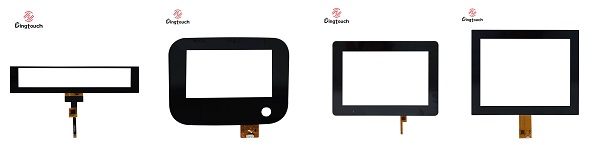
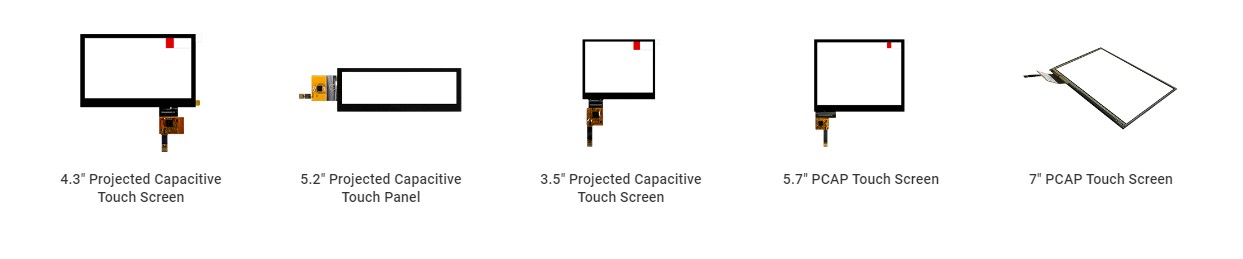
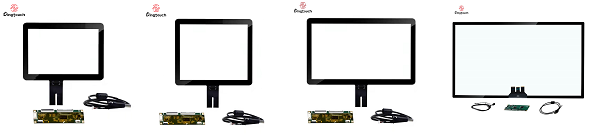
DINGTouch provides custom industrial touch display solutions for applications where standard LCD modules may not fully match the mechanical, optical, electrical, or environmental requirements.
Depending on the project, the display solution can be customized around:
- LCD size and resolution
- Brightness
- Wide-temperature operation
- PCAP touch
- Glove touch
- Water-rejection touch
- Cover glass
- AG / AR / AF surface treatment
- Optical bonding
- MIPI / LVDS / RGB / eDP / HDMI interfaces
- FPC and connector configuration
- Controller boards
- Mechanical dimensions
- Custom-shaped displays
For marine applications, the engineering evaluation should begin with the actual installation environment rather than a generic product category.
The project team can first define the required temperature, brightness, optical structure, touch conditions, mechanical dimensions, interfaces, power architecture, EMC requirements, and applicable certification requirements, and then determine the appropriate LCD and touch configuration.
Conclusion: Choose the Marine Display Around the Real Operating Environment
The real requirement for a marine LCD is not simply having one extremely high specification.
A reliable marine display needs to maintain stable and readable operation under the actual combination of:
salt mist + humidity + temperature changes + vibration + sunlight + night operation + touch interaction + electromagnetic interference + long-term operation.
For an indoor engine-room control terminal, a properly selected wide-temperature industrial LCD may be sufficient.
For bridge equipment, navigation terminals, or outdoor marine displays, the design may need to go further with:
- High brightness
- Deep dimming
- AR/AG optical treatment
- Optical bonding
- Glove and wet-touch capability
- Corrosion protection
- Wide-temperature design
- EMC considerations
- Applicable marine standards and certification
Most importantly, “suitable for the marine environment” and “marine-certified equipment” are not the same statement.
The correct approach is to start with the actual operating environment and system requirements, then select the LCD, touch panel, bonding structure, controller, power system, enclosure, and compliance strategy as a complete solution.
For marine equipment manufacturers looking for a customized industrial LCD or PCAP touch display, DINGTouch can evaluate the display requirements based on the intended application, installation environment, interface, mechanical constraints, and expected operating conditions.
DINGTouch — Custom Industrial Touch Display Solutions for Demanding Applications
Ready to Build Your Outdoor Display Solution?
Get in touch with us at sales@szdingtouch.com. Our expert engineers will help you design a cost-effective, tailored solution to meet your project’s exact specifications.
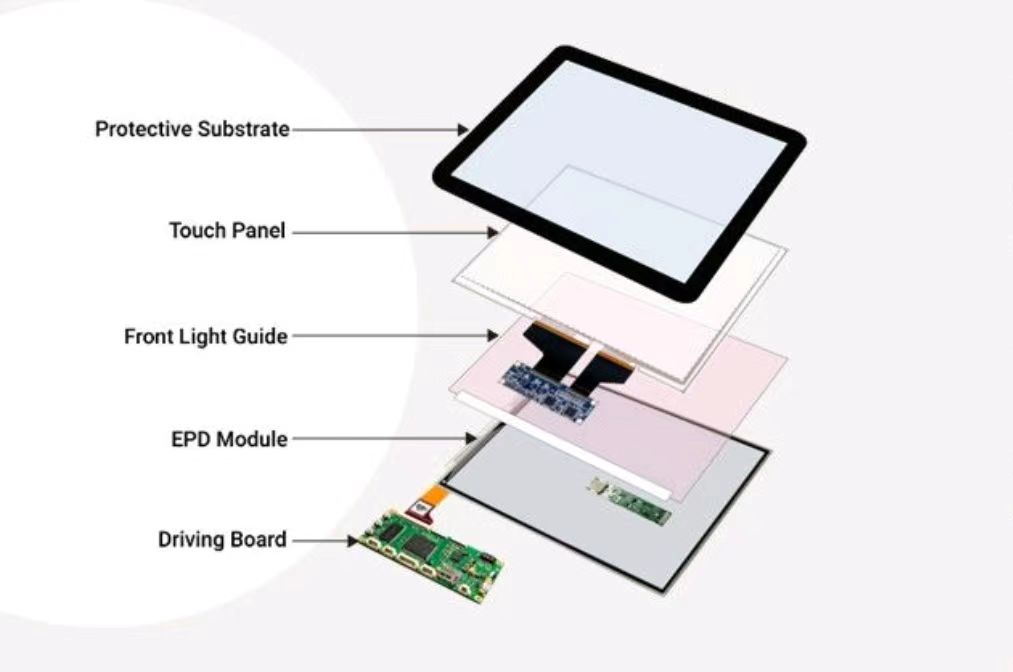
DINGTouch:Committed to continuous innovation and improvement of product quality to meet customers' high requirements and expectations.
DINGTouch is a manufacturer that provides high quality touch screen panels. Focus on the design, manufacturing and sales of touch screen panels, and are committed to providing customized solutions that satisfy customers.
DINGTouch: In the process of customizing touch screen panels, we focus on close cooperation and communication with customers. Understanding customers' needs and providing customized solutions will meet customers' individual needs. The company's products are favored by customers for their high quality and reliability, and provide them with the best touchscreen panel solutions.
DINGTouch:Committed to continuous innovation and improvement of product quality to meet customers' high requirements and expectations.
DINGTouch is a manufacturer that provides high quality touch screen panels. Focus on the design, manufacturing and sales of touch screen panels, and are committed to providing customized solutions that satisfy customers.
DINGTouch: In the process of customizing touch screen panels, we focus on close cooperation and communication with customers. Understanding customers' needs and providing customized solutions will meet customers' individual needs. The company's products are favored by customers for their high quality and reliability, and provide them with the best touchscreen panel solutions.
At DINGTOUCH, we are the world's leading touchscreen manufacturer, helping businesses around the world take advantage of this exciting technology. For more information, please visit the home page now.

DINGTouch is a company specializing in the R&D and production of touch screen technology, headquartered in Shenzhen, China. As a professional touch screen supplier, DINGTouch is committed to providing high-quality, stable and reliable touch screen products to meet the diverse needs of customers. We continue to carry out technological innovation and product optimization to ensure that its touch screen products have good sensitivity, accuracy and durability.
In addition to the products themselves, we also focus on cooperation and communication with customers, and are committed to providing customized solutions and excellent after-sales services. Through continuous efforts to improve product quality and customer satisfaction, we have established a good reputation in the touchscreen industry and won widespread market recognition.
In addition to the products themselves, we also focus on cooperation and communication with customers, and are committed to providing customized solutions and excellent after-sales services. Through continuous efforts to improve product quality and customer satisfaction, we have established a good reputation in the touchscreen industry and won widespread market recognition.
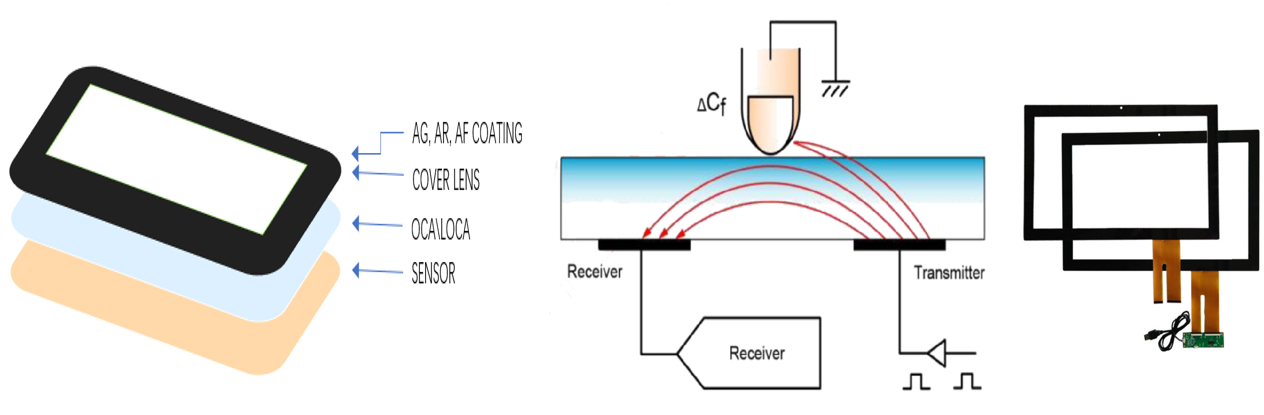
What DINGTOUCH can do:
• PCAP maximum size 65”
• Multi-touch (Touch screen can be customized to your needs.)
• Optical bonding service/air bonding
• LCD interface: HDMI/RGB/MIPI/LVDS/EDP, etc.
• PCAP interface: IIC/USB interface
• CTP can customize the cover glass surface treatment process AG (anti-glare), AR (anti-reflection), AF (anti-fingerprint), waterproof, and glove touch
• Supports 0.55 mm-12 mm coverslip touch.
• Support operating temperature: -40℃-90℃.
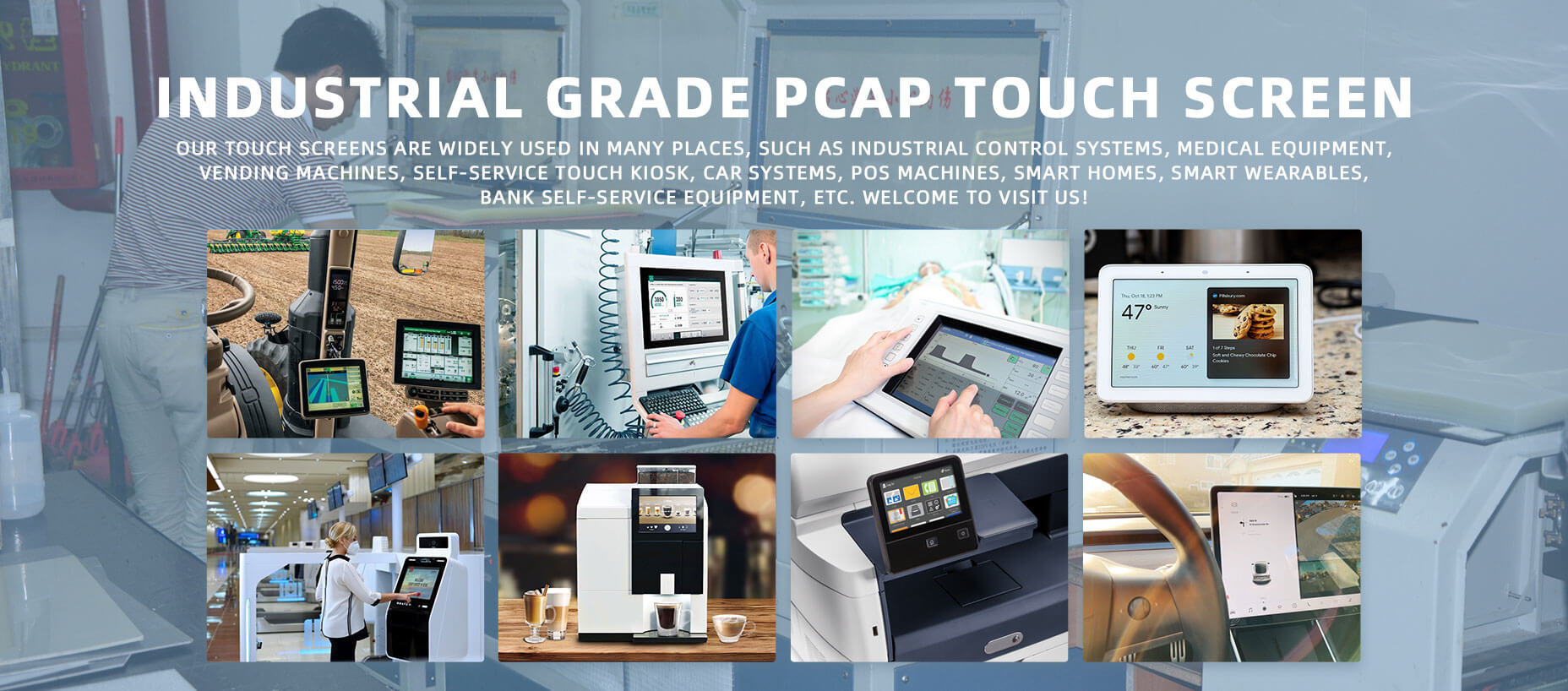
Dingtouch Industrial capacitive touch screen Manufacturer
In conclusion, Dingtouch as a professional touch screen manufacturer with more than 10 years touch screen experience.We have many capacitive touch screen . Such as 5 inch touch screen,7 inch touch screen,10.1inch touch screen,15 inch touch screen,15.6 inch touch screen,17 inch touch screen,18.5 inch touch screen,19 inch touch screen,21.5 inch touch screen,
CATEGORIES
CONTACT US
Contact: Dingtouch
Phone: +8615815536116
Tel: +8615815536116
Email: sales@szdingtouch.com
Add: Building A, Bailu Plaza, No. 48, Gonghe Industrial Road, Gongle Community, Xixiang Street, Baoan District, Shenzhen,China. 518126
 Dingtouch