News
IP65 vs IP66 vs IP67 vs IP68 vs IP69K: How to Choose the Right Protection Rating for Industrial Displays
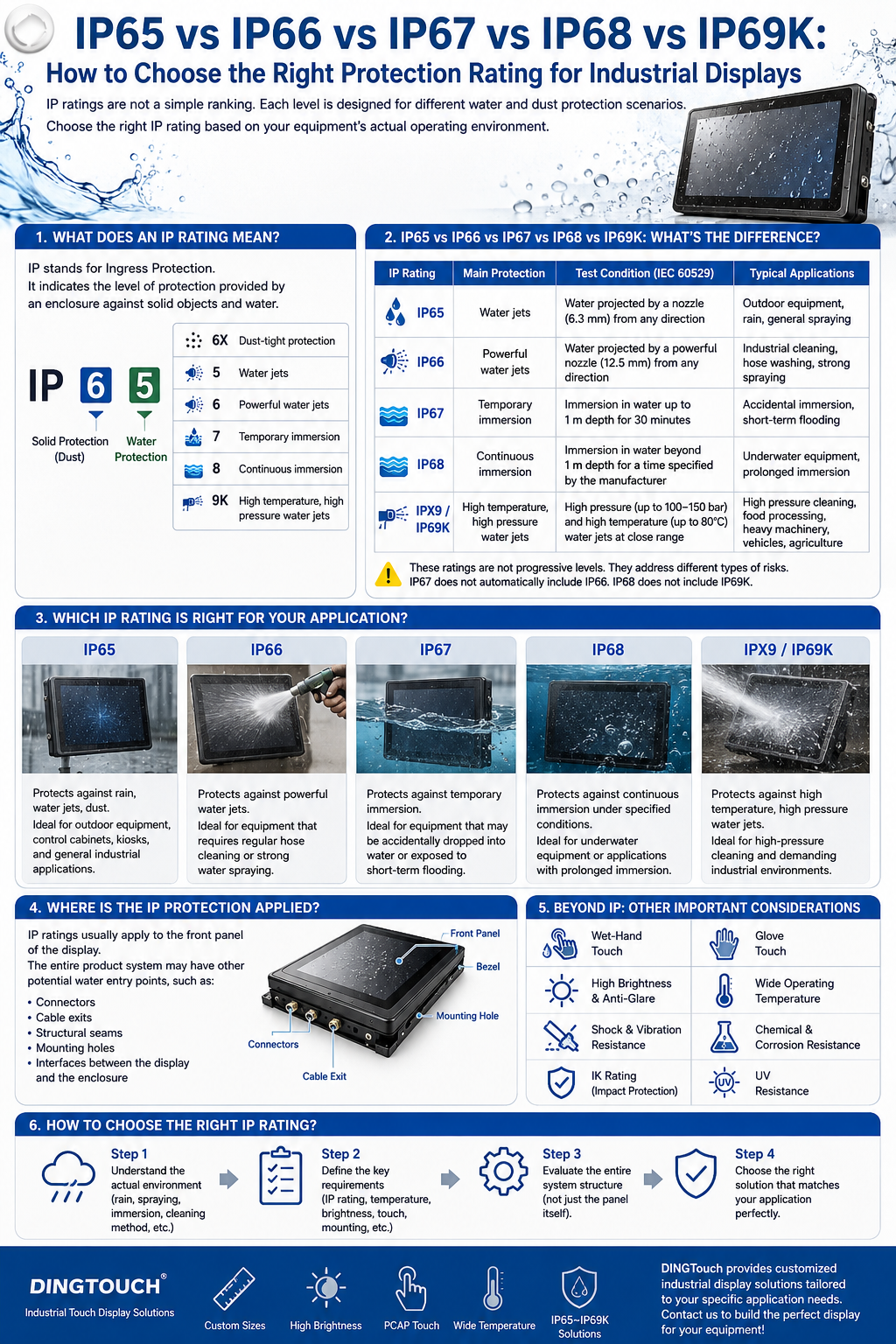 IP65 vs IP66 vs IP67 vs IP68 vs IP69K: How to Choose the Right Protection Rating for Industrial Displays
What is the difference between IP65, IP66, IP67, IP68, and IP69K? Does a higher number always mean better protection?
For industrial displays, dust and water protection is not simply a matter of whether protection is available or not. The appropriate IP rating should be selected according to the equipment’s actual operating environment, cleaning method, risk of water immersion, and installation structure.
Outdoor equipment may be exposed to rain and humidity. Factory equipment may encounter dust, oil, water vapor, and splashing. Food-processing equipment, agricultural machinery, and heavy-duty equipment may even need to be cleaned regularly with high-pressure water jets.
Therefore, when selecting an industrial display, the most important question is not:
“Which IP rating is the highest?”
It is:
“What kind of water, dust, and cleaning conditions will my equipment actually encounter?”
This article explains the differences between IP65, IP66, IP67, IP68, and IPX9/IP69K, and provides practical guidance for selecting the right IP protection level for industrial displays.
1. What Does an IP Rating Mean?
IP stands for Ingress Protection. An IP rating indicates the level of protection provided by an enclosure against solid foreign objects and water.
For example:
IP65
- The first digit “6” indicates the level of protection against solid foreign objects.
- The second digit “5” indicates the level of protection against water.
In general:
- IP6X — Focuses on dust protection
- IPX5 — Protection against water jets
- IPX6 — Protection against powerful water jets
- IPX7 — Protection against temporary immersion
- IPX8 — Protection against continuous immersion under manufacturer-specified conditions
- IPX9 — Protection against high-temperature, high-pressure water jets
Therefore, IP ratings should not be interpreted simply as a ranking where “the bigger the number, the better the waterproofing.”
IP65 and IP66 mainly address water jets; IP67 and IP68 focus on immersion; IPX9 focuses on high-temperature, high-pressure water jets.
Each rating corresponds to different test conditions and application scenarios.
2. What Is the Difference Between IP65, IP66, IP67, IP68, and IP69K?
Here is a quick comparison:
| Protection Rating | Main Protection | Typical Applications |
|---|---|---|
| IP65 | Water jet protection | Outdoor equipment, rain, general spraying |
| IP66 | Powerful water jet protection | Industrial cleaning, hose washing, strong spraying |
| IP67 | Temporary immersion protection | Accidental immersion, short-term flooding |
| IP68 | Continuous immersion under specified conditions | Underwater or prolonged immersion applications |
| IPX9 / IP69K | High-temperature, high-pressure water jet protection | High-pressure cleaning, heavy machinery, vehicles, agricultural equipment |
The key point:
These ratings are not simply progressive levels of waterproofing.
For example:
IP67 does not automatically mean IP66.
IP66 evaluates protection against powerful water jets, while IP67 evaluates protection against immersion.
Similarly:
IP68 does not equal IP69K.
IP68 focuses on immersion under specified conditions, while IPX9/IP69K focuses on high-temperature, high-pressure water jets.
If equipment may be submerged and also requires frequent high-pressure cleaning, the corresponding protection requirements should be evaluated separately.
3. IP65: Suitable for Outdoor Rain and General Spraying
IP65 primarily provides protection against dust and water jets.
For standard industrial and outdoor applications where equipment mainly encounters:
- Rain
- Water droplets
- General spraying
- Dust
- Humid environments
and there is no significant risk of immersion, IP65 may already provide sufficient protection.
Typical applications include:
- Industrial control equipment
- Automation equipment
- Outdoor information terminals
- Intelligent control cabinets
- Access control and interactive terminals
- Certain transportation equipment
For these applications, there is not always a need to pursue a higher IP rating and add unnecessary structural complexity and cost.
The right IP rating is often more valuable than simply choosing the highest IP rating available.
4. IP66: Designed for Powerful Spraying and Industrial Cleaning
Compared with IP65, IP66 provides enhanced protection against powerful water jets.
If an industrial display is installed on equipment that requires regular cleaning, such as:
- Industrial automation equipment
- Food-processing equipment
- Agricultural machinery
- Outdoor machinery
- Industrial production lines
- Heavy-duty equipment
and the equipment may be washed with a hose, IP66 may be more appropriate than IP65.
However, for industrial touch displays, waterproofing is not simply a matter of adding a “waterproof film” to the surface.
It involves the entire product structure, including:
Touch panel structure + LCD module + optical bonding + edge sealing + connectors + cable exits + mounting structure
Any potential water-entry point can affect the final protection performance.
Therefore, waterproofing an industrial display is essentially a system-level structural design challenge.
5. IP67: Focused on Temporary Immersion
IP67 is primarily designed for temporary immersion.
For example, equipment may experience:
- Accidental drops into water
- Flooding caused by heavy rain
- Short-term submersion
- Temporary water accumulation
In these situations, IP67 provides a different type of protection from IP65 or IP66.
However, an important point should be remembered:
IP67 does not mean that a product can operate underwater indefinitely.
IP67 and IP66 address different test conditions.
Therefore, if a customer requests:
“I need an IP67 industrial display.”
that is still not a complete technical requirement.
It is important to determine whether the equipment will experience occasional immersion or whether prolonged underwater operation is expected.
6. IP68: Designed for Continuous Immersion Under Specified Conditions
IP68 is intended for continuous immersion under conditions specified by the manufacturer or applicable standard.
Compared with IP67, IP68 is generally intended for more demanding immersion environments.
However, there is one important point that is often overlooked:
IP68 does not specify one universal immersion depth and duration for every product.
Actual requirements such as:
- Immersion depth
- Immersion duration
- Test method
- Operating conditions
must be confirmed according to the applicable product standard and manufacturer specification.
Therefore, when a customer says:
“I need an IP68 industrial display.”
the requirement still needs further clarification.
For example:
How deep will the equipment be submerged?
How long will it remain underwater?
Will immersion occur occasionally, or will the equipment operate underwater continuously?
Only after these conditions are clearly defined can the appropriate protection solution be selected.
7. IP69K: Designed for High-Temperature, High-Pressure Water Jets
IP69K is commonly associated with equipment that requires intensive cleaning, including industrial machinery, agricultural equipment, heavy-duty vehicles, and road-vehicle applications.
Its primary purpose is not ordinary rain protection or simple immersion, but rather:
High-temperature + high-pressure + powerful water-jet cleaning
For equipment that is frequently subjected to high-pressure washing, IPX9 or relevant IP69K requirements may need to be considered.
It is important to understand that:
IP68 and IP69K solve different problems.
- IP68: Focuses on immersion under specified conditions
- IP69K: Focuses on high-temperature, high-pressure water jets
Therefore, it is incorrect to assume:
“IP69K has a bigger number, so it must provide better protection than IP68 in every situation.”
In reality, they address different test environments.
If equipment needs both immersion protection and high-pressure cleaning protection, the corresponding requirements should be evaluated separately.
8. If an Industrial Display Is Rated IP65, What Exactly Is Protected?
This is an important point that is often overlooked in industrial display projects.
For example, a product may be specified as:
Front Panel IP65
This generally means:
The front panel meets the relevant IP65 protection requirements under specified test conditions.
However, this does not necessarily mean that the entire display assembly or the customer's complete machine is IP65-rated.
An industrial display may have multiple potential water-entry points, including:
- Connectors
- Cable and FPC exits
- Structural seams
- Screw holes
- Mounting holes
- Display bezels
- Interfaces between the touch panel and enclosure
- Mounting interfaces between the display and the customer's equipment
Therefore, if the customer requires the complete machine to achieve IP65, IP67, or IP68, the entire system structure needs to be evaluated rather than simply looking at the display panel's IP rating.
9. A Waterproof touchscreen Is About More Than Waterproofing
Industrial touch displays differ from consumer displays because they often need to operate in much more challenging environments.
Outdoor equipment may encounter:
- Rainwater
- Wet-hand operation
- Gloved operation
- Multi-touch interaction
- Oil contamination
- Temperature fluctuations
- Direct sunlight
Therefore, in addition to IP protection, industrial touch displays may need to consider:
Wet-Hand Touch
For outdoor equipment, humid environments, and water-exposed applications, the touchscreen may need reliable operation when water is present on the touch surface.
Glove Touch
For industrial production, agricultural machinery, and outdoor equipment, operators may need to use gloves. The touch technology and controller should therefore be selected according to the actual glove type and application requirements.
High-Brightness Display
Waterproofing alone is not enough for outdoor applications.
Under direct sunlight, the display may also require:
High brightness + low reflection + wide viewing angles
Optical bonding and AR/AG surface treatments can also be considered to improve outdoor visibility.
Wide Operating Temperature
Industrial equipment may operate continuously in high- or low-temperature environments. The display and touch panel should therefore be selected according to the actual operating and storage temperature requirements.
This is another major difference between industrial displays and standard consumer displays.
10. IP Protection Does Not Mean Protection Against Every Harsh Environment
IP ratings primarily address:
Dust + Water
However, industrial equipment may face many other environmental challenges.
| Environmental Requirement | Key Consideration |
| Dust and water protection | IP rating |
| Mechanical impact | IK rating |
| High/low temperature | Operating/storage temperature |
| Vibration | Structural and reliability design |
| Chemicals | Material compatibility |
| Corrosive environments | Corrosion-resistant design |
| Strong sunlight | High brightness, AR/AG, optical bonding |
| Glove operation | Touch controller and touch parameters |
| Underwater operation | IP68 and specific immersion conditions |
Therefore:
IP69K ≠ high-temperature resistance
IP69K ≠ mechanical impact resistance
IP69K ≠ resistance to every cleaning chemical
IP69K ≠ a solution to every outdoor environmental challenge
If the customer requires wide-temperature operation, high brightness, impact resistance, corrosion resistance, vibration resistance, or specialized touch functionality, these requirements should be defined during the early stages of the project.
11. How to Choose the Right IP Rating for an Industrial Display?
The appropriate rating can be selected according to the equipment's actual operating environment.
Outdoor Rain and General Spraying
Consider:
IP65
Suitable for standard outdoor terminals, industrial control equipment, and similar applications.
Regular Hose Cleaning
Consider:
IP66
Suitable for industrial equipment, agricultural machinery, and applications requiring regular washing.
Risk of Temporary Immersion
Consider:
IP67
Suitable for equipment that may encounter flooding, accidental immersion, or temporary submersion.
Defined Continuous Immersion
Consider:
IP68
The required immersion depth, duration, and test conditions must be clearly defined.
Frequent High-Temperature, High-Pressure Cleaning
Consider:
IPX9 / IP69K
Especially relevant for heavy machinery, agricultural equipment, vehicles, and demanding industrial cleaning environments.
Both Immersion and High-Pressure Cleaning
Do not simply choose the “highest” IP rating.
Instead, evaluate:
Immersion protection requirements + High-pressure water-jet protection requirements
and design the product according to the applicable test standards and overall equipment structure.
12. Industrial Display IP Protection Should Ultimately Be Evaluated at the System Level
A truly industrial-grade touch display should not be selected based on a single IP number.
During the development stage, it is better to evaluate:
Size → Resolution → Brightness → Touch Technology → Operating Temperature → Optical Bonding → Sealing Structure → Mounting Method → IP Rating → Overall Environment
For example, an outdoor agricultural display may require:
IP65/IP67 + 1000+ nit high brightness + wide temperature + glove touch + optical bonding + anti-glare treatment
A display used on equipment requiring high-pressure cleaning may instead focus on:
IP66/IP69K + sealing structure + cleaning-environment resistance + reliable connector design
Therefore, a professional industrial display solution is not about blindly pursuing the highest IP rating.
It is about designing the display around the equipment's actual operating conditions.
Conclusion: The Best IP Rating Is the One That Matches the Application
In summary:
IP65
Mainly protects against dust and water jets. Suitable for outdoor rain and general spraying.
IP66
Provides enhanced protection against powerful water jets. Suitable for industrial cleaning and strong spraying.
IP67
Focuses on temporary immersion and short-term submersion.
IP68
Designed for immersion under manufacturer-specified conditions, with specific immersion requirements clearly defined.
IPX9 / IP69K
Designed for high-temperature, high-pressure water jets and demanding cleaning environments.
When selecting an industrial display, don't simply ask:
“Which IP rating is the highest?”
Instead, ask:
“Will my equipment encounter rain, spraying, immersion, or high-temperature, high-pressure cleaning?”
Once the actual operating environment is clearly defined, the right industrial display solution can be selected.
DINGTouch specializes in industrial touch display solutions and can provide customized solutions based on display size, resolution, brightness, touch technology, operating temperature, mounting structure, and IP protection requirements.
Our solutions cover PCAP touchscreens, TFT LCD display modules, TP+LCD solutions, optical bonding, high-brightness outdoor displays, and waterproof touch display solutions, tailored to the specific requirements of each application.
Don't simply pursue the highest IP rating. Choose the protection level and industrial display solution that truly matches your equipment.
Ready to Build Your Outdoor Display Solution?
Get in touch with us at sales@szdingtouch.com. Our expert engineers will help you design a cost-effective, tailored solution to meet your project’s exact specifications.
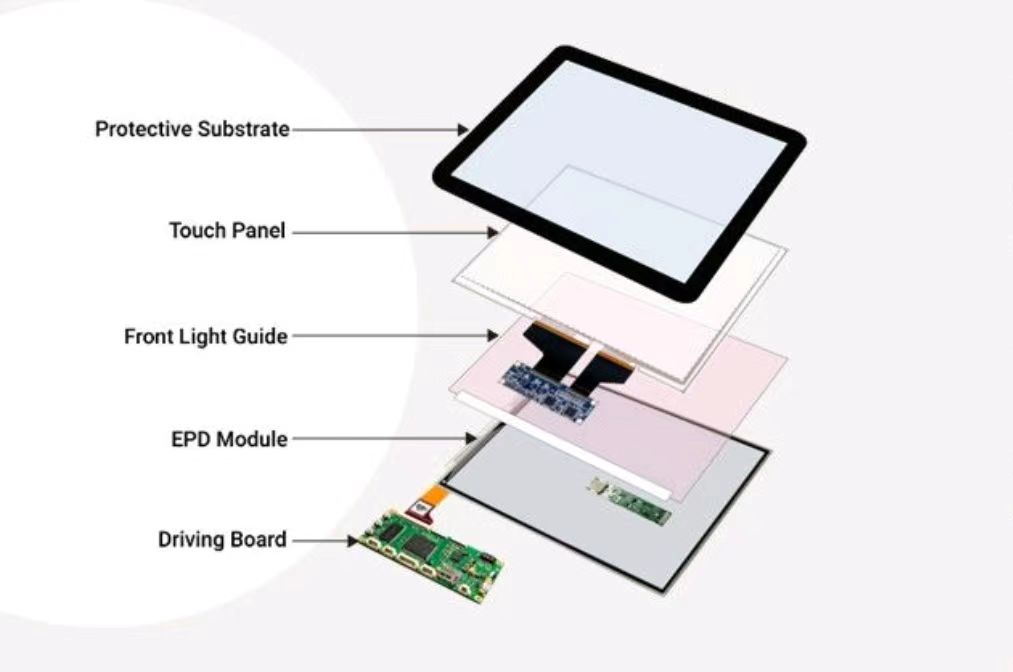
DINGTouch:Committed to continuous innovation and improvement of product quality to meet customers' high requirements and expectations.
DINGTouch is a manufacturer that provides high quality touch screen panels. Focus on the design, manufacturing and sales of touch screen panels, and are committed to providing customized solutions that satisfy customers.
DINGTouch: In the process of customizing touch screen panels, we focus on close cooperation and communication with customers. Understanding customers' needs and providing customized solutions will meet customers' individual needs. The company's products are favored by customers for their high quality and reliability, and provide them with the best touchscreen panel solutions.
DINGTouch:Committed to continuous innovation and improvement of product quality to meet customers' high requirements and expectations.
DINGTouch is a manufacturer that provides high quality touch screen panels. Focus on the design, manufacturing and sales of touch screen panels, and are committed to providing customized solutions that satisfy customers.
DINGTouch: In the process of customizing touch screen panels, we focus on close cooperation and communication with customers. Understanding customers' needs and providing customized solutions will meet customers' individual needs. The company's products are favored by customers for their high quality and reliability, and provide them with the best touchscreen panel solutions.
At DINGTOUCH, we are the world's leading touchscreen manufacturer, helping businesses around the world take advantage of this exciting technology. For more information, please visit the home page now.

DINGTouch is a company specializing in the R&D and production of touch screen technology, headquartered in Shenzhen, China. As a professional touch screen supplier, DINGTouch is committed to providing high-quality, stable and reliable touch screen products to meet the diverse needs of customers. We continue to carry out technological innovation and product optimization to ensure that its touch screen products have good sensitivity, accuracy and durability.
In addition to the products themselves, we also focus on cooperation and communication with customers, and are committed to providing customized solutions and excellent after-sales services. Through continuous efforts to improve product quality and customer satisfaction, we have established a good reputation in the touchscreen industry and won widespread market recognition.
In addition to the products themselves, we also focus on cooperation and communication with customers, and are committed to providing customized solutions and excellent after-sales services. Through continuous efforts to improve product quality and customer satisfaction, we have established a good reputation in the touchscreen industry and won widespread market recognition.
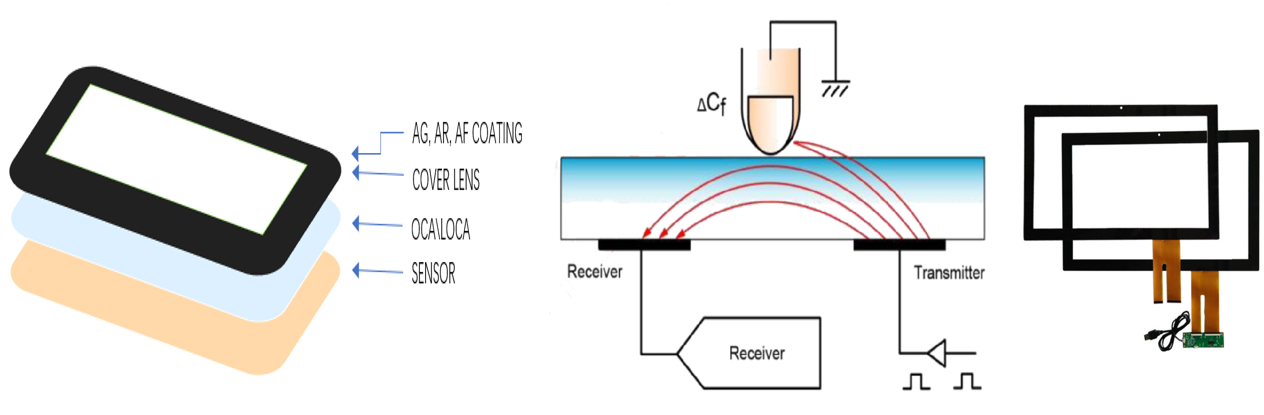
What DINGTOUCH can do:
• PCAP maximum size 65”
• Multi-touch (Touch screen can be customized to your needs.)
• Optical bonding service/air bonding
• LCD interface: HDMI/RGB/MIPI/LVDS/EDP, etc.
• PCAP interface: IIC/USB interface
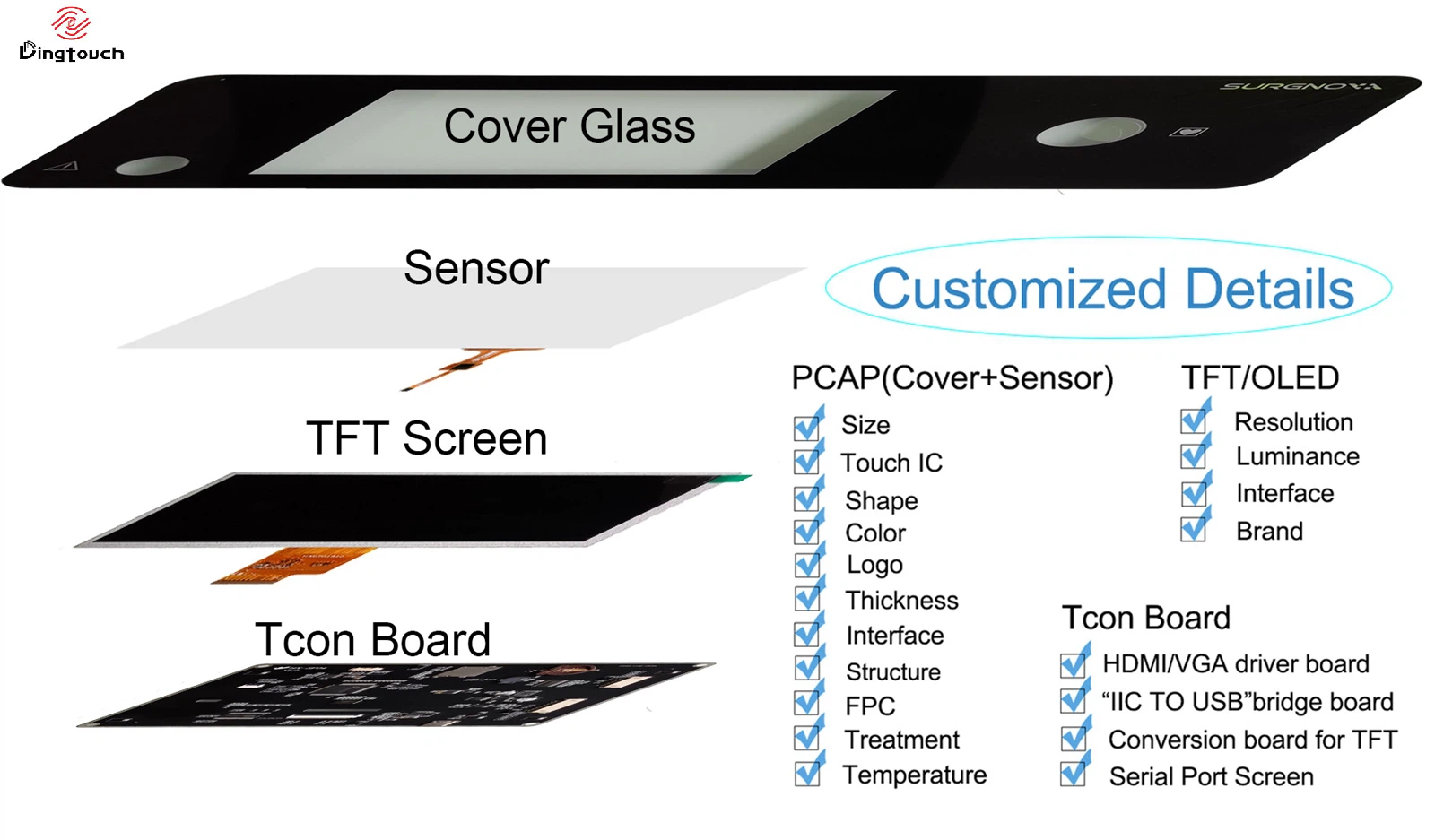
• CTP can customize the cover glass surface treatment process AG (anti-glare), AR (anti-reflection), AF (anti-fingerprint), waterproof, and glove touch
• Supports 0.55 mm-12 mm coverslip touch.
• Support operating temperature: -40℃-90℃.
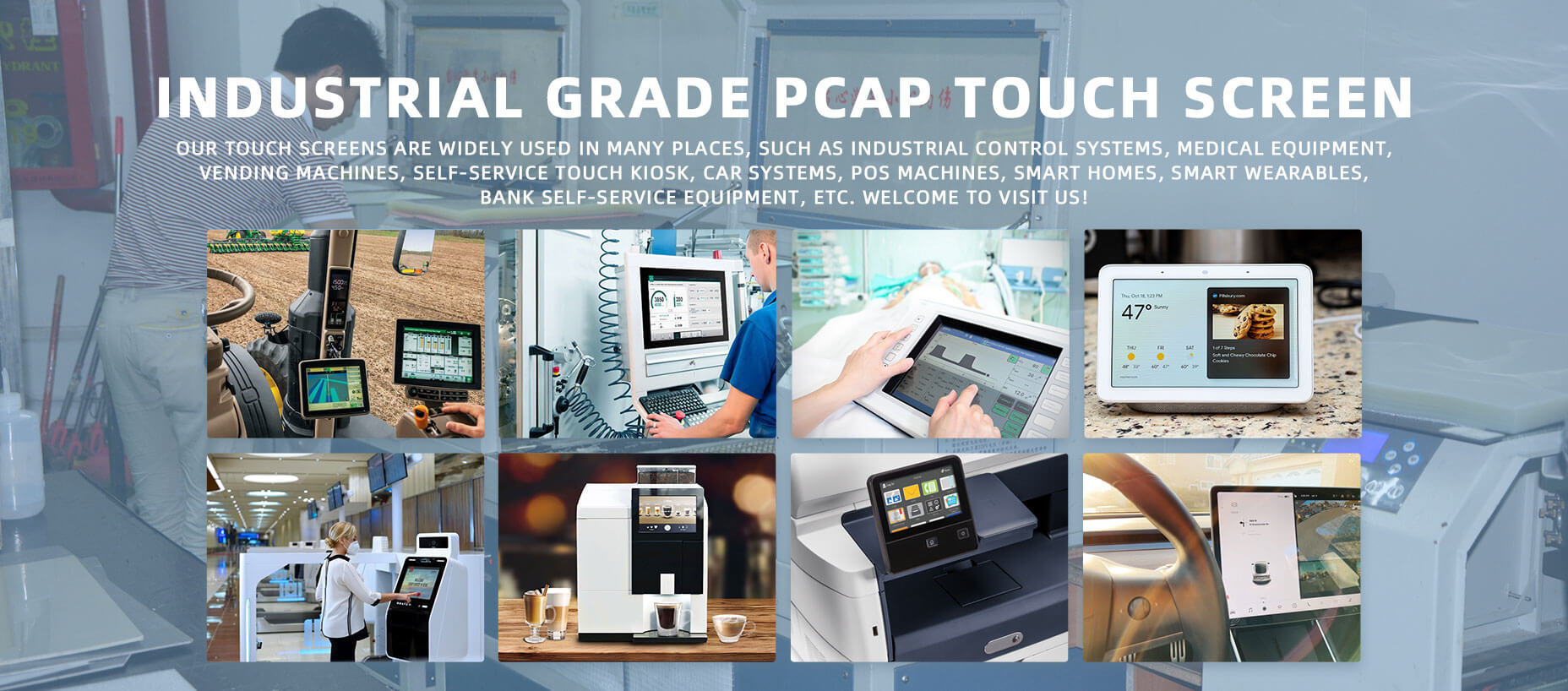
Dingtouch Industrial capacitive touch screen Manufacturer
In conclusion, Dingtouch as a professional touch screen manufacturer with more than 10 years touch screen experience.We have many capacitive touch screen . Such as 5 inch touch screen,7 inch touch screen,10.1inch touch screen,15 inch touch screen,15.6 inch touch screen,17 inch touch screen,18.5 inch touch screen,19 inch touch screen,21.5 inch touch screen,32 inch touch screen, However, we also welcome to customize your own touch screen . Contact our team today to learn what capacitive touch screen are best for our retail business needs.
Contact us NOW! sales@szdingtouch.com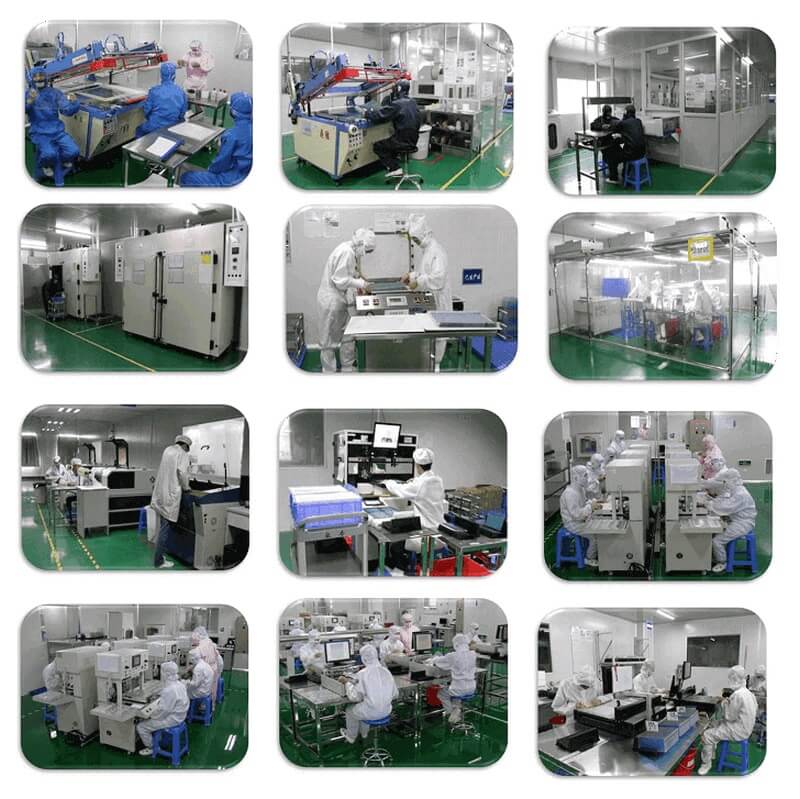
#Medicaltouchscreencalibration, #capacitivetouchcalibrationguide, #IEC60601touchscreen, #DINGTouchmedicaldisplay, #touchscreenaccuracy, #touchscreen driftfix, #medicalequipmenttouchsolutions, #IP65touchpanel, #IK10medicaltouchscreen, #glove touch medical monitor,#ILITEKTouchControllerICSelectionGuide ,#OCAtoOCR #GT911,#CustomizedWideTemperatureTouchScreenSolutions,#Waterproof Touchscreen,
#highbrightnessLCD, #sunlightreadabledisplay,#industrialLCDbacklight, #outdoor displaymodule, #customLCDsolution, #1000–2000nitsdisplay, #DINGTouchtouchscreen.
#capacitivetouchscreen, #EMI/EMCoptimization, #anti-interferencetechnology, #DINGTouch,#customtouchscreensolutions, #industrialtouchdisplay, #medicaltouch screen, #5Gtouchscreen, #AIanti-interferencealgorithm, #smarttouchdisplay,
DINGTouch — Custom Touch Display Solutions Expert
Every touch, clear and precise, ready for any environment.
Every touch, clear and precise, ready for any environment.
CATEGORIES
CONTACT US
Contact: Dingtouch
Phone: +8615815536116
Tel: +8615815536116
Email: sales@szdingtouch.com
Add: Building A, Bailu Plaza, No. 48, Gonghe Industrial Road, Gongle Community, Xixiang Street, Baoan District, Shenzhen,China. 518126
 Dingtouch