News
ESP32-P4 2-Lane MIPI Touch Display | Custom LCD & PCAP Solution
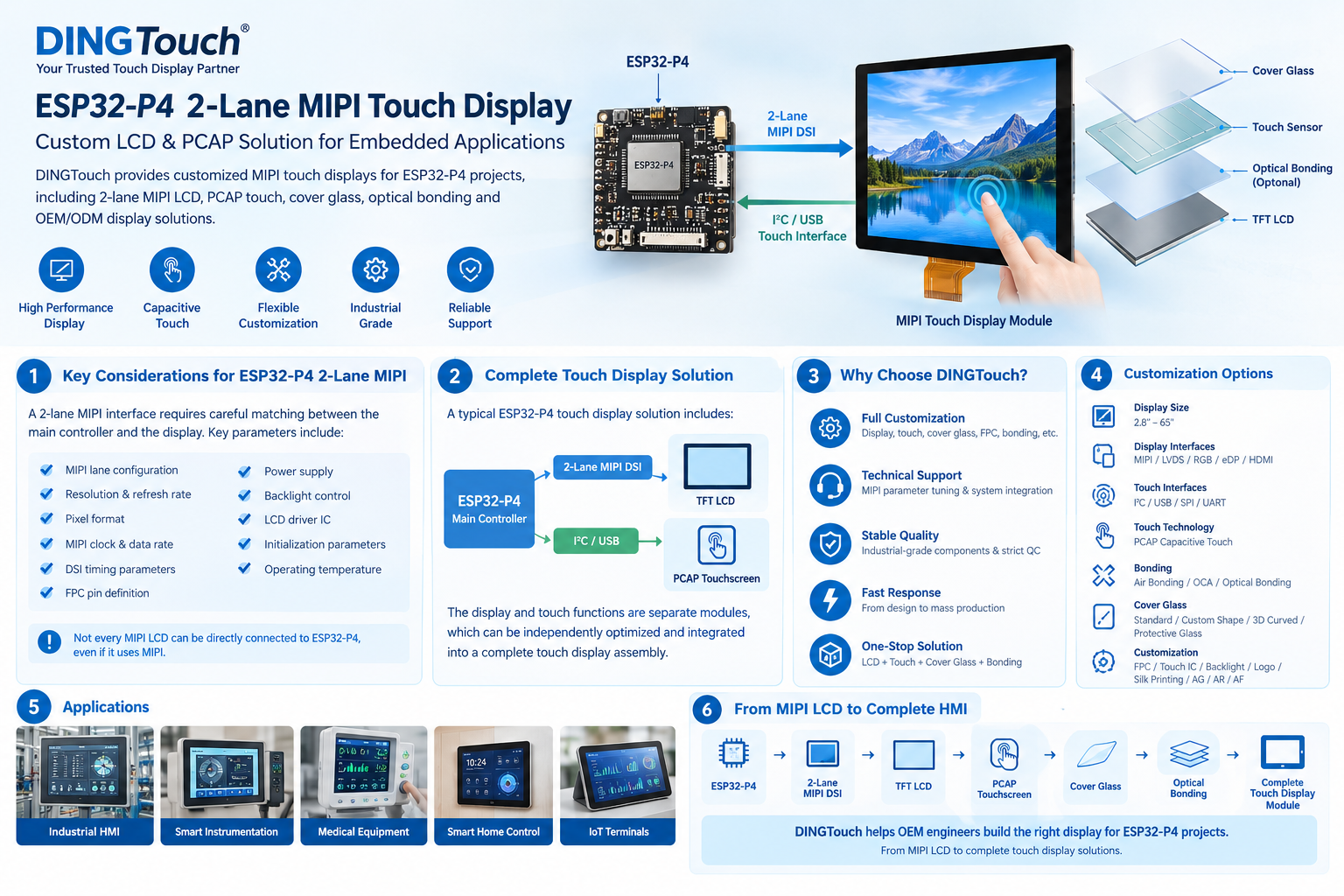 ESP32-P4 2-Lane MIPI Touch Display: How to Choose the Right Display Solution
As embedded devices continue to evolve toward higher performance, compact design, and richer graphical interfaces, the combination of ESP32-P4, MIPI display, and capacitive touch is becoming an attractive solution for industrial HMI, smart control panels, instrumentation, medical equipment, and other embedded applications.
For an ESP32-P4 project using a 2-lane MIPI interface, choosing a display is not simply a matter of finding an LCD with a compatible MIPI interface.
MIPI lane configuration, resolution, refresh rate, display timing, FPC pin definition, driver IC, touch controller, and system integration all need to be considered together.
DINGTouch provides customized industrial and embedded touch display solutions, including MIPI LCD + PCAP touchscreen + cover glass + optical bonding, helping OEM and ODM customers develop display solutions matched to their ESP32-P4 platforms.
1. What Does a 2-Lane MIPI Interface Mean for ESP32-P4?
When designing an embedded display system based on ESP32-P4, one of the first parameters to confirm is the MIPI DSI configuration between the main controller and LCD.
If the project uses a 2-lane MIPI DSI interface, the selected display must be properly matched to the host-side MIPI configuration.
Key parameters may include:
- MIPI DSI lane number
- LCD resolution
- Refresh rate
- Pixel format
- MIPI clock and data rate
- DSI timing parameters
- FPC pin definition
- Power supply
- LCD driver IC
- Initialization parameters
- Backlight control
Therefore, not every MIPI LCD can be directly connected to an ESP32-P4 simply because it uses MIPI.
For OEM and ODM projects, confirming these parameters at the beginning of development can help reduce hardware compatibility and software debugging risks.
2. How to Match an MIPI Touch Display with ESP32-P4?
A typical ESP32-P4 touch display solution can be structured as:
ESP32-P4
↓
2-Lane MIPI DSI
↓
TFT LCD
PCAP Capacitive Touch
↓
I²C / USB Touch Interface
The display and touch functions are generally separate modules, which means they can be independently optimized and then integrated into one complete touch display assembly.
This approach gives OEM engineers greater flexibility when selecting:
- Display size
- Resolution
- Brightness
- MIPI configuration
- Touch IC
- Cover glass
- Touch interface
- Bonding method
DINGTouch can customize these components according to the requirements of the final product.
3. Do Not Choose an ESP32-P4 MIPI LCD by Resolution Alone
When engineers begin selecting a display, it is common to start with the resolution.
For example:
“The ESP32-P4 uses MIPI, so I need an 800×480 or 1024×600 MIPI display.”
However, resolution is only one part of the display selection process.
Two MIPI LCD with the same 800×480 resolution may have different:
- MIPI lane configurations
- LCD driver IC
- Initialization sequences
- Timing parameters
- Pixel formats
- FPC pinouts
- Operating voltages
- Backlight circuits
As a result, the same resolution does not necessarily mean the displays are interchangeable.
For an ESP32-P4 project, it is more efficient to evaluate the complete display interface and electrical specifications before selecting the panel.
DINGTouch recommends providing the following information at the early project stage:
MCU + MIPI lane number + display size + resolution + brightness + touch requirements + operating temperature
This allows the display supplier to evaluate the complete solution rather than simply recommending a standard LCD.
4. How to Select the Touch Interface for an ESP32-P4 Display?
If the product requires touch interaction, the PCAP capacitive touchscreen needs to be considered together with the MIPI LCD.
Common touch communication interfaces include:
- I²C
- USB
- SPI
- UART
For many embedded HMI applications, I²C is a commonly used touch interface because of its simple system integration.
Depending on the application, DINGTouch can evaluate different touch controller solutions, including Goodix, ILITEK, EETI, and Microchip solutions.
For demanding industrial applications, the touch system may also need to support:
- Glove touch
- Wet-finger operation
- Water resistance
- Thick cover glass
- EMI-resistant operation
- Multi-touch
- High touch accuracy
- Stable operation in harsh environments
Touch performance depends not only on the touch IC but also on the sensor design, cover glass thickness, firmware parameters, FPC design, and overall mechanical structure.
5. What Products Can Use an ESP32-P4 + 2-Lane MIPI + PCAP Solution?
The combination of ESP32-P4, MIPI LCD, and PCAP touch is suitable for many embedded products that require graphical interfaces and touch interaction.
Industrial HMI
For industrial controllers, automation equipment, control panels, and machine interfaces.
Smart Instrumentation
A MIPI display can provide a graphical user interface, while PCAP touch enables parameter configuration and operator interaction.
Medical Equipment
Display size, cover glass, touch performance, brightness, and bonding can be customized according to the equipment design and application requirements.
Smart Home Control Panels
The compact structure of MIPI display solutions makes them suitable for smart control panels requiring both visual interaction and touch control.
IoT Control Terminals
ESP32-P4 combined with an MIPI LCD and PCAP touchscreen can provide a more advanced graphical interface for embedded IoT products.
6. How DINGTouch Supports ESP32-P4 MIPI Display Projects
For OEM customers, the challenge is often not simply purchasing an MIPI LCD.
The more important questions are:
Will the display initialize correctly?
Will the image remain stable?
Can the touch function work reliably?
Can the display parameters be adjusted for the target platform?
DINGTouch can support ESP32-P4 projects from three main aspects: display, touch, and mechanical integration.
6.1 MIPI LCD Matching
Based on the ESP32-P4 project requirements, DINGTouch can evaluate:
- 2-lane MIPI configuration
- Resolution
- Refresh rate
- Interface
- FPC definition
- Power supply
- Brightness
- Operating temperature
6.2 MIPI Parameter Support
Different LCD driver ICs and panels may require different initialization and timing parameters.
During project development, DINGTouch can work with customers on parameters such as:
- LCD initialization parameters
- MIPI lane configuration
- Display timing
- Pixel format
- Backlight control
- Panel operating parameters
6.3 PCAP touchscreen Customization
The touch layer can be customized according to the product's mechanical and electrical requirements, including:
- Cover glass
- Touch sensor
- Touch IC
- FPC
- Sensor pattern
- Touch firmware
- Touch interface
6.4 Complete Touch Display Assembly
For products with specific mechanical requirements, DINGTouch can integrate:
LCD + Touch Sensor + Cover Glass + Optical Bonding
into a complete touch display module.
This helps reduce integration work for OEM customers and provides a more consistent display and touch solution.
7. Why Choose a Customized Touch Display for ESP32-P4 Projects?
A standard display may appear to be the fastest solution during the initial development stage. However, engineers may later encounter issues such as:
- MIPI interface incompatibility
- Incorrect FPC dimensions
- Different touch controller requirements
- Different LCD initialization parameters
- Insufficient brightness
- Inadequate operating temperature
- Mechanical installation conflicts
For products that will eventually enter mass production, it can be more efficient to involve the display supplier during the early design stage.
DINGTouch can coordinate the development of:
LCD + PCAP Touch + Cover Glass + FPC + Optical Bonding + Display Interface
according to the customer's product requirements.
8. DINGTouch ESP32-P4 MIPI Touch Display Solution
DINGTouch provides customized display solutions for embedded products based on ESP32-P4 and other embedded platforms.
Depending on the project requirements, the following parameters can be customized:
Display Size
2.8"–65"
Display Interfaces
MIPI / LVDS / RGB / eDP / HDMI
Touch Interfaces
I²C / USB / SPI / UART
Touch Technology
PCAP Capacitive Touch
Bonding
Air Bonding / OCA / Optical Bonding
Cover Glass
Standard / Custom Shape / 3D Curved / Protective Glass
Customization Options
FPC / Touch IC / Backlight / Logo / Silk Printing / AG / AR / AF
For industrial and embedded applications, additional options can include high brightness, wide temperature operation, water-resistant touch, glove touch, wet touch, EMI optimization, and rugged mechanical design.
9. From ESP32-P4 to a Complete HMI: More Than Just an MIPI LCD
A successful ESP32-P4 display project requires the entire system to be considered as one solution:
ESP32-P4
↓
2-Lane MIPI DSI
↓
TFT LCD
↓
PCAP touchscreen
↓
Cover Glass
↓
Optical Bonding
↓
Complete Touch Display Module
This is where DINGTouch value goes beyond supplying a standard LCD.
By considering the customer's MCU, interface, mechanical structure, touch requirements, and operating environment, DINGTouch can help develop a complete touch display solution for embedded products.
Conclusion
For an embedded project using an ESP32-P4 with a 2-lane MIPI interface, selecting the right display requires more than matching the screen size and resolution.
Engineers should evaluate the complete system, including:
MIPI Lane Configuration + Resolution + Timing + Driver IC + FPC + Touch IC + Touch Interface + Mechanical Design
DINGTouch provides customized MIPI LCD, PCAP touchscreen, cover glass, optical bonding, and complete touch display assemblies for industrial and embedded applications.
Whether you are developing an industrial HMI, smart control panel, instrument, medical device, or IoT terminal, DINGTouch can work with your engineering team to develop a display solution matched to your ESP32-P4 platform.
From MIPI LCD to complete touch display solutions — DINGTouch helps OEM engineers build the right display for ESP32-P4 projects.
CATEGORIES
CONTACT US
Contact: Dingtouch
Phone: +8615815536116
Tel: +8615815536116
Email: sales@szdingtouch.com
Add: Building A, Bailu Plaza, No. 48, Gonghe Industrial Road, Gongle Community, Xixiang Street, Baoan District, Shenzhen,China. 518126
 Dingtouch