News
Ch-LCD vs E-Ink vs TFT-LCD: A Deep Technical Comparison of Three Display Technologies
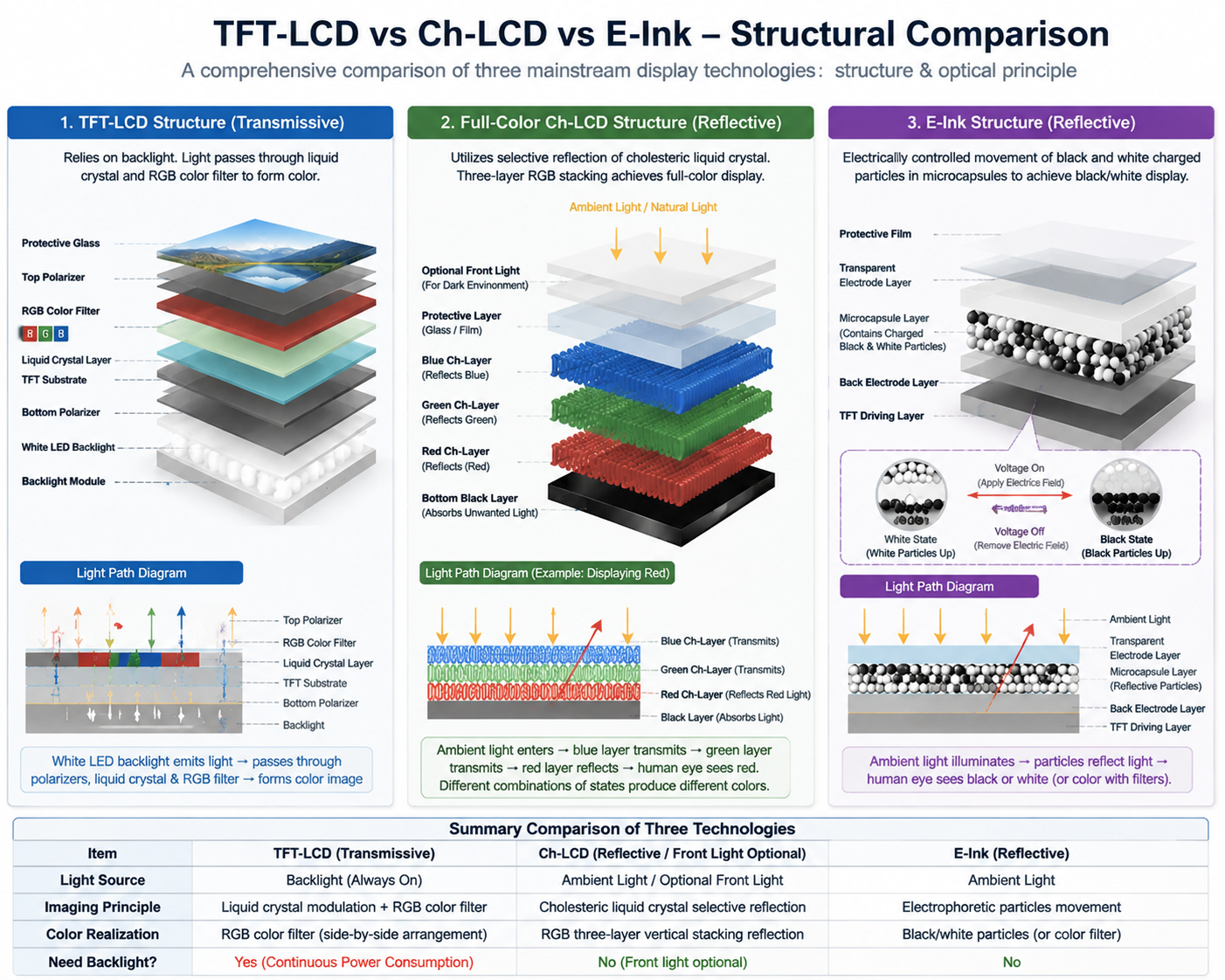 Ch-LCD vs E-Ink vs TFT-LCD: A Deep Technical Comparison of Three Display Technologies
Principles, Structures, Power Consumption, and Application Scenarios Explained
In the rapidly evolving fields of industrial displays, outdoor terminals, smart labels, and ultra-low-power devices, TFT-LCD, Ch-LCD (Cholesteric Liquid Crystal Display), and E-Ink (Electronic Paper) are often discussed together.
Although all three technologies offer advantages in low power consumption, outdoor visibility, or static image retention, their optical principles, material structures, color generation methods, and application boundaries are fundamentally different.
Many engineers and product designers still have common misunderstandings:
- Is Ch-LCD just another type of electronic paper?
- Why can’t E-Ink achieve the same color performance as LCD?
- Why is Ch-LCD more suitable for outdoor applications than traditional LCD?
- Which technology represents the future of ultra-low-power color displays?
This article provides a comprehensive comparison of TFT-LCD, Full-Color Ch-LCD, and E-Ink from the perspectives of display structure, imaging mechanism, color reproduction, power consumption, refresh capability, environmental performance, and industrial applications.
1. TFT-LCD: The Mature Display Technology Based on Backlight Transmission
1.1 Basic TFT-LCD Structure
TFT-LCD is a transmissive display technology that relies on a backlight module as the primary light source.
1.2 How Does TFT-LCD Produce Color?
TFT-LCD itself does not emit light. Instead, it controls the amount of light transmitted through the liquid crystal layer.
The process:
- The LED backlight generates white light.
- Light passes through the liquid crystal layer.
- TFT transistors control the alignment of liquid crystal molecules.
- The light transmission ratio of each pixel is adjusted.
- RGB color filters separate the light into red, green, and blue components.
- The RGB sub-pixels combine to create the final image.
Therefore:
TFT-LCD = Backlight + Liquid Crystal Light Modulation + RGB Color Filter
1.3 Core Characteristics of TFT-LCD
Advantages:
✔ High refresh rate
✔ Excellent video performance
✔ Mature supply chain
✔ High resolution capability
✔ Cost-effective manufacturing
Limitations:
✘ Requires continuous backlight operation
✘ High power consumption for static images
✘ Reduced visibility under strong sunlight
✘ Significant optical loss caused by RGB filters
Typical applications:
- Industrial HMI systems
- Medical displays
- Automotive displays
- Smart terminals
- Indoor control panels
2. Ch-LCD: A Reflective Display Technology Driven by Ambient Light
2.1 What is Ch-LCD?
Ch-LCD stands for:
Cholesteric Liquid Crystal Display
It is a reflective display technology based on the unique optical properties of cholesteric liquid crystal molecules.
The biggest difference compared with TFT-LCD:
TFT-LCD controls how much light passes through, while Ch-LCD controls which wavelength of light is reflected.
3. Full-Color Ch-LCD Structure: Vertical RGB Stacking Technology
- Red Ch-layer → Reflects red light
By stacking three layers together, a full-color reflective display can be achieved.
Unlike TFT-LCD, which places RGB pixels side-by-side, full-color Ch-LCD uses a vertical RGB stacking structure.
Each cholesteric liquid crystal layer reflects a specific wavelength:
- Blue Ch-layer → Reflects blue light
- Green Ch-layer → Reflects green light
4. Ch-LCD Color Generation: Bragg Reflection Principle
The key technology of Ch-LCD is:
Selective Reflection Based on Molecular Helical Structure
Cholesteric liquid crystal molecules naturally form a spiral structure.
The helical pitch determines the reflected wavelength.
When ambient light enters the display:
Planar State (P State)
The liquid crystal layer reflects specific colors.
Focal Conic State (FC State)
The layer becomes transparent, allowing light to pass through to lower layers.
By controlling the state of each RGB layer, different colors can be generated.
5. E-Ink Electronic Paper: Display Technology Based on Electrophoretic Particles
5.1 Basic E-Ink Structure
E-Ink belongs to:
Electrophoretic Display Technology
5.2 How Does E-Ink Work?
Inside each microcapsule are:
- Positively charged white particles
- Negatively charged black particles
An electric field controls particle movement.
White particles move upward:
→ White display
Black particles move upward:
→ Black display
Therefore:
E-Ink = Electrical control of charged particle movement
It is fundamentally different from:
- Liquid crystal rotation
- Light reflection control
6. Ch-LCD vs E-Ink: Key Technical Differences
| Comparison | Ch-LCD | E-Ink |
|---|---|---|
| Technology | Cholesteric Liquid Crystal Display | Electrophoretic Display |
| Imaging Principle | Bragg reflection from liquid crystal molecules | Movement of charged particles |
| Backlight Required | No | No |
| Optical Mode | Reflective | Reflective |
| Static Power Consumption | Near zero | Near zero |
| Image Retention | Bistable | Bistable |
| Color Capability | Full color through RGB stacking | Mainly monochrome, color requires additional solutions |
| Refresh Speed | Faster response | Relatively slow |
| Video Capability | Better | Limited |
| Outdoor Visibility | Excellent | Excellent |
| Display Appearance | Saturated reflective colors | Paper-like appearance |
7. Why is Ch-LCD More Suitable Than E-Ink for Dynamic Outdoor Displays?
Although both technologies feature ultra-low power consumption, their target applications are different.
E-Ink Advantages:
E-Ink provides a paper-like visual experience:
✔ Extremely low power consumption
✔ Comfortable long-term reading experience
✔ Excellent static image retention
Typical applications:
- E-readers
- Electronic shelf labels
- Smart signs
- Information boards
Ch-LCD Advantages:
Ch-LCD focuses on:
✔ Full-color reflective display
✔ Strong sunlight readability
✔ Faster refresh response
✔ Industrial-grade outdoor operation
Suitable applications:
- EV charging stations
- Outdoor information terminals
- Smart retail displays
- Industrial instruments
- Low-power IoT devices
8. Ch-LCD: Bridging the Gap Between LCD Performance and Electronic Paper Efficiency
Traditional LCD:
High performance, but requires continuous power.
E-Ink:
Ultra-low power, but limited in color and dynamic interaction.
Ch-LCD:
Combines color capability, reflective operation, outdoor visibility, and ultra-low power consumption.
It represents a promising solution for:
Next-generation outdoor low-power color displays.
9. Future Trends in Industrial Display Technology
With the rapid growth of:
- Smart cities
- EV charging infrastructure
- Outdoor IoT devices
- Smart logistics
- Industry 4.0 terminals
Display technology is evolving from:Future display solutions will become more energy-efficient and environmentally adaptable.
Technology positioning:
TFT-LCD
Continues to dominate high-performance interactive displays.
E-Ink
Remains the preferred solution for static information display and reading applications.
Ch-LCD
Has strong potential to become a key technology for full-color, outdoor, ultra-low-power industrial displays.
Conclusion
TFT-LCD, Ch-LCD, and E-Ink are not simply replacement technologies. They are optimized for different application requirements.
Choose TFT-LCD when you need:
- High refresh rate
- Video playback
- Complex touch interaction
Choose E-Ink when you need:
- Extremely low power consumption
- Long-term static image display
Choose Full-Color Ch-LCD when you need:
- Color display
- Outdoor sunlight readability
- Ultra-low power operation
- Industrial reliability
As outdoor intelligent devices continue to grow, Ch-LCD is becoming one of the most promising next-generation reflective display technologies.
#ChLCD #CholestericLCD #EInk #ElectronicPaper #TFTLCD #ReflectiveDisplay #OutdoorDisplay #LowPowerDisplay #IndustrialDisplay #FutureDisplayTechnology
CATEGORIES
CONTACT US
Contact: Dingtouch
Phone: +8615815536116
Tel: +8615815536116
Email: sales@szdingtouch.com
Add: Building A, Bailu Plaza, No. 48, Gonghe Industrial Road, Gongle Community, Xixiang Street, Baoan District, Shenzhen,China. 518126
 Dingtouch