News
IK-Rated Cover Glass: The Complete Engineering Guide to Impact-Resistant Glass for Industrial Touch Displays
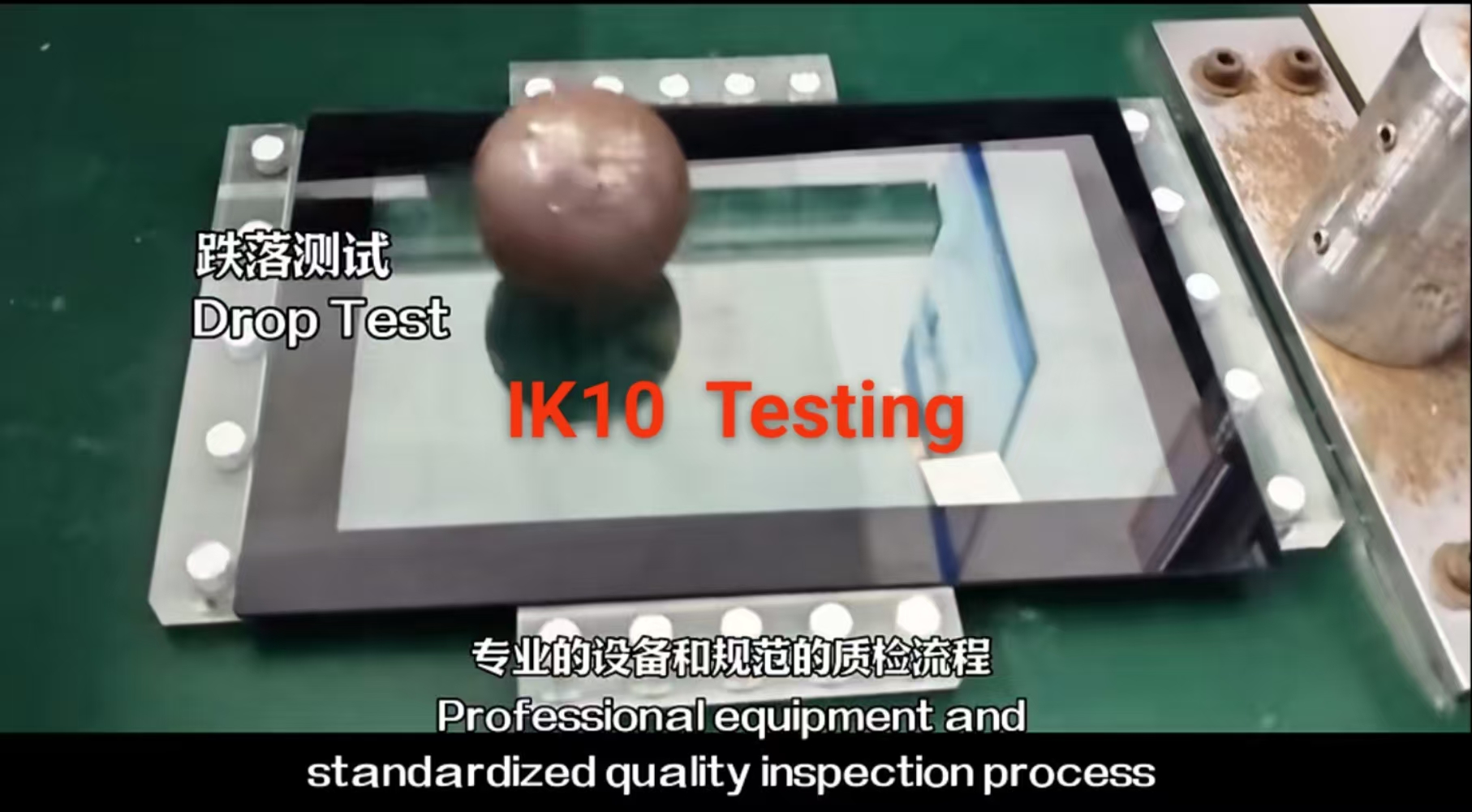
IK-Rated Cover Glass: The Complete Engineering Guide to Impact-Resistant Glass for Industrial Touch Displays
Industrial touch displays are no longer confined to clean indoor environments. Today, they are deployed in manufacturing plants, transportation systems, mining equipment, marine navigation consoles, medical devices, self-service kiosks, EV charging stations, and outdoor automation systems. These applications expose display surfaces to repeated mechanical impacts, vandalism, harsh weather, and continuous operation under demanding conditions.
In these environments, standard cover glass is often insufficient. A single accidental impact from a metal tool, repeated contact from industrial equipment, or intentional vandalism can cause catastrophic failure of the display, leading to expensive downtime and maintenance costs.
This is why IK-rated cover glass has become a critical design element for modern industrial touch displays.
Unlike ordinary protective glass, IK-rated cover glass is engineered and tested to withstand defined levels of mechanical impact according to the IEC 62262 international standard. Selecting the appropriate IK rating ensures that a touch display maintains its structural integrity, optical performance, and touch functionality even after exposure to severe impacts.
This comprehensive engineering guide explains everything engineers, product designers, and purchasing managers need to know about IK-rated cover glass—from international standards and impact testing to structural design, material selection, manufacturing processes, and practical application recommendations.
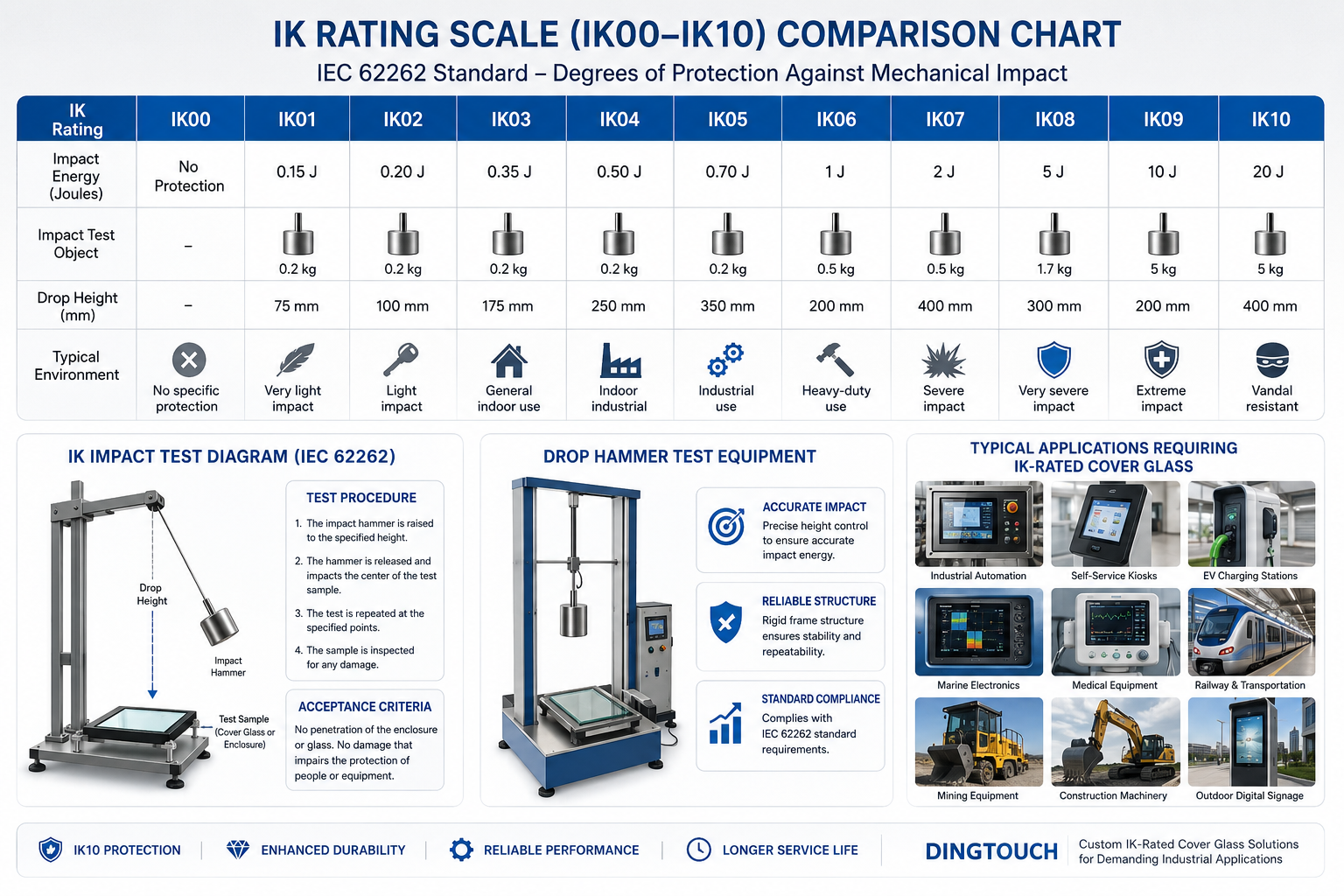 What Is IK-Rated Cover Glass?
IK-rated cover glass is a specially engineered protective glass designed to resist mechanical impacts without cracking, shattering, or compromising the functionality of the display beneath it.
Unlike decorative glass used in consumer electronics, industrial cover glass must perform multiple functions simultaneously:
- Protect the LCD and touch sensor from impact damage.
- Maintain high optical clarity and light transmission.
- Preserve touch sensitivity.
- Resist scratches, chemicals, and environmental exposure.
- Meet international impact-resistance standards.
An IK rating indicates the amount of impact energy that the glass assembly can withstand under standardized testing conditions.
It is important to note that an IK rating applies to the entire assembly, not just the glass itself. Factors such as glass thickness, chemical strengthening, mounting structure, support frame, cushioning materials, and optical bonding all contribute to the final performance.
For example, two cover glasses with the same thickness may achieve different IK ratings depending on their frame design or installation method.
Why Impact Resistance Matters
Industrial displays often operate in environments where accidental impacts are unavoidable.
Typical sources of impact include:
- Falling hand tools
- Metal components
- Forklift collisions
- Maintenance equipment
- Heavy gloves
- Cleaning equipment
- Public vandalism
- Transportation vibration
- Construction debris
Without sufficient impact resistance, even a minor collision may result in:
- Broken cover glass
- LCD damage
- Touch sensor failure
- Water ingress
- Safety hazards
- Equipment downtime
- Increased maintenance costs
By incorporating IK-rated cover glass during the design phase, manufacturers can significantly improve product durability and reduce lifecycle costs.
Understanding the IEC 62262 Standard
The IK rating system is defined by IEC 62262, an international standard published by the International Electrotechnical Commission (IEC).
Before the introduction of IEC 62262, manufacturers used different national methods to describe impact resistance, making comparisons difficult.
The IEC standard established a unified testing method that specifies:
- Impact energy levels
- Test equipment
- Impact locations
- Acceptance criteria
- Classification levels
Today, IEC 62262 is widely recognized across Europe, North America, and Asia as the benchmark for evaluating the mechanical protection of electrical equipment enclosures and display assemblies.
For manufacturers supplying industrial equipment to global markets, compliance with IEC 62262 helps demonstrate product reliability and simplifies customer qualification.
What Does an IK Rating Mean?
An IK rating represents the amount of impact energy, measured in joules (J), that an enclosure or protective glass can withstand without unacceptable damage.
The higher the IK rating, the greater the impact resistance.
For example:
- IK06 withstands 1 joule.
- IK07 withstands 2 joules.
- IK08 withstands 5 joules.
- IK09 withstands 10 joules.
- IK10 withstands 20 joules.
While these numbers may appear small, the corresponding impact forces are significant. An IK10 test simulates the impact of a 5 kg object dropped from a height of 400 mm, producing 20 joules of energy.
This level of protection is sufficient for many public installations and heavy-duty industrial applications.
IK Rating Classification (IK00–IK10)
The following table summarizes the complete IK rating system defined by IEC 62262.
| IK Rating | Impact Energy | Typical Equivalent Test |
|---|---|---|
| IK00 | No Protection | Not tested |
| IK01 | 0.15 J | Small accidental contact |
| IK02 | 0.20 J | Light tool contact |
| IK03 | 0.35 J | Minor mechanical impact |
| IK04 | 0.50 J | Hand-held object |
| IK05 | 0.70 J | Light industrial use |
| IK06 | 1 J | Small hand tools |
| IK07 | 2 J | Medium mechanical impact |
| IK08 | 5 J | Heavy-duty industrial equipment |
| IK09 | 10 J | Severe accidental impact |
| IK10 | 20 J | High-impact and vandal-resistant applications |
As the required IK level increases, engineers must optimize not only the glass itself but also the complete mechanical structure supporting it.
Where Is IK-Rated Cover Glass Used?
Different industries require different levels of impact protection depending on the operating environment.
Industrial Automation
Factory HMIs are frequently exposed to tools, machine components, and operator contact. IK07 to IK09 protection is commonly specified to ensure long-term reliability.
EV Charging Stations
Public charging terminals are installed outdoors and are vulnerable to accidental impacts and deliberate vandalism. IK10 cover glass is widely adopted to protect the display and touch interface.
Marine Electronics
Navigation systems and control panels operate in harsh marine environments where wave motion, equipment handling, and heavy-duty maintenance increase the risk of mechanical damage. IK08 to IK10 solutions are commonly required.
Medical Equipment
Medical monitors and diagnostic devices must withstand frequent cleaning and daily use while maintaining excellent optical quality. Depending on the application, IK06 to IK08 protection is often sufficient.
Self-Service Kiosks
Ticketing machines, payment terminals, ATMs, and information kiosks installed in public spaces typically require IK10-rated cover glass to minimize maintenance costs and resist vandalism.
Construction and Mining Equipment
Displays mounted on heavy machinery experience continuous vibration, falling debris, and harsh operating conditions. IK09 or IK10 protection is generally recommended.
Why IK10 Has Become the Industry Benchmark
Among all impact resistance levels, IK10 has become the preferred specification for premium industrial equipment.
An IK10-rated cover glass offers several advantages:
- Superior resistance to accidental impacts.
- Increased equipment reliability.
- Reduced maintenance and replacement costs.
- Better protection against vandalism.
- Longer product service life.
- Enhanced customer confidence in demanding environments.
For manufacturers targeting global industrial markets, designing around IK10 requirements often provides a competitive advantage, as many OEM customers now include IK10 compliance in their technical specifications.
Engineering Insight
Achieving an IK10 rating is not simply a matter of increasing glass thickness. Successful IK10 designs require a combination of:
- Chemically strengthened aluminosilicate glass.
- Optimized edge geometry and polished corners.
- Proper frame support and load distribution.
- Elastic cushioning materials to absorb impact energy.
- High-quality optical bonding to improve structural integrity.
- Careful control of assembly stress during installation.
Only by considering the entire system can engineers reliably meet IEC 62262 requirements while maintaining optical performance and touch responsiveness.
CATEGORIES
CONTACT US
Contact: Dingtouch
Phone: +8615815536116
Tel: +8615815536116
Email: sales@szdingtouch.com
Add: Building A, Bailu Plaza, No. 48, Gonghe Industrial Road, Gongle Community, Xixiang Street, Baoan District, Shenzhen,China. 518126
 Dingtouch