News
What Is LCD Mura? Understanding Display Uniformity Issues, Causes, and Engineering Solutions
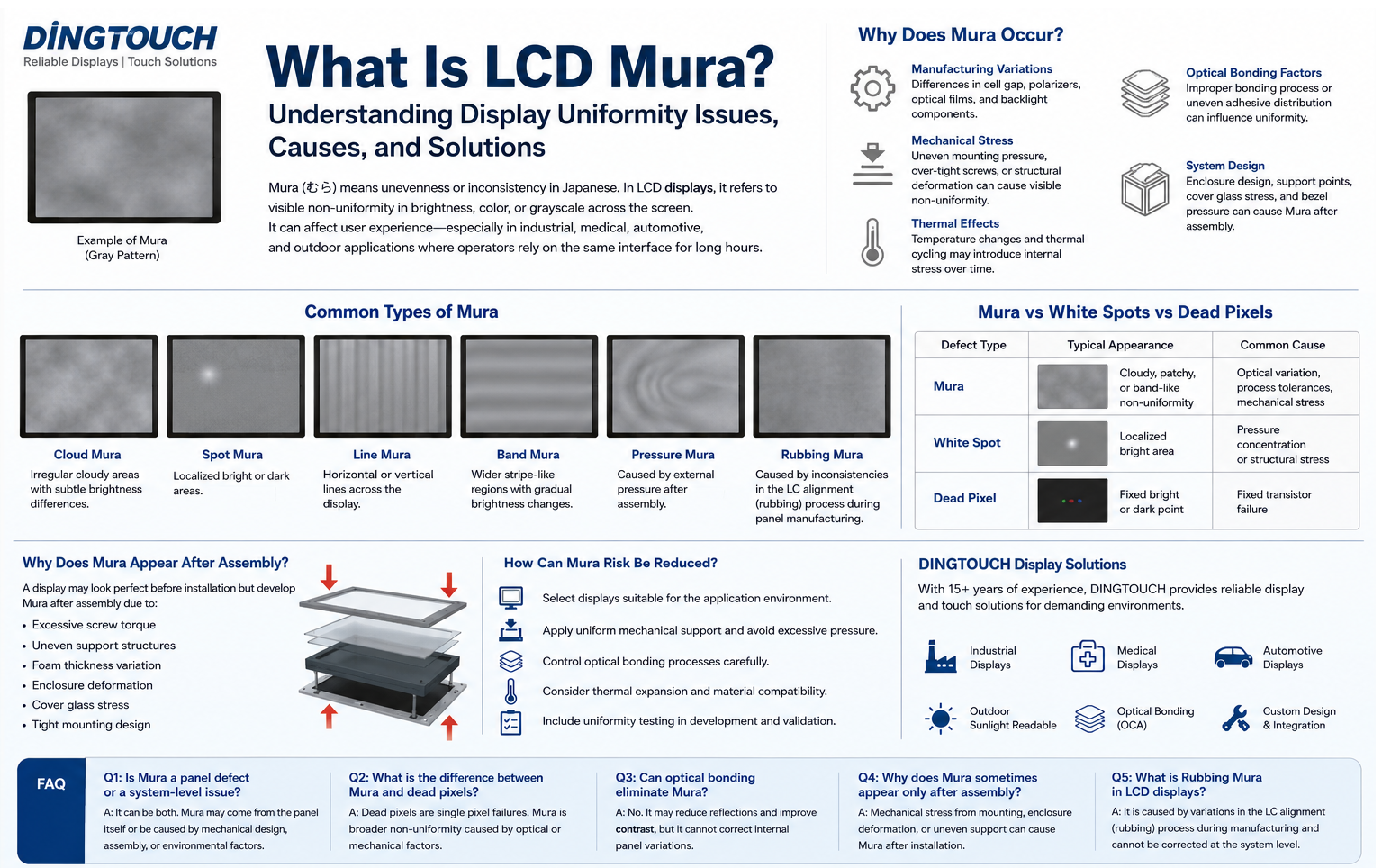 What Is LCD Mura? Understanding Display Uniformity Issues, Causes, and Engineering Solutions
Why Mura Matters More Than Many Display Specifications
When evaluating a display, engineers often focus on specifications such as resolution, brightness, contrast ratio, viewing angle, and color gamut.
However, a display that meets every specification on paper can still present visual quality concerns once it enters production.
You may notice:
- Cloud-like shadows on gray backgrounds
- Uneven brightness near display edges
- Vertical or horizontal bands
- Localized dark or bright areas
- Color shifts in specific regions
In many industrial, medical, automotive, and outdoor applications, these visual inconsistencies become more noticeable than resolution or contrast specifications because users often view the same interface continuously for long periods.
These effects are collectively known as Mura.
At DINGTouch, Mura evaluation is an important part of display integration projects because display performance is influenced not only by panel quality but also by mechanical design, optical bonding, and assembly processes.
What Is Mura in LCD Display?
The term Mura originates from the Japanese word "むら," meaning unevenness, inconsistency, or irregularity.
In the display industry, Mura refers to visible non-uniformity in:
- Brightness
- Color
- Grayscale
- Optical appearance
Unlike dead pixels or electrical failures, Mura typically results from optical variations and structural interactions within the display stack.
Common visual symptoms include:
- Cloudy regions
- Bright spots
- Dark spots
- Banding patterns
- Edge brightness differences
- Localized color variation
Mura becomes particularly visible when displaying:
- Mid-gray patterns
- Solid colors
- Uniform backgrounds
- Low-detail images
For this reason, grayscale test patterns are commonly used during display quality inspection.
Common Types of LCD Mura
Different Mura patterns often indicate different root causes.
1. Cloud Mura
Cloud Mura appears as irregular cloudy areas with subtle brightness differences.
Characteristics:
- Soft edges
- Diffuse appearance
- Difficult to define precisely
Potential causes:
- Backlight non-uniformity
- Optical film variation
- Internal panel stress
- Cell-gap inconsistency
2. Spot Mura
Spot Mura appears as localized bright or dark regions.
It is often confused with pressure marks or white spots.
Potential causes:
- Material inconsistencies
- Localized stress concentration
- Manufacturing process variation
3. Line Mura
Line Mura appears as visible horizontal or vertical lines across the display.
Possible causes include:
- Process variations during manufacturing
- Optical stack inconsistency
- Backlight structure differences
- Polarizer-related variations
4. Band Mura
Band Mura appears as wider stripe-like regions with gradual transitions between brighter and darker areas.
Characteristics:
- More noticeable on large displays
- Often visible on gray backgrounds
- Can affect image consistency
5. Pressure Mura
Pressure Mura is one of the most common concerns in industrial touch display projects.
Unlike panel-originated Mura, Pressure Mura often develops after assembly.
Typical causes include:
- Excessive screw torque
- Uneven support structures
- Foam thickness variation
- Cover glass stress
- Tight enclosure tolerances
- Bezel compression
This explains why a display may pass incoming inspection but show shadowing or ripple-like patterns after integration.
6. Rubbing Mura
Rubbing Mura originates during LCD cell manufacturing.
During production, alignment layers are mechanically rubbed to control liquid crystal orientation.
If rubbing conditions vary due to:
- Uneven pressure
- Roller wear
- Contamination
- Alignment direction deviation
localized brightness and color variations may occur.
Typical symptoms include:
- Subtle shading
- Directional streaks
- Banding under gray patterns
Unlike assembly-induced Mura, Rubbing Mura originates inside the LCD cell and generally cannot be corrected during system integration.
Mura vs White Spots vs Dead Pixels
These issues may appear visually similar but have completely different root causes.
| Defect Type | Typical Appearance | Common Cause |
|---|---|---|
| Mura | Cloudy, patchy, band-like non-uniformity | Optical variation, process tolerance, mechanical stress |
| White Spot | Localized bright region | Pressure concentration or structural stress |
| Dead Pixel | Fixed bright or dark point | Pixel transistor failure |
Understanding the difference is critical because corrective actions vary significantly.
Replacing a panel may solve a dead-pixel issue immediately.
Mura-related concerns often require investigation of the entire display system.
What Causes LCD Mura?
Mura rarely originates from a single factor.
In most cases, multiple influences interact simultaneously.
Manufacturing Variations
Modern LCD modules contain numerous layers:
- TFT glass
- Liquid crystal layer
- Polarizers
- Optical films
- Backlight components
Small variations can influence light transmission and visual uniformity.
Examples include:
- Cell gap variation
- Polarizer inconsistency
- Optical film variation
- Backlight luminance differences
Mechanical Stress
Mechanical forces can alter the optical behavior of LCD structures.
Common sources include:
- Excessive mounting force
- Uneven support locations
- Structural deformation
- Long-term vibration
At DINGTouch, mechanical stress analysis is often performed during custom display projects because improper mounting remains one of the leading causes of field-uniformity issues.
Thermal Effects
Display materials expand and contract at different rates.
Repeated thermal cycling may gradually introduce internal stress.
Applications particularly affected include:
- Outdoor kiosks
- EV charging stations
- Transportation systems
- Industrial control equipment
Thermal-induced stress can influence long-term display uniformity.
Optical Bonding Considerations
Optical bonding offers several advantages:
- Reduced reflection
- Higher contrast
- Better sunlight readability
- Improved environmental reliability
However, optical bonding does not eliminate panel-originated Mura.
Poor process control can introduce additional stress, while properly controlled optical bonding generally improves overall display performance.
Why Does Mura Sometimes Appear After Assembly?
This is one of the most common questions during product development.
A display may appear perfectly uniform during incoming inspection but exhibit visible non-uniformity after installation.
In many cases, the LCD itself is not defective.
Potential causes include:
- Uneven mounting pressure
- Chassis deformation
- Cover glass stress
- Tight bezel designs
- Improper support point distribution
As industrial products become thinner while cover glass becomes thicker, mechanical interaction between the display and enclosure becomes increasingly important.
For this reason, DINGTouch recommends evaluating displays as part of the complete system rather than as isolated components.
Why Is Mura Difficult to Inspect?
Mura evaluation is significantly more challenging than dead-pixel inspection.
Human vision is highly sensitive to brightness differences under specific conditions.
Visibility can change depending on:
- Viewing angle
- Ambient light
- Gray level
- Viewing distance
- Image content
Professional evaluation often uses:
- Mid-gray test patterns
- Imaging colorimeters
- Camera-based uniformity analysis
- Automated inspection systems
Acceptance criteria vary according to application requirements.
Is Mura Always Considered a Defect?
Not necessarily.
Some degree of brightness variation exists in virtually all display technologies.
The key question is whether the variation affects the intended application.
Examples:
Consumer Electronics
Minor Mura may be acceptable.
Industrial HMIs
Stable readability is the priority.
Medical Equipment
More stringent uniformity requirements may apply.
Automotive Displays
Visibility standards are often stricter due to safety considerations.
Ultimately, acceptable Mura levels depend on customer expectations and application-specific requirements.
Can LCD Mura Be Repaired?
The answer depends on the root cause.
If Mura originates within the LCD cell itself:
Repair is generally impractical.
If Mura is caused by external stress:
Visibility may be reduced through structural improvements.
Potential solutions include:
- Reducing mounting pressure
- Optimizing support locations
- Modifying enclosure design
- Improving assembly tolerances
- Revising bonding processes
Replacing the display alone may not solve the issue if the original stress source remains.
How DINGTouch Helps Reduce Mura Risk
With over 15 years of experience in custom touch and display integration, DINGTouch helps customers minimize display-uniformity risks through engineering-focused design.
Our capabilities include:
Mechanical Design Optimization
- Stress-controlled mounting structures
- Customized support solutions
- Cover glass integration analysis
Optical Bonding Expertise
- OCA full optical bonding
- Reflection reduction
- Uniformity-focused process control
Industrial Reliability Validation
- Thermal cycling tests
- Vibration testing
- Long-term stability verification
Custom Display Engineering
- Industrial TFT LCD solutions
- Medical display systems
- Outdoor sunlight-readable displays
- Vehicle and transportation displays
Final Thoughts
Mura is often misunderstood because it does not behave like a traditional display defect.
Rather than being caused by a single component failure, Mura typically results from the interaction of:
- Panel manufacturing tolerances
- Optical structures
- Mechanical stress
- Thermal influences
- System integration design
For industrial display projects, the objective is rarely to achieve absolute perfection. Instead, successful engineering focuses on controlling Mura visibility to a level appropriate for the application.
By considering the complete display system early in development, engineers can significantly reduce unexpected uniformity issues later in the product lifecycle.
At DINGTouch, we support customers with custom TFT LCD displays, PCAP touch screens, optical bonding solutions, and full display integration services designed for industrial, medical, transportation, and outdoor environments.
CATEGORIES
CONTACT US
Contact: Dingtouch
Phone: +8615815536116
Tel: +8615815536116
Email: sales@szdingtouch.com
Add: Building A, Bailu Plaza, No. 48, Gonghe Industrial Road, Gongle Community, Xixiang Street, Baoan District, Shenzhen,China. 518126
 Dingtouch