News
How to Fix Low LCD Brightness: Engineering Solutions for Sunlight-Readable Displays
How to Fix Low LCD Brightness: Engineering Solutions for Sunlight-Readable Displays
Why LCD Brightness Matters in Industrial and Outdoor Applications
In industrial automation, medical equipment, transportation systems, marine electronics, and outdoor kiosks, LCD brightness directly impacts usability and operational reliability.
A display that appears clear indoors may become completely unreadable under direct sunlight. Poor visibility can lead to operator errors, reduced efficiency, and even safety risks.
At DINGTouch, we frequently help customers solve brightness-related challenges through customized display and touch solutions. Understanding the root causes is the first step toward selecting the right engineering approach.
1. What Causes Low LCD Brightness?
LCD brightness limitations are rarely caused by a single component. Instead, they result from a combination of optical, electrical, and mechanical factors.
1.1 Low Backlight Output
The LED backlight is the primary light source of an LCD module.
Typical brightness levels include:
- Standard indoor displays: 250–400 nits
- Industrial displays: 500–1000 nits
- Outdoor sunlight-readable displays: 1200–2500+ nits
Insufficient backlight power remains the most common cause of poor display visibility.
1.2 Low Polarizer Light Transmission
Every LCD contains upper and lower polarizers.
If the polarizers have low transmittance, a significant portion of the generated light is lost before reaching the viewer.
Higher-transmittance polarizers can noticeably improve display brightness without increasing power consumption.
1.3 Inefficient Optical Film Design
Optical films determine how effectively light is directed toward the user.
These include:
- Diffuser Films
- Prism Films
- Reflector Films
- Brightness Enhancement Films (BEF)
- Dual Brightness Enhancement Films (DBEF)
Poor-quality films can waste a substantial amount of available backlight energy.
1.4 Air Gap Losses in Display Assembly
Traditional air-gap assembly introduces multiple reflective interfaces.
Each interface reflects a portion of light back into the display, reducing effective brightness and contrast.
1.5 Driver IC and Backlight Configuration Limitations
Brightness may also be restricted by:
- PWM duty-cycle settings
- Backlight driver current limits
- Gamma curve configuration
- Power management constraints
In some cases, brightness can be improved through firmware optimization alone.
1.6 Environmental Conditions
Sometimes the display itself is bright enough, but external conditions reduce visibility.
Common examples include:
- Direct sunlight exposure
- Reflective cover glass
- Strong ambient lighting
- Deep bezels or housing shadows
In these situations, optical optimization becomes more important than simply increasing brightness.
2. Six Proven Methods to Increase LCD Brightness
Solution 1: Upgrade the LED Backlight System
The most direct and effective approach.
Methods include:
- Increasing LED quantity
- Using higher-efficiency LEDs
- Increasing drive current
- Adopting dual-chip LED technology
Advantages
✔ Significant brightness improvement
✔ Essential for outdoor applications
✔ Supports 1200–2500 nit designs
Considerations
✘ Higher power consumption
✘ Increased heat generation
✘ May require thermal redesign
Solution 2: Use High-Transmittance Polarizers
Premium polarizers can improve overall light throughput without changing the backlight system.
Advantages
✔ Lower power requirements
✔ Improved image clarity
✔ Better energy efficiency
Considerations
✘ Higher material cost
✘ Requires LCD optical redesign
Solution 3: Integrate BEF or DBEF Brightness Enhancement Films
BEF (Brightness Enhancement Film)
Uses micro-prism structures to focus light toward the viewer.
Typical brightness increase:
30%–60%
DBEF (Dual Brightness Enhancement Film)
Recycles polarized light that would otherwise be lost.
Typical brightness increase:
70%–100%
DBEF is widely used in premium industrial, automotive, and medical displays.
Advantages
✔ No increase in power consumption
✔ Excellent cost-to-performance ratio
✔ Significant brightness gains
Considerations
✘ Material cost
✘ Precise assembly orientation required
Solution 4: Optimize the Optical Film Stack
Upgrading diffuser and reflector materials improves internal light utilization.
Advantages
✔ Improved luminance uniformity
✔ Relatively low cost
✔ Better optical efficiency
Considerations
✘ Moderate brightness improvement
✘ Requires backlight redesign
Solution 5: Apply Full Optical Bonding
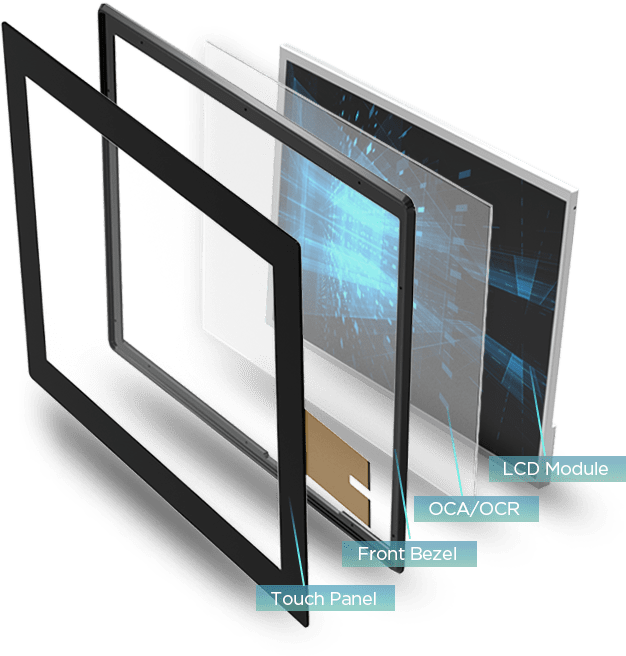
Optical bonding eliminates the air gap between the LCD and touch panel using OCA or OCR materials.
Compared with traditional air-gap assembly, optical bonding offers:
- 5%–10% brightness improvement
- Higher contrast ratio
- Reduced internal reflections
- Better sunlight readability
Advantages
✔ Enhanced outdoor visibility
✔ Improved durability
✔ Better visual performance
Considerations
✘ More complex manufacturing process
✘ Higher production cost
Solution 6: Optimize Software and Driver Parameters
In some systems, brightness limitations originate from software configuration.
Optimization areas include:
- PWM duty cycle
- Backlight driver settings
- Gamma correction
- Power management profiles
Advantages
✔ No hardware changes
✔ Fast implementation
✔ Low cost
Considerations
✘ Limited improvement potential
✘ Cannot exceed hardware limitations
3. How to Achieve Sunlight-Readable LCD Performance
For outdoor equipment, brightness alone is not enough.
Sunlight readability depends on the balance between luminance and reflection control.
At DINGTouch, a typical sunlight-readable display solution combines:
- 1200–2000 nit high-brightness backlight
- DBEF optical enhancement films
- Full optical bonding (OCA)
- AR (Anti-Reflective) coating
- AG (Anti-Glare) treatment
- AF (Anti-Fingerprint) coating
This integrated optical design delivers excellent readability even under harsh outdoor lighting conditions.
Typical applications include:
- Industrial HMI systems
- EV charging stations
- Medical devices
- Marine navigation displays
- Outdoor kiosks
- Transportation terminals
- Agricultural equipment
- Smart city infrastructure
4. DINGTouch High-Brightness Display Solutions
With more than 15 years of experience in custom touch and display engineering, DINGTouch provides complete display solutions tailored for demanding environments.
Our capabilities include:
Custom LCD Brightness
- 800 nits
- 1000 nits
- 1500 nits
- 2000+ nits
Optical Enhancement Technologies
- OCA Full Optical Bonding
- AR Coating
- AG Coating
- AF Coating
- DBEF Integration
Rugged Industrial Design
- Wide temperature operation
- IP65/IP67 sealing
- IK-rated cover glass
- Glove touch support
- EMI/EMC optimization
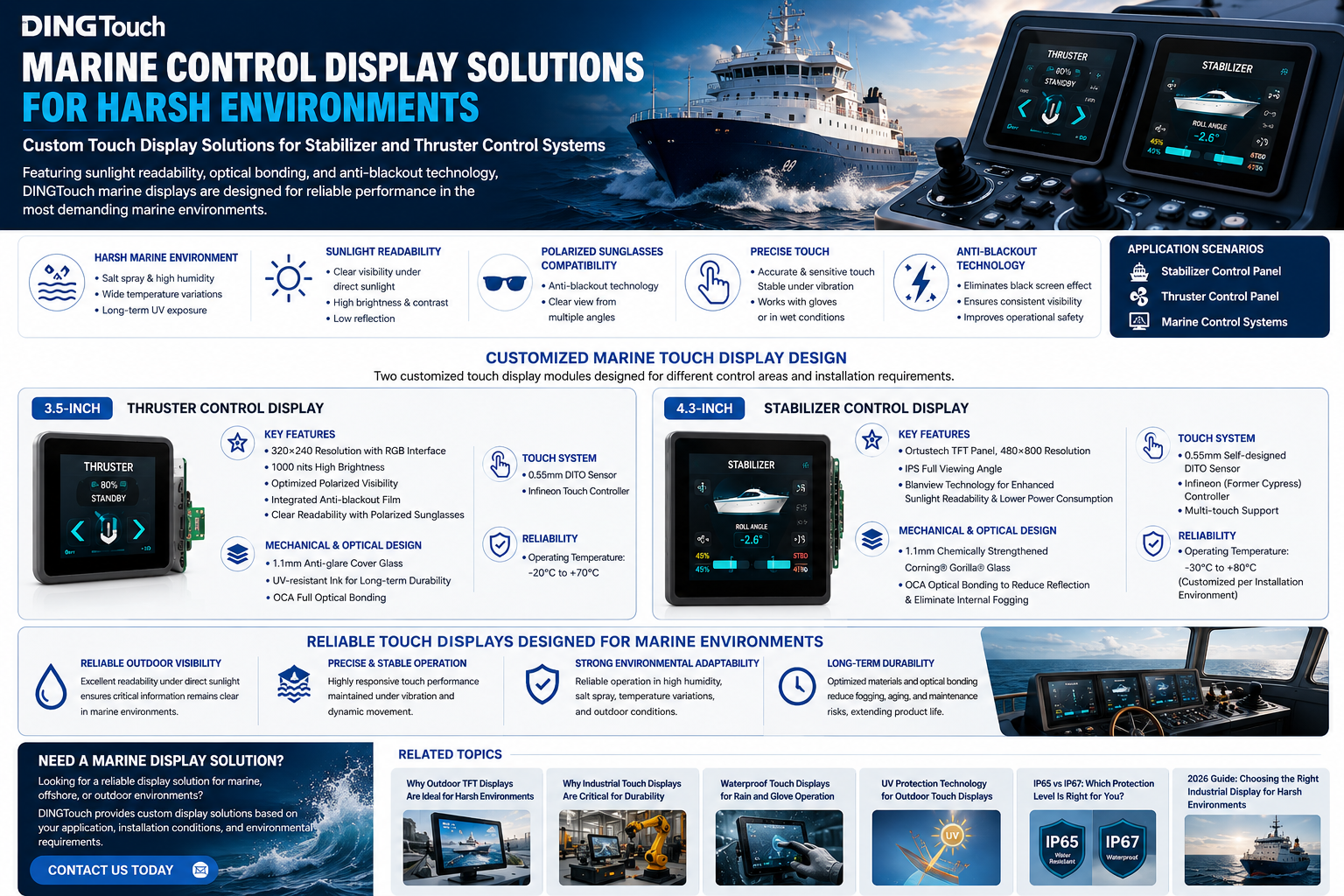
From industrial automation to medical and outdoor applications, DINGTouch helps customers maximize display visibility while maintaining reliability and long service life.
 Conclusion
Low LCD brightness is rarely caused by a single factor. Effective brightness enhancement requires a comprehensive engineering approach involving:
- High-brightness LED backlights
- BEF and DBEF optical films
- High-transmittance polarizers
- Optimized optical stack design
- Full optical bonding
- Display driver optimization
The best solution depends on the application environment, power budget, thermal constraints, and visibility requirements.
If your project requires a custom high-brightness LCD, sunlight-readable touch display, or optical bonding solution, contact the DINGTouch engineering team to discuss your requirements.
CATEGORIES
CONTACT US
Contact: Dingtouch
Phone: +8615815536116
Tel: +8615815536116
Email: sales@szdingtouch.com
Add: Building A, Bailu Plaza, No. 48, Gonghe Industrial Road, Gongle Community, Xixiang Street, Baoan District, Shenzhen,China. 518126
 Dingtouch