News
OLED vs. LCD: Key Differences, Advantages, Disadvantages & Selection Guide
OLED vs. LCD: Key Differences, Advantages, Disadvantages & Selection Guide
OLED and LCD are two of the most widely used display technologies in smartphones, industrial equipment, medical devices, automotive displays, smart terminals, and consumer electronics.
Many people know that OLED offers deeper blacks, higher contrast, and an ultra-thin design, while LCD is more affordable and has virtually no typical OLED burn-in risk.
However, from a product design and procurement perspective, the differences between OLED and LCD go far beyond image quality.
The most fundamental difference is simple:
LCD relies on a backlight to produce light, while OLED pixels generate their own light.
This fundamental structural difference affects black levels, contrast ratio, power consumption, thickness, lifetime, dimming methods, burn-in risk, and application suitability.
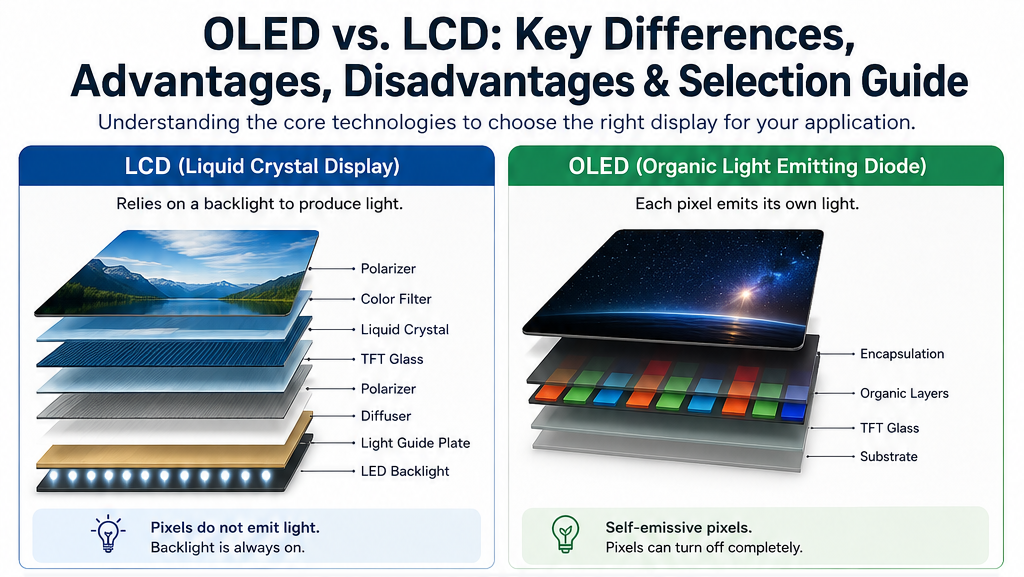 1. What Is the Difference Between LCD and OLED?
In simple terms, you can think of an LCD as:
“A light source + a liquid crystal layer that controls the light.”
A typical LCD module uses an LED backlight to provide illumination. The light passes through optical films, the liquid crystal layer, color filters, and polarizing structures.
By controlling the orientation of liquid crystal molecules, the display controls how much light passes through each pixel, creating different brightness levels and images.
Therefore:
LCD pixels do not generate light themselves.
OLED works differently.
Each OLED pixel contains an organic light-emitting device. When electrical current is applied, the pixel emits light. When the pixel is turned off, it can become completely dark.
Therefore:
OLED does not require a traditional LCD backlight.
This is the fundamental reason why OLED can deliver extremely high contrast, true black, ultra-thin structures, and flexible or foldable displays.
2. How Does LCD Work?
The basic LCD display structure can be simplified as:
LED Backlight → Liquid Crystal Layer → Color Filter → Polarizing Structure → Display Image
The backlight provides the light, while the liquid crystal layer controls how much light passes through.
For example, when displaying a white area, more backlight is allowed to pass through. When displaying a dark area, less light passes through.
However, because the LCD backlight generally operates across the display area, the backlight is still active even when the screen displays black.
As a result:
LCD black is usually closer to dark gray rather than absolute black.
High-end LCD technologies can improve black levels and contrast through technologies such as local dimming and Mini LED backlighting, but the fundamental principle remains the same: the LCD uses a backlight combined with liquid crystal modulation.
3. How Does OLED Work?
OLED takes a fundamentally different approach.
Each OLED pixel acts as an independent light-emitting unit.
When the display needs to show white, the pixels emit light.
When different colors are required, the corresponding sub-pixels are controlled to produce the desired color.
When black is displayed, the corresponding pixels can simply be turned off.
This creates one of OLED biggest advantages:
Black pixels can actually turn off.
For example, consider an image with a black background and a bright object.
With LCD:
The black area may still have some light leakage from the backlight.
With OLED:
The black pixels can be switched off completely.
This allows OLED displays to achieve extremely high native contrast.
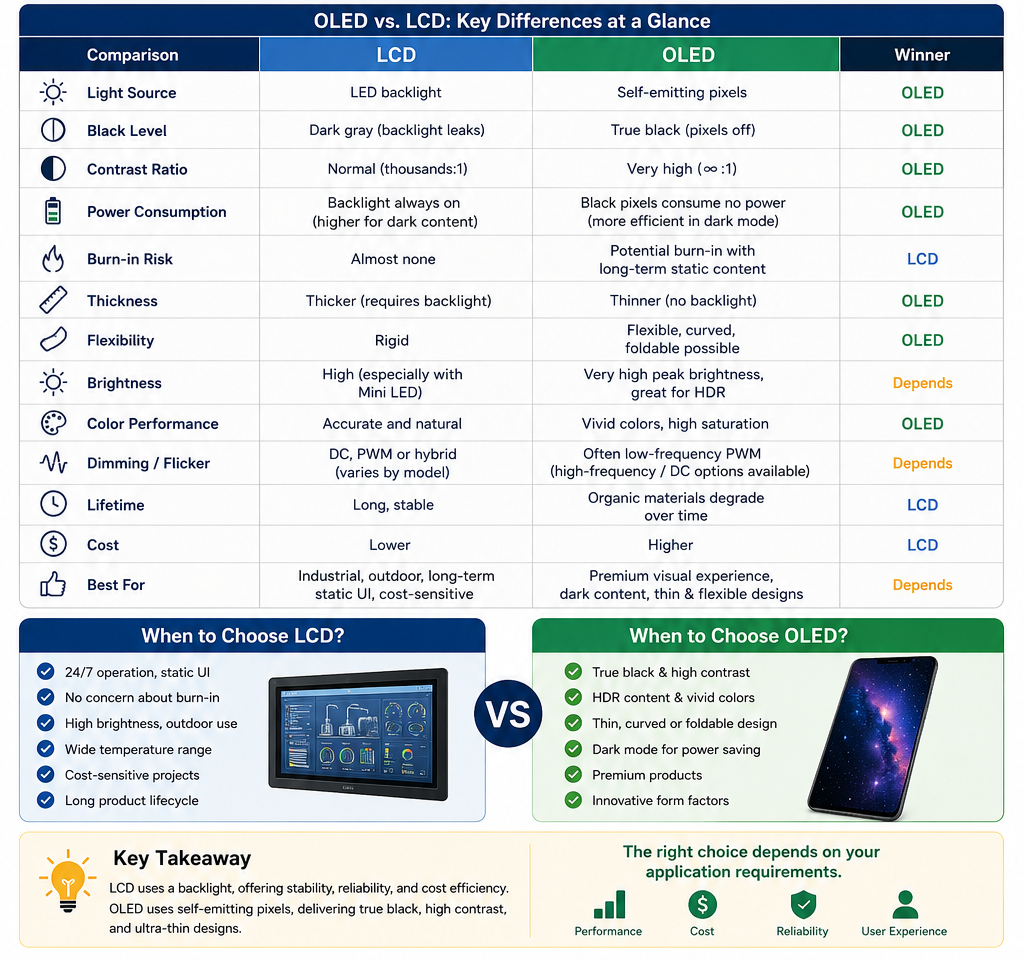
4. OLED vs. LCD: Key Differences at a Glance
| Comparison | LCD | OLED |
|---|---|---|
| Light source | LED backlight | Self-emitting pixels |
| Black level | Dark areas may appear slightly gray | True/deep black |
| Contrast | High, depending on panel and backlight design | Extremely high; theoretically near-infinite |
| Power consumption | Backlight remains active | Black pixels can be turned off |
| Burn-in | No typical OLED burn-in issue | Long-term static content can cause burn-in |
| Thickness | Requires a backlight structure | Can be thinner without a traditional backlight |
| Flexibility | Standard LCD is generally rigid | Can support flexible, curved and foldable designs |
| Color | Mature and accurate color performance | High saturation and strong contrast |
| Brightness | High-brightness LCD are widely used outdoors | Very high peak brightness on modern OLED |
| Lifetime | Mature and stable technology | Organic materials gradually age |
| Dimming | DC, PWM or hybrid methods | PWM is common; high-frequency PWM/DC options are also available |
| Cost | Generally more cost-effective | Generally more expensive |
| Static UI | Well suited to long-term static content | Static content requires burn-in management |
| Industrial applications | Highly mature and widely used | Suitable for specific applications requiring premium image quality |
5. Black Levels: Why Does OLED Produce True Black?
Black performance is one of the most noticeable differences between LCD and OLED.
When an LCD displays black, its backlight usually remains active. Even when the liquid crystal layer blocks most of the light, some light leakage can remain.
OLED works differently.
When an OLED pixel displays black, that pixel can simply be switched off.
Therefore, in a dark environment:
LCD → dark gray / black
OLED → true or near-true black
This makes OLED particularly attractive for movies, HDR content, dark scenes, and dark-mode interfaces.
Night scenes, space scenes, and images with large black areas can look significantly more immersive on OLED.
6. Contrast Ratio: Why Does OLED Have an Advantage?
Contrast ratio represents the difference between the brightest and darkest parts of an image.
LCD contrast is affected by the performance of the liquid crystal layer and backlight system.
OLED can switch individual pixels off completely, producing extremely low black levels.
As a result, OLED can achieve an extremely high native contrast ratio, theoretically approaching infinity.
This is one reason OLED is widely used in:
- Premium smartphones
- Smartwatches
- VR/AR devices
- High-end TV
- HDR displays
- Portable entertainment devices
7. Power Consumption: OLED Is Not Always More Efficient
A common misconception is:
OLED is always more energy-efficient than LCD.
This is not necessarily true.
OLED's major power advantage comes from displaying black and dark content.
When an OLED pixel displays black, it can be turned off.
For example:
OLED + Dark UI → More pixels turned off → Lower power consumption
With LCD:
Backlight remains active → Dark content still consumes backlight power
However, when displaying large areas of bright white content, the OLED power advantage can become smaller.
Actual power consumption depends on:
- Display content
- Brightness level
- Panel architecture
- Driver design
- Refresh rate
- Dimming technology
Therefore, OLED should not automatically be considered more energy-efficient in every application.
8. OLED Burn-In: One of the Main Long-Term Considerations
OLED self-emissive architecture provides excellent image quality, but it also introduces an important long-term consideration:
Pixel aging
OLED pixels gradually degrade as they operate over time.
If certain areas of the screen display the same content continuously, those pixels may age differently from surrounding pixels.
Typical examples include:
- Smartphone status bars
- Navigation buttons
- Game HUD
- Fixed video platform controls
- Industrial HMI interface elements
- Medical equipment status indicators
This may result in:
Image retention
and, in more severe cases:
OLED burn-in
However, it is important to understand that:
OLED does not mean automatic burn-in.
Modern OLED displays use various technologies to reduce the risk, including:
- Pixel shifting
- Brightness management
- Screen protection functions
- Compensation algorithms
In normal dynamic use, many OLED displays can operate for years without obvious burn-in.
The higher-risk combination is generally:
High brightness + long operating time + static content
9. Why Is LCD Suitable for Long-Term Static UI?
Industrial HMI, medical equipment, automation systems, and control terminals often need to display fixed information for long periods.
Typical information includes:
- Temperature
- Pressure
- Battery status
- Equipment status
- Navigation menus
- Control buttons
- Parameters
- Logos
For these applications, LCD is often easier to implement for long-term stable operation.
Therefore, if a product requires:
24/7 operation + static UI + long product lifecycle
LCD can be a very practical choice.
10. Thickness and Structure: OLED Has a Clear Advantage
A conventional LCD module typically includes:
- LED backlight
- Light guide plate
- Diffuser films
- Prism films
- Liquid crystal layer
- Color filters
- Polarizing layers
This makes the overall optical structure relatively complex.
OLED does not require a traditional backlight, which allows manufacturers to reduce part of the display thickness.
This makes OLED particularly suitable for:
- Ultra-thin smartphones
- Smartwatches
- Curved displays
- Foldable devices
- Flexible electronics
However, the final thickness of a complete display module still depends on the entire system, including the cover glass, touch panel, polarizer, FPC, bonding process, and mechanical structure.
11. Brightness: OLED Does Not Automatically Mean Better Outdoor Visibility
Modern OLED displays can achieve very high peak brightness, particularly for HDR highlights.
However, when selecting a display for industrial or outdoor applications, it is not enough to simply compare:
OLED vs. LCD
Outdoor readability depends on many factors, including:
- Peak brightness
- Full-screen brightness
- Contrast
- Surface reflectivity
- Anti-Glare (AG) coating
- Anti-Reflection (AR) treatment
- Optical bonding
- Polarizer design
- Ambient light
Therefore, a high-brightness LCD can still be an excellent solution for:
- Outdoor industrial equipment
- Vehicle-mounted displays
- POS systems
- Self-service terminals
- Outdoor instruments
- Industrial control systems
12. Color Performance: OLED Is More Vivid, But LCD Can Also Deliver Excellent Accuracy
OLED displays are generally known for:
- High contrast
- High saturation
- Vivid colors
- Excellent HDR performance
This makes OLED very attractive for consumer electronics.
However, if the application prioritizes:
Color accuracy, consistency, and long-term stability
high-quality IPS LCD panels can also provide excellent color performance.
For industrial and professional displays, more saturated colors do not necessarily mean better performance.
Depending on the application, engineers may evaluate:
- sRGB
- Adobe RGB
- DCI-P3
- NTSC
- Color temperature
- Gamma
- ΔE
rather than simply choosing between OLED and LCD.
13. PWM and Dimming: OLED Is Not Automatically Worse for the Eyes
Display flicker is another topic that often creates confusion.
Some OLED displays use PWM dimming, particularly at low brightness levels. People who are sensitive to flicker may experience visual discomfort with certain implementations.
However:
OLED does not automatically mean eye strain.
LCD displays can also use PWM dimming.
Therefore, users who are sensitive to flicker should pay attention to the actual dimming technology used by the display.
Possible solutions include:
- DC Dimming
- PWM Dimming
- High-Frequency PWM
- Hybrid Dimming
Some OLED displays use high-frequency PWM or other advanced dimming technologies to improve the viewing experience at low brightness.
The key point is:
Do not judge a display simply by whether it is OLED or LCD. Check the actual dimming architecture and specifications.
14. Lifetime: LCD and OLED Age in Different Ways
LCD does not experience organic emissive material degradation in the same way as OLED.
For LCD modules, long-term reliability is more commonly associated with:
- LED backlight aging
- Backlight brightness degradation
- Liquid crystal characteristics
- Driver electronics
- Operating temperature
- Power stability
OLED displays, on the other hand, need to consider:
Long-term degradation of organic emissive materials.
In particular, applications involving:
High brightness + high temperature + continuous operation
require careful evaluation of OLED lifetime and brightness degradation.
15. Should Industrial Equipment Use LCD or OLED?
For industrial, medical, outdoor, and long-running equipment, display selection should not focus only on image quality.
Consider the following factors.
When LCD Is the Better Choice
LCD is often preferred when the equipment requires:
- 24/7 continuous operation
- Static UI
- Long product lifecycle
- Minimal burn-in concerns
- High brightness
- Outdoor readability
- Wide operating temperature
- Cost efficiency
- Long-term supply stability
For these applications:
Industrial-grade LCD is often a practical and reliable solution.
When OLED Is the Better Choice
OLED can be a strong choice when the product prioritizes:
- True black
- Extremely high contrast
- HDR performance
- Ultra-thin design
- Curved displays
- Foldable structures
- Premium visual experience
- Dark user interfaces
- Flexible display designs
For these applications:
OLED offers significant advantages.
16. LCD vs. OLED: Which One Should You Choose?
| Application | Recommended Technology |
| Industrial HMI | LCD ⭐⭐⭐⭐⭐ |
| Medical equipment | LCD / OLED depending on requirements |
| Outdoor displays | High-brightness LCD ⭐⭐⭐⭐⭐ |
| 24/7 static UI | LCD ⭐⭐⭐⭐⭐ |
| Smartphones | OLED / LCD |
| Smartwatches | OLED ⭐⭐⭐⭐⭐ |
| Foldable devices | OLED ⭐⭐⭐⭐⭐ |
| Premium TVs | OLED ⭐⭐⭐⭐⭐ |
| HDR video | OLED ⭐⭐⭐⭐⭐ |
| Cost-sensitive products | LCD ⭐⭐⭐⭐⭐ |
| Long-term static content | LCD ⭐⭐⭐⭐⭐ |
| Ultra-thin devices | OLED ⭐⭐⭐⭐⭐ |
| High-brightness industrial equipment | LCD / Mini LED LCD |
| Dark-mode interfaces | OLED |
17. LCD and OLED Are Not Simply Competing Technologies
It is not accurate to say that OLED will simply replace LCD in every application.
The two technologies have different strengths.
OLED focuses on:
Image quality + high contrast + ultra-thin structures + flexible design
LCD focuses on:
Reliability + cost efficiency + long-term operation + brightness + industrial suitability
Especially in industrial displays, a well-designed LCD remains a highly competitive solution.
Technologies such as:
- IPS LCD
- High-brightness LED backlighting
- Mini LED
- Optical bonding
- Anti-Glare (AG)
- Anti-Reflection (AR)
- Anti-Fingerprint (AF)
- Wide-temperature design
- IP65/IP67 protection
- EMI shielding
can further improve LCD display performance in demanding environments.
18. DINGTouch: From LCD/OLED Displays to Customized Touch Display Solutions
For equipment manufacturers, the most important question is not simply:
“LCD or OLED?”
The better question is:
“What display technology best matches the operating environment, mechanical structure, performance requirements, and lifecycle of my product?”
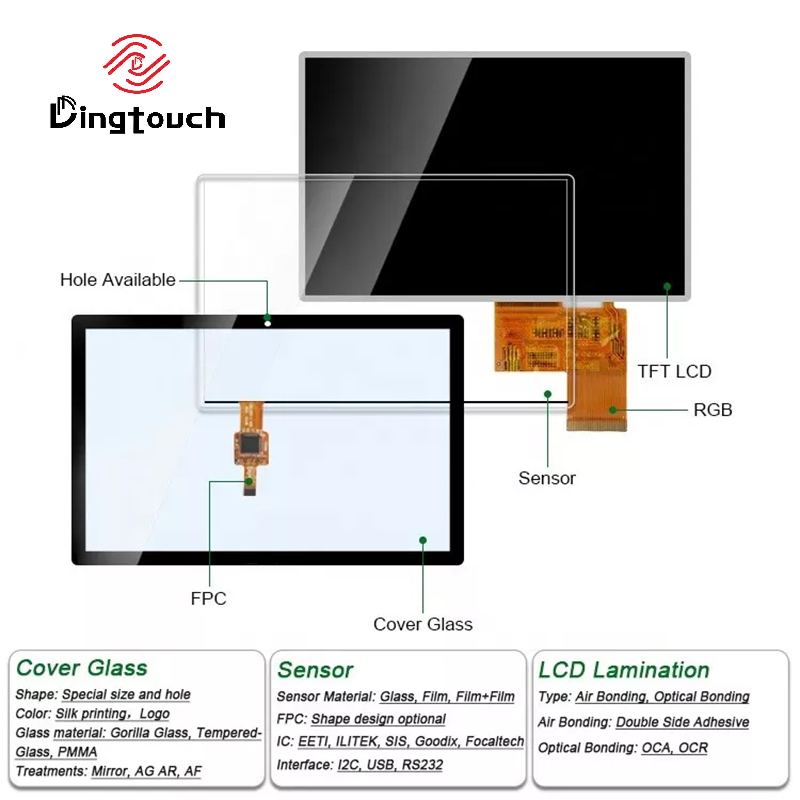
A complete touch display module may include:
Display + Touch Panel + Cover Glass + Bonding + Touch Controller + Interface
The complete module should be evaluated based on:
- Display size
- Resolution
- Brightness
- Touch technology
- Multi-touch capability
- Operating temperature
- Storage temperature
- Waterproof requirements
- Impact resistance
- Optical bonding
- EMI/EMC requirements
- Interface
- Mechanical dimensions
- Product lifecycle
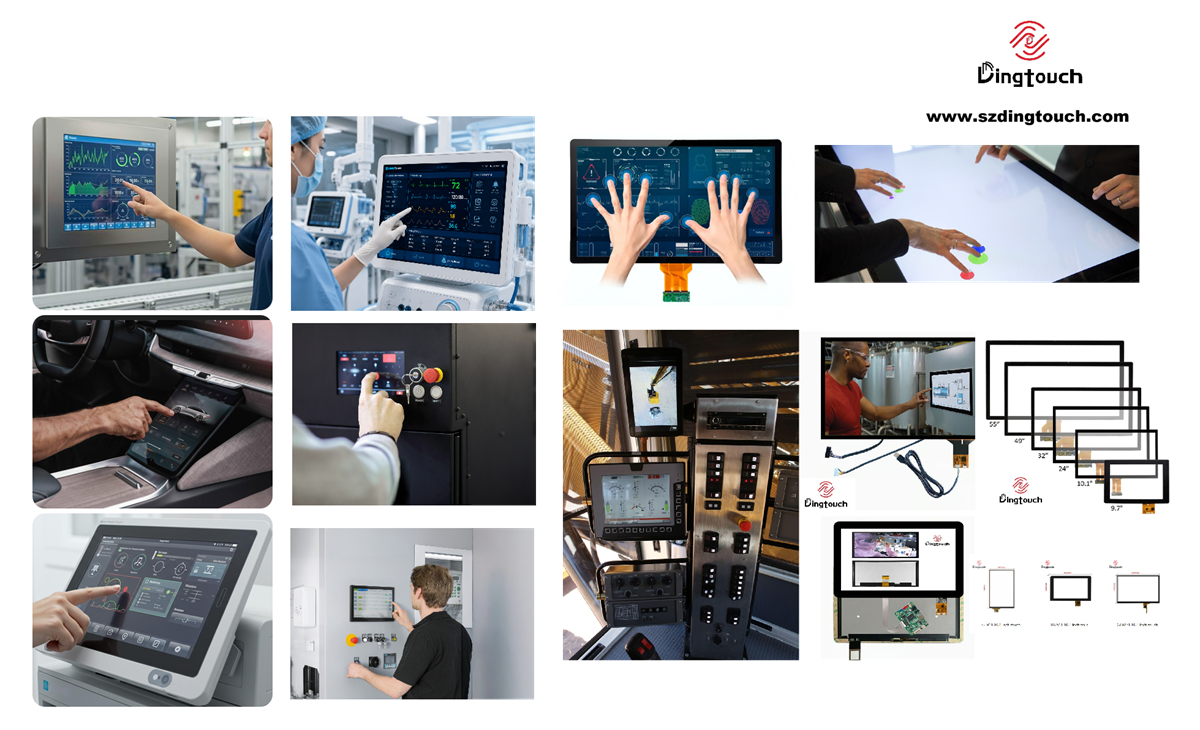
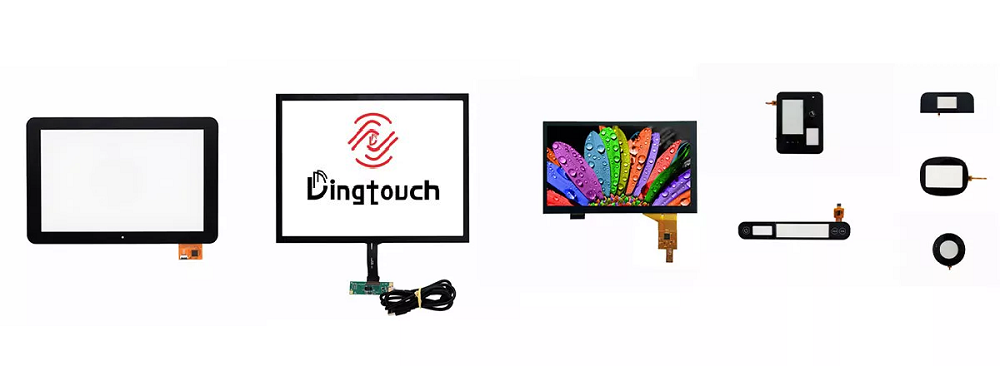
DINGTouch specializes in customized capacitive touch screens, TFT LCD touch displays, and industrial touch display solutions.
Depending on the application, display modules can be customized in areas such as:
- Display size
- Resolution
- Brightness
- Touch panel
- Cover glass
- Touch controller
- Interface
- Optical bonding
- Mechanical structure
- Environmental specifications
For industrial equipment that needs to operate reliably for years, selecting the right display technology is often more important than simply choosing the newest technology.
19. OLED vs. LCD: Frequently Asked Questions
Q1: Is OLED always better than LCD?
No.
OLED has clear advantages in black levels, contrast, thinness, and flexible structures.
LCD, however, remains highly competitive in cost, long-term static display, industrial reliability, brightness, and outdoor applications.
Q2: Will an OLED display definitely suffer from burn-in?
No.
OLED technology has a potential burn-in risk, but normal dynamic usage does not automatically result in noticeable burn-in.
Long-term static images displayed at high brightness require more attention.
Q3: Is OLED always more power-efficient?
Not necessarily.
OLED can be more efficient when displaying black or dark content because black pixels can be switched off.
However, when displaying large bright areas, the power advantage may become smaller.
Q4: Is OLED automatically worse for the eyes?
No.
The viewing experience depends heavily on the display's dimming technology.
Users sensitive to flicker should check:
PWM frequency, DC dimming, high-frequency PWM, and low-brightness behavior.
Q5: Why are LCD displays still widely used in industrial equipment?
Because industrial equipment often prioritizes:
Reliability, long lifetime, brightness, wide-temperature operation, cost efficiency, and stable long-term display performance.
These remain important strengths of LCD technology.
20. Final Takeaway: OLED Prioritizes Visual Experience, While LCD Excels in Stability and Reliability
In one sentence:
LCD uses a backlight and offers mature technology, stable performance, cost efficiency, and strong suitability for long-term industrial operation. OLED uses self-emitting pixels to deliver true black, extremely high contrast, and ultra-thin designs, making it ideal for premium visual experiences and innovative form factors.
Professional display selection should not simply ask:
“Is LCD better than OLED?”
Instead, ask:
“What display performance, operating environment, reliability, and lifetime does my product actually require?”
For industrial HMIs, medical devices, outdoor terminals, automation equipment, and self-service systems, brightness, wide-temperature performance, optical bonding, reliability, and long-term stability may be more important than simply choosing OLED.
For smartphones, smart wearables, VR/AR devices, premium entertainment products, and foldable devices, OLED high contrast, true black, thin structure, and flexible form factor can provide significant advantages.
Ultimately, the right display technology is the one that achieves the best balance between:
Performance + Cost + Reliability + User Experience.
LCD or OLED? The right answer depends on the application.
DINGTouch — Your Partner for Customized Capacitive Touch Screens and Touch Display Solutions, providing reliable touch technologies for industrial, medical, commercial, automotive, and smart-device applications.
CATEGORIES
CONTACT US
Contact: Dingtouch
Phone: +8615815536116
Tel: +8615815536116
Email: sales@szdingtouch.com
Add: Building A, Bailu Plaza, No. 48, Gonghe Industrial Road, Gongle Community, Xixiang Street, Baoan District, Shenzhen,China. 518126
 Dingtouch