News
AMOLED Banding: What Causes It and How to Minimize It
AMOLED Banding: What Causes It and How to Minimize It
AMOLED (Active-Matrix Organic Light-Emitting Diode) displays are widely recognized for their exceptional contrast, vibrant colors, and deep blacks. They are commonly used in smartphones, tablets, wearable devices, automotive displays, and Industrial touch screen solutions. However, despite their impressive visual performance, AMOLED panels can sometimes exhibit a phenomenon known as banding.
AMOLED banding appears as visible stripes, gradients, or uneven transitions between shades of color, particularly in dark scenes or low-brightness conditions. Understanding the causes of AMOLED banding and implementing effective mitigation strategies can significantly improve display quality and user experience.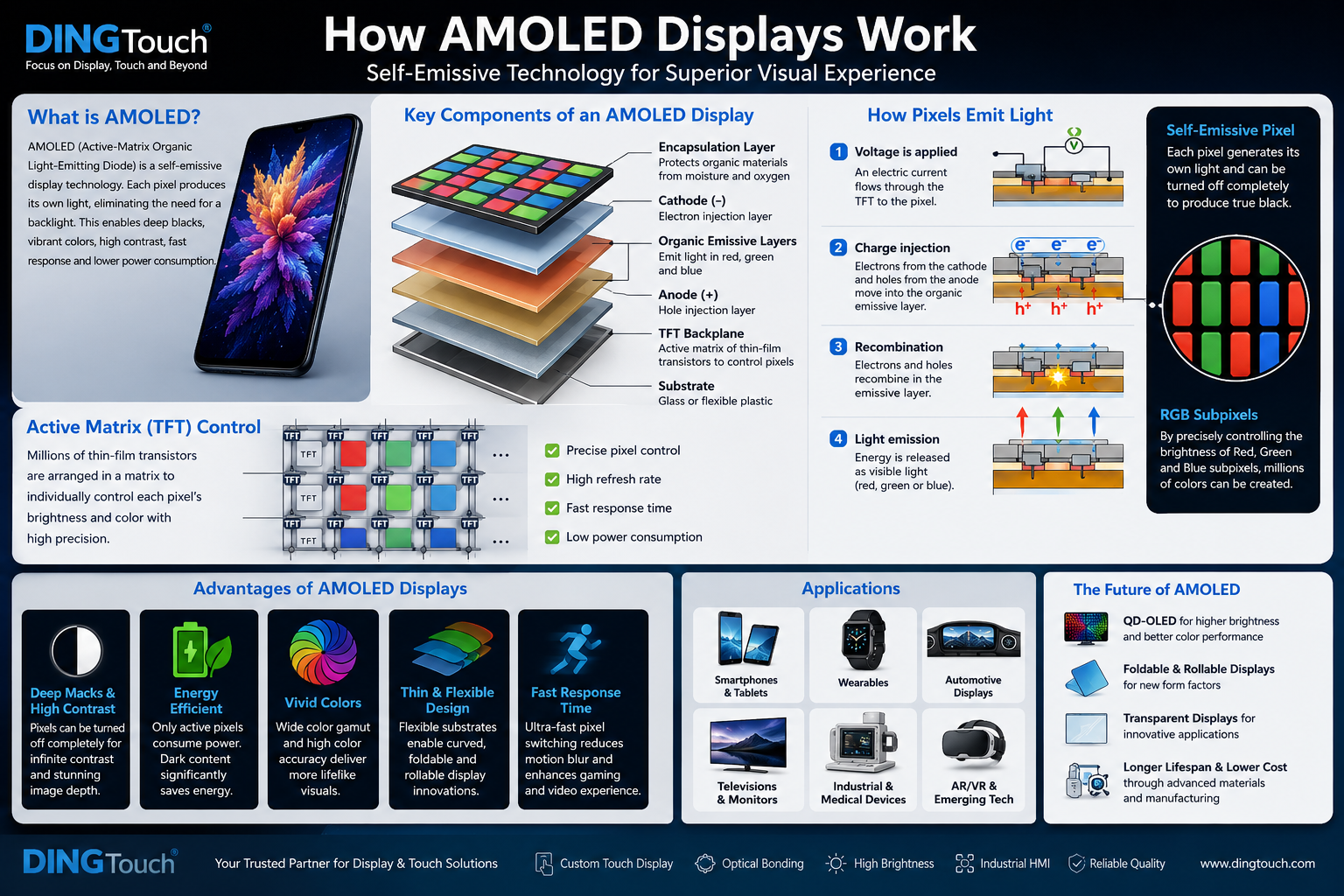
What Is AMOLED Banding?
AMOLED banding refers to the appearance of visible lines, stripes, or abrupt transitions in areas where colors or brightness should change smoothly.
Instead of displaying a seamless gradient, the screen may show:
- Vertical or horizontal bands
- Uneven gray levels
- Color transition artifacts
- Dark streaks in low-brightness scenes
- Gradient stepping effects
Banding is often most noticeable when:
- Viewing dark backgrounds
- Displaying grayscale images
- Watching movies with dim scenes
- Using the device at low brightness settings
- Viewing smooth color gradients


What Causes AMOLED Banding?
Several factors contribute to AMOLED banding, ranging from hardware limitations to software processing issues.
1. Limited Bit Depth
One of the most common causes of banding is insufficient color depth.
Displays represent colors using digital values:
- 8-bit panel = 16.7 million colors
- 10-bit panel = 1.07 billion colors
When a display lacks enough color levels, smooth gradients become divided into visible steps, creating banding artifacts.
Example
A gradient transitioning from black to dark gray may contain only a limited number of brightness levels. Human eyes can detect these transitions, making the gradient appear striped rather than smooth.
2. Low-Brightness Gamma Compression
AMOLED displays often struggle most in near-black regions.
At low brightness:
- Pixel driving voltages become extremely small
- Brightness differences between adjacent gray levels become more noticeable
- Gamma correction imperfections become visible
This phenomenon is commonly called:
- Black crush
- Near-black banding
- Dark scene posterization
3. Panel Uniformity Variations
Every AMOLED panel contains millions of individual OLED subpixels.
Manufacturing tolerances can cause slight differences in:
- Pixel brightness
- Organic material characteristics
- Electrical resistance
- Aging behavior
These variations may produce:
- Vertical bands
- Mura effects
- Uneven grayscale appearance
Large AMOLED displays are particularly susceptible to panel uniformity issues.
4. Display Driver Calibration Errors
The display driver IC controls how pixels respond to image data.
Improper calibration may lead to:
- Inconsistent gray transitions
- Uneven luminance response
- Color shift across brightness levels
Poor factory calibration can significantly increase visible banding.
5. Image Compression Artifacts
Sometimes the display itself is not the problem.
Low-quality content may already contain banding due to:
- JPEG compression
- Video compression
- Limited color information
- Streaming bitrate limitations
Even a high-end AMOLED screen will reveal compression-induced banding if the source image lacks sufficient gradient information.
6. PWM Dimming Effects
Many AMOLED displays use Pulse Width Modulation (PWM) to control brightness.
At lower brightness levels:
- Duty cycles become shorter
- Gray-level rendering becomes more challenging
- Transition smoothness may decrease
Although PWM does not directly create banding, it can make existing banding more noticeable.
Why Is AMOLED Banding More Visible in Dark Scenes?
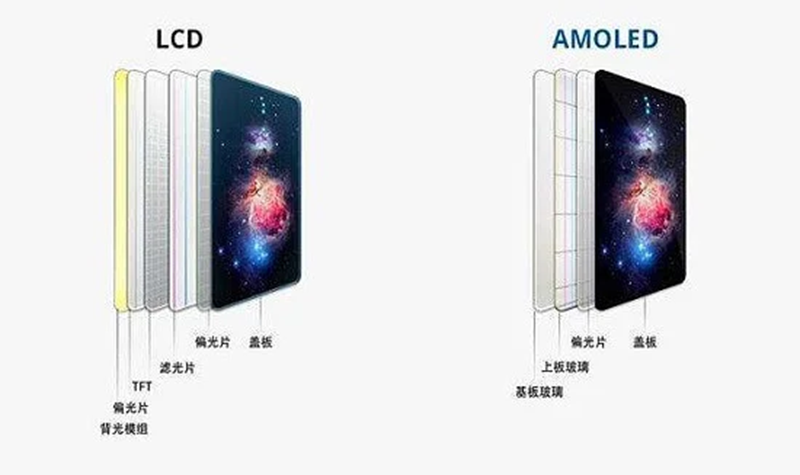
Unlike LCD, AMOLED pixels emit light individually.
This provides excellent contrast but also means:
- Small voltage differences produce visible luminance changes
- Near-black transitions become harder to control
- Human eyes are highly sensitive to dark-tone irregularities
As a result, AMOLED displays may show more noticeable banding in shadows than bright areas.
How Manufacturers Minimize AMOLED Banding
Display manufacturers use several techniques to reduce banding and improve image quality.
Higher Bit-Depth Panels
Modern premium AMOLED displays increasingly support:
- True 10-bit color
- 12-bit internal processing
- HDR rendering pipelines
More available color levels create smoother gradients and reduce visible stepping.
Advanced Gamma Calibration
Factory calibration helps optimize:
- Grayscale accuracy
- Color consistency
- Low-brightness performance
Accurate gamma curves reduce abrupt transitions between adjacent brightness levels.
Dithering Technology
Dithering artificially introduces tiny pixel variations to simulate intermediate colors.
Benefits include:
- Smoother gradients
- Reduced posterization
- Improved shadow detail
This technique is widely used in smartphones, monitors, and OLED televisions.
Compensation Algorithms
Modern AMOLED controllers utilize compensation systems to:
- Monitor pixel characteristics
- Correct brightness variations
- Improve panel uniformity
These algorithms reduce visible vertical banding and mura effects over time.
Improved OLED Materials
New OLED materials provide:
- Better luminance consistency
- Enhanced voltage stability
- More uniform pixel aging
These improvements help reduce long-term banding issues.
How Users Can Reduce Visible Banding
While some banding originates from hardware limitations, users can often minimize its appearance.
Increase Screen Brightness
Banding is typically most visible at very low brightness levels.
Increasing brightness slightly can:
- Improve grayscale smoothness
- Reduce shadow artifacts
- Enhance perceived image quality
Use High-Quality Content
Choose:
- HDR videos
- High-bitrate streaming services
- Lossless images
- Professional content sources
Higher-quality content contains smoother gradients and fewer compression artifacts.
Enable HDR When Available
HDR content often includes:
- Higher bit depth
- Better gradient information
- Expanded dynamic range
This can significantly reduce visible banding.
Keep Display Firmware Updated
Manufacturers frequently release updates that improve:
- Display calibration
- Gamma curves
- Brightness algorithms
- Uniformity compensation
Firmware improvements can noticeably reduce banding on some devices.
AMOLED vs LCD: Which Shows Less Banding?
The answer depends on the specific display.
AMOLED Advantages
- Perfect blacks
- Infinite contrast
- Superior HDR performance
- Individual pixel control
LCD Advantages
- More consistent near-black behavior
- Less sensitivity to OLED material variation
- Better uniformity in some applications
Modern premium AMOLED panels generally outperform standard LCDs, but poorly calibrated OLED panels may exhibit more visible banding in dark scenes.
Future Technologies Reducing AMOLED Banding
The display industry continues to improve AMOLED performance through:
- AI-assisted calibration
- Real-time compensation algorithms
- Higher bit-depth processing
- Tandem OLED structures
- Advanced driver IC technologies
- MicroOLED innovations
Future AMOLED displays are expected to deliver significantly smoother grayscale transitions and virtually invisible banding.
Conclusion
AMOLED banding is a common visual artifact that appears as visible stripes or uneven transitions in gradients, especially in dark scenes and low-brightness conditions. It can result from limited bit depth, panel uniformity variations, gamma calibration issues, image compression, and OLED driving characteristics.
Fortunately, modern AMOLED technologies—including 10-bit color processing, advanced calibration, dithering, and compensation algorithms—have greatly reduced the visibility of banding. By combining high-quality panel design with proper software optimization, manufacturers can deliver smoother gradients, better shadow detail, and a superior viewing experience.
For industrial, medical, automotive, and consumer applications, selecting a well-calibrated AMOLED display from an experienced display solution provider is one of the most effective ways to minimize banding and maximize visual performance.



Ready to Build Your Outdoor Display Solution?
Get in touch with us at sales@szdingtouch.com. Our expert engineers will help you design a cost-effective, tailored solution to meet your project’s exact specifications.
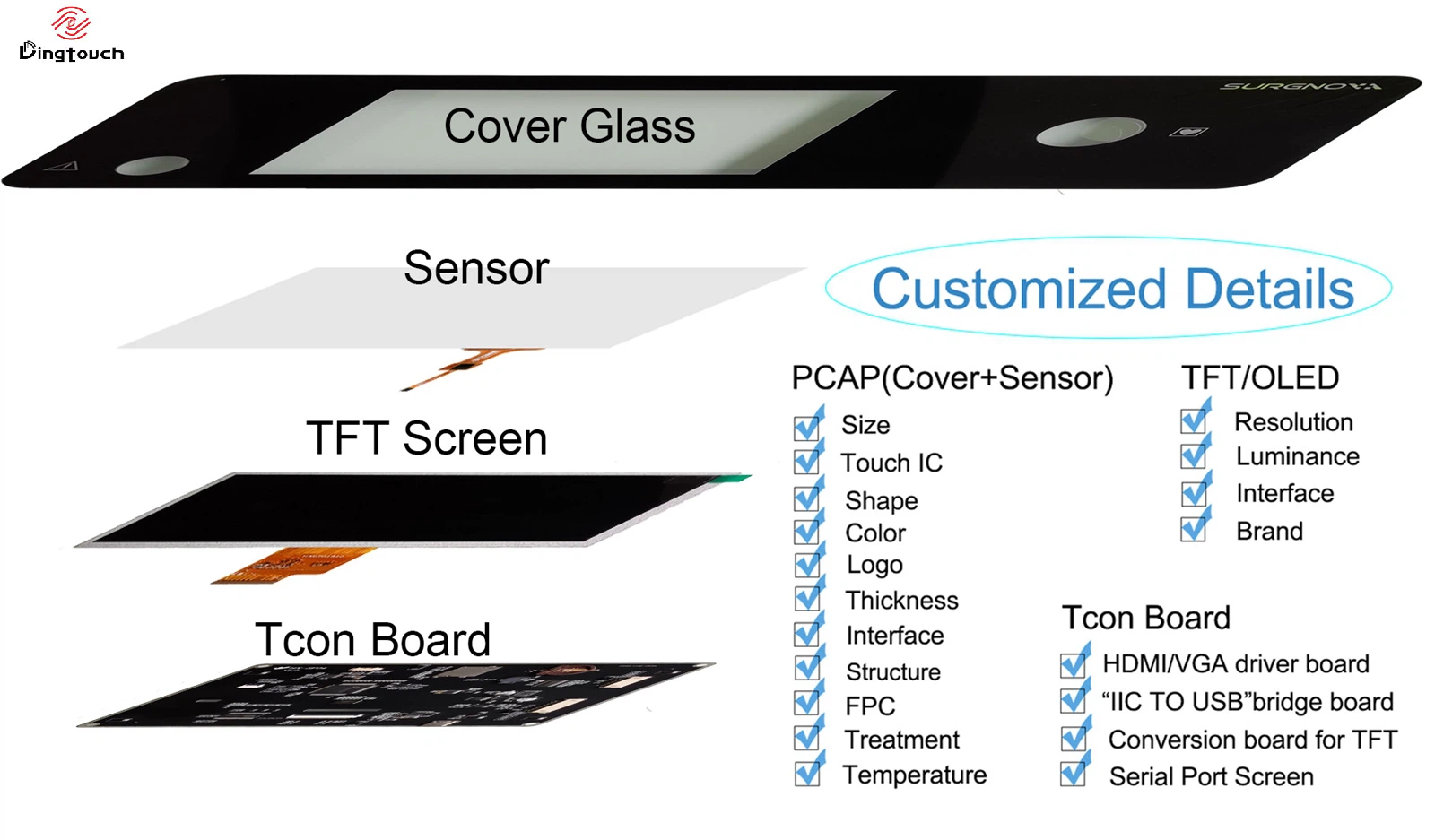
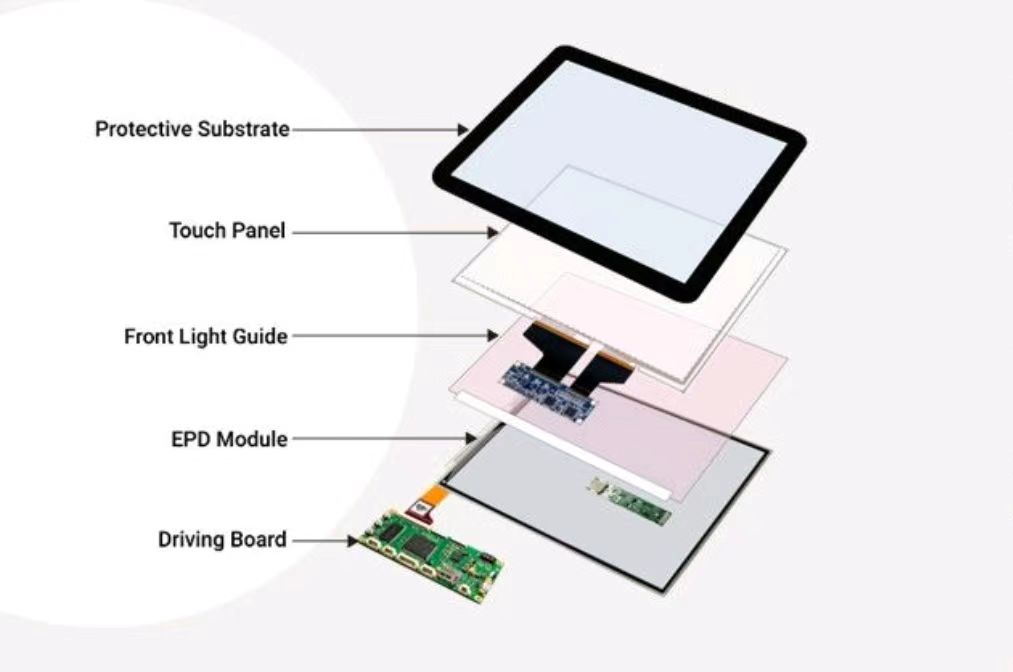
DINGTouch:Committed to continuous innovation and improvement of product quality to meet customers' high requirements and expectations.
DINGTouch is a manufacturer that provides high quality touch screen panels. Focus on the design, manufacturing and sales of touch screen panels, and are committed to providing customized solutions that satisfy customers.
DINGTouch: In the process of customizing touch screen panels, we focus on close cooperation and communication with customers. Understanding customers' needs and providing customized solutions will meet customers' individual needs. The company's products are favored by customers for their high quality and reliability, and provide them with the best touchscreen panel solutions.
DINGTouch:Committed to continuous innovation and improvement of product quality to meet customers' high requirements and expectations.
DINGTouch is a manufacturer that provides high quality touch screen panels. Focus on the design, manufacturing and sales of touch screen panels, and are committed to providing customized solutions that satisfy customers.
DINGTouch: In the process of customizing touch screen panels, we focus on close cooperation and communication with customers. Understanding customers' needs and providing customized solutions will meet customers' individual needs. The company's products are favored by customers for their high quality and reliability, and provide them with the best touchscreen panel solutions.
At DINGTOUCH, we are the world's leading touchscreen manufacturer, helping businesses around the world take advantage of this exciting technology. For more information, please visit the home page now.

DINGTouch is a company specializing in the R&D and production of touch screen technology, headquartered in Shenzhen, China. As a professional touch screen supplier, DINGTouch is committed to providing high-quality, stable and reliable touch screen products to meet the diverse needs of customers. We continue to carry out technological innovation and product optimization to ensure that its touch screen products have good sensitivity, accuracy and durability.
In addition to the products themselves, we also focus on cooperation and communication with customers, and are committed to providing customized solutions and excellent after-sales services. Through continuous efforts to improve product quality and customer satisfaction, we have established a good reputation in the touchscreen industry and won widespread market recognition.
In addition to the products themselves, we also focus on cooperation and communication with customers, and are committed to providing customized solutions and excellent after-sales services. Through continuous efforts to improve product quality and customer satisfaction, we have established a good reputation in the touchscreen industry and won widespread market recognition.
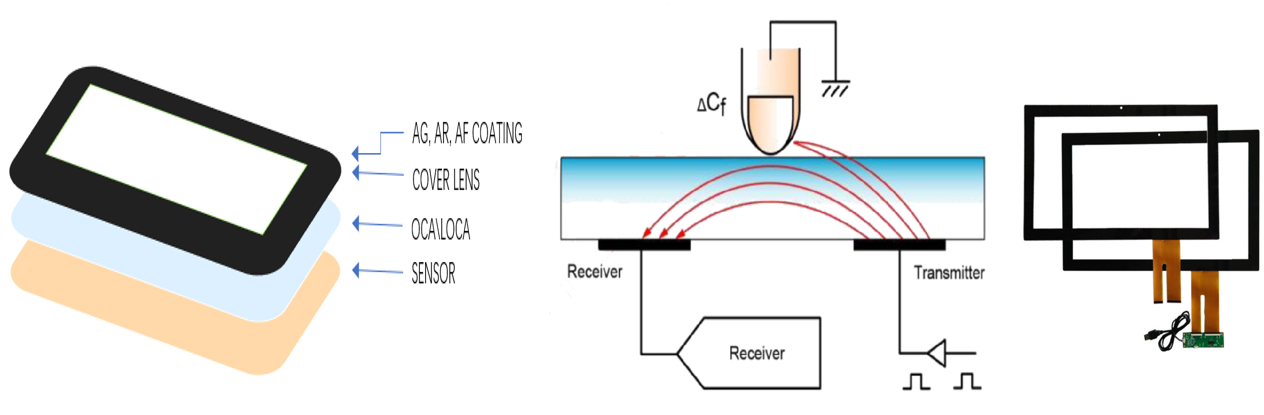
What DINGTOUCH can do:
• PCAP maximum size 65”
• Multi-touch (Touch screen can be customized to your needs.)
• Optical bonding service/air bonding
• LCD interface: HDMI/RGB/MIPI/LVDS/EDP, etc.
• PCAP interface: IIC/USB interface
• CTP can customize the cover glass surface treatment process AG (anti-glare), AR (anti-reflection), AF (anti-fingerprint), waterproof, and glove touch
• Supports 0.55 mm-12 mm coverslip touch.
• Support operating temperature: -40℃-90℃.
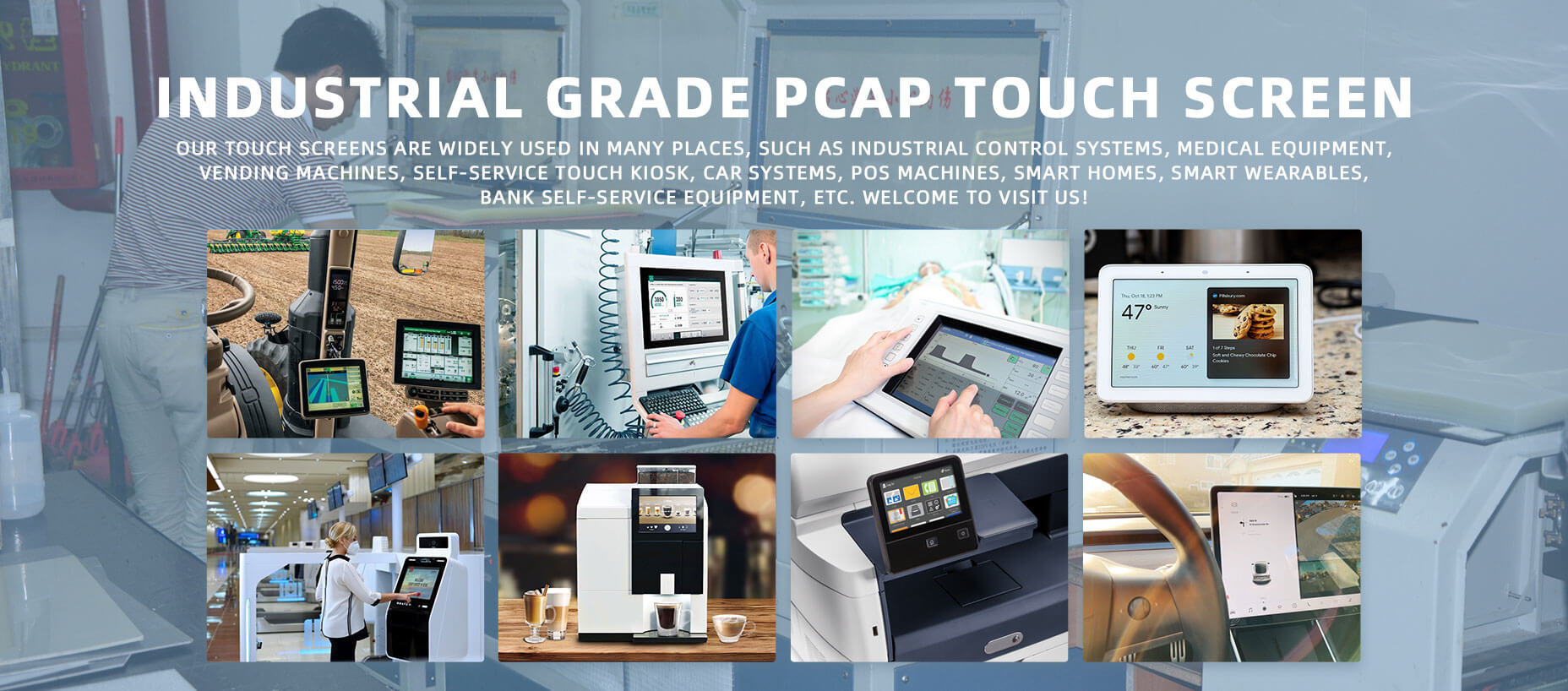
Dingtouch Industrial capacitive touch screen Manufacturer
In conclusion, Dingtouch as a professional touch screen manufacturer with more than 10 years touch screen experience.We have many capacitive touch screen. Such as 5 inch touch screen,7 inch touch screen,10.1inch touch screen,15 inch touch screen,15.6 inch touch screen,17 inch touch screen,18.5 inch touch screen,19 inch touch screen,21.5 inch touch screen,32 inch touch screen, However, we also welcome to customize your own touch screen . Contact our team today to learn what capacitive touch screen are best for our retail business needs.
Contact us NOW! sales@szdingtouch.com
#Medicaltouchscreencalibration, #capacitivetouchcalibrationguide, #IEC60601touchscreen, #DINGTouchmedicaldisplay, #touchscreenaccuracy, #touchscreen driftfix, #medicalequipmenttouchsolutions, #IP65touchpanel, #IK10medicaltouchscreen, #glove touch medical monitor,#ILITEKTouchControllerICSelectionGuide ,#OCAtoOCR #GT911,#CustomizedWideTemperatureTouchScreenSolutions,#Waterproof Touchscreen,
#highbrightnessLCD, #sunlightreadabledisplay,#industrialLCDbacklight, #outdoor displaymodule, #customLCDsolution, #1000–2000nitsdisplay, #DINGTouchtouchscreen.
DINGTouch — Custom Touch Display Solutions Expert
Every touch, clear and precise, ready for any environment.
Every touch, clear and precise, ready for any environment.
CATEGORIES
CONTACT US
Contact: Dingtouch
Phone: +8615815536116
Tel: +8615815536116
Email: sales@szdingtouch.com
Add: Building A, Bailu Plaza, No. 48, Gonghe Industrial Road, Gongle Community, Xixiang Street, Baoan District, Shenzhen,China. 518126
 Dingtouch