News
Transparent Conductive Layers: Single-Layer ITO vs. Double-Layer ITO in Glass Touch Sensors

Transparent Conductive Layers: Single-Layer ITO vs. Double-Layer ITO in Glass Touch Sensors
In modern touch-enabled devices—from sleek self-service kiosks and automotive dashboards to industrial control systems—the invisible layer that makes touch interaction possible is Indium Tin Oxide (ITO).
ITO is a transparent conductive material that allows glass surfaces to detect touch input, forming the technological foundation of capacitive touchscreen.
However, not all ITO sensor structures are the same. The choice between Single-Layer ITO (SITO) and Double-Layer ITO (DITO) can significantly influence a touch screen’s optical clarity, durability, sensitivity, and overall performance.
In this article, we’ll explore how these two ITO structures work and help you determine which option best suits your next touch screen project.
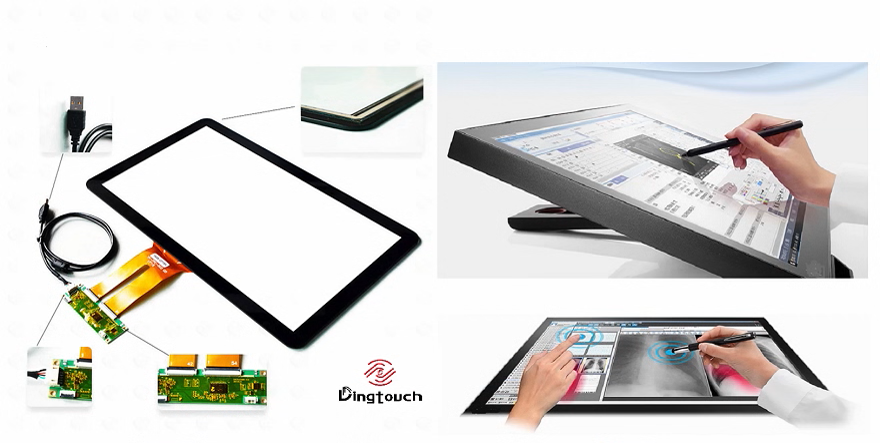
What Is ITO and How Does It Work?
Indium Tin Oxide (ITO) is a transparent conductive ceramic material typically deposited onto glass substrates using sputtering technology.
In a capacitive touch sensor, patterned ITO electrodes create an electrostatic field across the glass surface. When a finger or stylus touches the screen, it disturbs this field. The touch controller then detects the change and calculates the exact touch location.
The key difference between SITO and DITO lies in the number of ITO layers and how the sensing electrodes are arranged.
Single-Layer ITO (SITO): Cost-Effective and Reliable
A Single-Layer ITO sensor uses one patterned ITO layer on glass that contains both the transmitting (X) and receiving (Y) electrodes.
How It Works
The X and Y electrodes are etched on the same ITO layer and separated by microscopic metal bridges (typically molybdenum-aluminum-molybdenum structures) to prevent direct electrical contact.
Key Characteristics
Structure
Single ITO layer combined with metal bridge connections.
Manufacturing Process
Simpler fabrication with fewer processing steps, resulting in faster production and higher yield rates.
Optical Clarity
Generally good transparency, though under certain lighting conditions faint bridge reflections may be visible.
Cost Efficiency
Lower material consumption makes SITO a more economical choice.
Typical Applications
SITO sensors are commonly used in:
-
Consumer electronics
-
Cost-sensitive industrial control panels
-
Basic self-service terminals
-
Smart home interfaces
Double-Layer ITO (DITO): Superior Optical and Touch Performance
A Double-Layer ITO sensor uses two independent ITO layers—one dedicated to X electrodes and the other to Y electrodes. These layers are laminated together using Optically Clear Adhesive (OCA).
How It Works
By separating the X and Y electrodes into different layers, the DITO structure eliminates the need for metal bridge connections, resulting in improved transparency and uniformity.
Key Characteristics
Structure
Two ITO layers stacked and laminated together.
Optical Clarity
Excellent visual uniformity with no visible bridging artifacts.
Durability
Improved mechanical strength and enhanced thermal stability.
Touch Performance
Higher signal-to-noise ratio (SNR), enabling more reliable multi-touch detection—even when wearing gloves or operating in humid environments.
Cost Consideration
Additional materials and lamination processes increase overall manufacturing cost.
Typical Applications
DITO structures are widely used in:
-
Automotive displays
-
Medical equipment interfaces
-
Outdoor touchscreen
-
High-end commercial and industrial displays
SITO vs. DITO: Key Comparison
| Feature | Single-Layer ITO (SITO) | Double-Layer ITO (DITO) | Winner |
|---|---|---|---|
| Cost | Lower | Higher | SITO – more cost-efficient |
| Optical Clarity | Very good | Excellent | DITO – bridge-free visuals |
| Durability | Good | Better | DITO – stronger laminated structure |
| Sensor Performance | Standard | Superior | DITO – higher SNR and multi-touch reliability |
| Thickness | Thinner | Slightly thicker | SITO – ideal for slim designs |
| Manufacturing | Easier | More complex | SITO – faster production |
Which ITO Structure Should You Choose?
Choose SITO if you need:
-
A cost-effective touch solution
-
Reliable operation in standard indoor environments
-
Touch integration for consumer appliances, basic kiosks, or industrial panels
Choose DITO if your application requires:
-
Premium optical clarity and touch precision
-
Long-term reliability in demanding environments
-
Deployment in automotive, medical, or outdoor display systems
Conclusion
Despite the emergence of new conductive materials such as silver nanowires and metal mesh, ITO glass remains the industry standard for capacitive touch sensors because it provides an excellent balance of conductivity, transparency, and durability.
-
SITO is an ideal solution for cost-sensitive projects that still require dependable touch performance.
-
DITO is the preferred choice for high-end applications where optical perfection, environmental stability, and superior touch sensitivity are critical.
As a professional manufacturer of custom touch solutions, DINGTouch offers both SITO and DITO capacitive touch technologies, enabling us to deliver touch panels tailored to your specific application requirements.
If you need expert guidance in selecting the right touch sensor structure for your project, feel free to contact the DINGTouch technical team for professional support.
RELATED NEWS
- Customer support2021-03-26
- Industrial Touch screen for Kiosks and V2021-04-08
- How are touchscreen manufactured2021-04-09
- Why a Touch Screen Overlay is a Good Ide2021-04-10
- Get Customized Touch Screen Panel in Onl2021-04-13
CATEGORIES
CONTACT US
Contact: Dingtouch
Phone: +8615815536116
Tel: +8615815536116
Email: sales@szdingtouch.com
Add: Building A, Bailu Plaza, No. 48, Gonghe Industrial Road, Gongle Community, Xixiang Street, Baoan District, Shenzhen,China. 518126
 Dingtouch